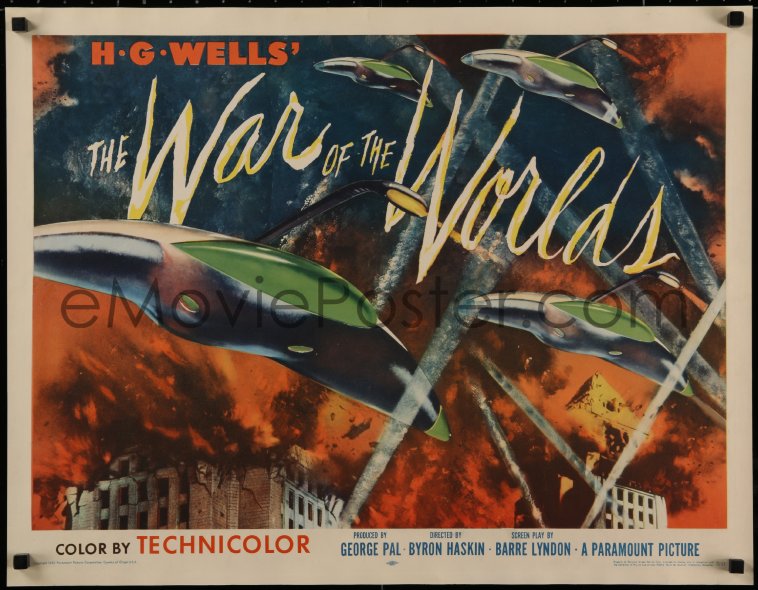
George Pal’s War of the Worlds (1952) was an adaption of the H.G. Wells novel about Martian invasion of Earth updated to the 1950s. The issue of appeasement was raised in a different manner. Image courtesy of eMoviePoster
Kevin Brianton
Strategic Communication Senior Lecturer, Melbourne: Australia.
George Pal’s War of the Worlds (1952) was an adaption of the H.G. Wells novel about Martian invasion of Earth updated to the 1950s. The issue of appeasement was raised in a different manner. In one scene, three men approached a Martian ship, while one waved a white flag. The group was blasted to bits by the invaders. In The Thing, there was conflict between scientists and the military, in War of the Worlds the scientists and the military, in War of the Worlds the scientists were shown to be in concert with the military. Their attempts to use nuclear weapons failed badly, but it was their failure which showed the power of God.
The religious faith of the people was the ultimate defence against invaders. In the final scene, people prayed in churches for divine intervention as the Martian war machines that moved inexorably towards them blasting everything to rubble. The priest led the prayers saying:
… Deliver us from the fear which has become upon us, form the evil that grows even nearer, from the terror that soon will knock upon the door of this our house … Oh Lord, we pray, grant us the miracle of thy intervention.[1]
The words in this speech are interesting. The Martians are ‘the evil’, ‘the terror’, and ‘the fear’, they are not seen as an invading army. When the Martians finally fired at the church, they were struck down as the earth’s bacteria and viruses began to take hold. The voice over says:
After all that men could do had failed, the Martians were defeated by the littlest thing that God in his wisdom had put upon this earth.[2]
God would intervene where everything else had failed, just as it was hoped that God would intervene to save America if needed. It was a message of reassurance. The world was in ruins, but they had survived. Even the strength and technology of the Martians was no match for the power of God.
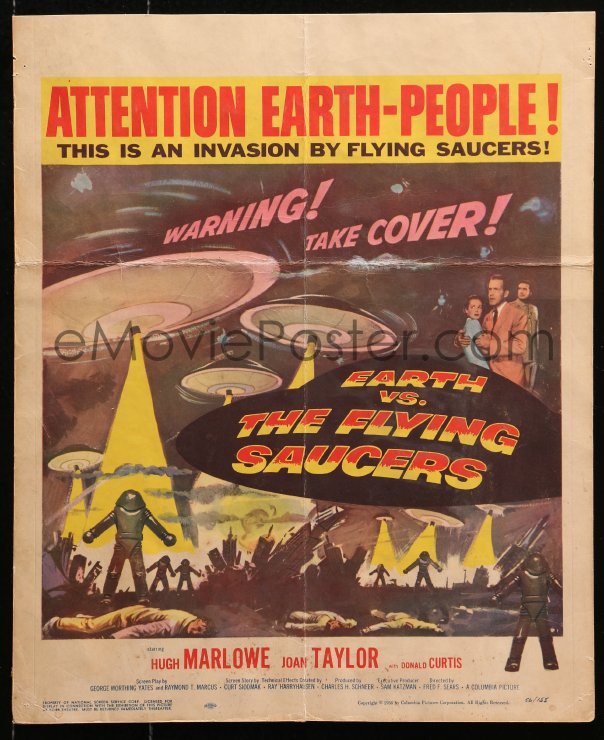
Scenes of destruction were quite common in alien invasion films. In Earth Vs The Flying Saucers (1956), the attack on Washington reminded the audience of the destructive potential of an all-out Russian nuclear attack. The film was released at the time of the Sputnik launch and it had a resonance far greater than its makers and probably realised. Stephen King remembered the impact it had on him as a child. Just before seeing the film, it was announced to the audience that the USSR had launched Sputnik.
Scenes of destruction were quite common in alien invasion films. In Earth Vs The Flying Saucers (1956), the attack on Washington reminded the audience of the destructive potential of an all-out Russian nuclear attack. Image courtesy of eMoviePoster.
Those greedy, twisted monsters piloting the saucers are really the Russians; the destruction of the Washington Monument, the Capitol dome, and the Supreme Court – all rendered with graphic eerie believability by Harryhausen stop-motion effects – becoming nothing less than the destruction one would expect when the A bombs finally fly.
And then the end of the movie comes. The last saucer has been shot down by Hugh Marlowe’s secret weapon, an ultrasonic gun that interrupts the electromagnetic magnetic drive of the flying saucers, or some sort of similar agreeable foolishness. Loudspeakers blare from every Washington street corner, seemingly: “The present danger … is over.” The camera shows us clear skies. He evil old monsters with their frozen snarls and their twisted-root faces have been vanquished.[3]
For King, the paradoxical trick of cinema had worked. The horror had been taken in hand, and used to destroy itself. The deeper fear of the threat of the Russian Sputnik had been excised.[4]
In a time of fear, audiences were drawn to films with monsters with incredible powers. The defeat of these monsters in the film was an important psychological victory for the audience. In horror films, it was vital that the monsters were gruesome, powerful and dangerous. The more gruesome and the more dangerous, the better. For if these monsters could be destroyed, then the United States could face the worst horrors created by the Russians. The horror element of science fiction films was crucial to their success as it provided the momentary release from people’s fears. As the 1950s progressed, the aliens tended to be more and more belligerent. This may have been due to the influence of studios wary of any taint of liberalism in their films. But that would be unlikely, as science fiction, like westerns and musicals, were seen as simple entertainment, and provided there was no overt political message, the writers and directors could do pretty much as they pleased. It was more likely that audiences of the 1950s wanted scary aliens and they got them.
[1]War of the Worlds, (d) Byron Haskin, Barre Lynon.
[2]War of the Worlds op cit. The line was from the original H.G. Wells novel War of The Worlds.
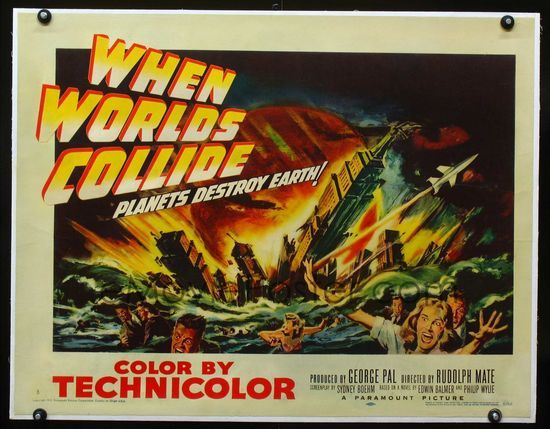
When Worlds Collide (1951) which dealt with the destruction of the planet Earth. Image courtesy of eMoviePoster
Kevin Brianton
Strategic Communication Senior Lecturer, Melbourne: Australia.
Nuclear fears of annihilation haunted the 1950s. This depressing view of world destruction continued in George Pal’s next film: When Worlds Collide. Many science fiction films had dealt with the destruction or breakdown of society, but the physical end of the planet was virtually a new area.[1] Cecil B. DeMille had originally been slated for the film in a much earlier period. The rights to the story by Philip Wylie and Edwin Balmer were originally bought in 1933 by Paramount, when director DeMille was planning a related project called “The End of the World.” DeMille had hoped to rush the project into production after filming wrapped on This Day and Age (1933), but the script was never even written and the studio scrapped the project.
In When Worlds Collide scientists discovered that a new sun and its planet were spinning across the galaxy toward earth. The planet would move close to the earth, causing tidal waves and mass destruction, and then the new sun would engulf the earth. The only hope for civilisation was a small spacecraft which could hop planets just before the fatal collision. The film opened with biblical saying:
And God looked upon the earth and behold it was corrupt; for all flesh had corrupted his way upon the earth … And God said unto Noah, ‘The end of flesh is come before me; for the earth is filled with violence through them; and , behold I will destroy them with the earth…[2]
This was remarkably close to the vision of evangelist Billy Graham who, after President Truman had announced a nuclear weapon had been exploded in the Soviet Union, had preached in 1949 that the choice for America was now between religious revival and nuclear judgement. The choice was between western culture founded on religion, and communism which was against all religion. The country had abandoned the ten commandments and faced judgement for its misdeeds.[3] In 1949, he delivered a sermon on the fate of the United States which rang with biblical doom.
Let us look for a moment at the political realm. Let’s see what is happening – not only in the city of Los Angeles, but in the western world. The world is divided into two sides. ON the one side we see so-called Western culture. Western culture and its fruit had its foundation in the bible, the Word of God, and in the revivals of he Seventeenth and Eighteenth Centuries. Communism on the other hand, had decided against God, against Christ, against the bible, against all religion. Communism is not only an economic interpretation of life – Communism is a religion that is directed and motivated by the Devil himself who has declared war against almighty God. Do you know that the Fifth Columnists, called Communists, are more rampant in Los Angeles than any other city in America? We need a revival.[4]
Just as God had destroyed Sodom and Gomorrah, Pompeii, and the Roman empire, he would destroy the United States, and Los Angeles in particular, if it strayed any longer or further from the moral path. The nuclear threat was a biblical judgement for moral failings. These speeches were the catalyst which launched Graham to become a nationwide media celebrity.
Graham’s apocalyptic vision of nuclear judgement resonated throughout When Worlds Collide. The conclusion of the film showed the earth burning as it approached the surface of he new sun. Nuclear-like explosions ripped from its surface as it was absorbed. This image must have terrified the American public of the 1950s with its connotations of nuclear destruction. The most chilling part of When Worlds Collide was the inevitable nature of the destruction of the earth, just as the cold war promised an inevitable nuclear conflagration. The film may have reassured an American public at one level by showing that life would continue in some form after nuclear destruction. However, with its biblical judgement of corruption and the inevitable nature of the world’s destruction, it was an uncomfortable film to watch.
[1][1] The theme had been used before in a film called The Comet (1910) and two German films Himmelskibet (1917) and Verdens Undergang (1916). The two German films probably reflected some of the gloom as the First World War dragged on. A few science fiction films saw the collapse of society such as the British film Things to Come (1936). See the introduction to Phil Hardy, (ed.). Science Fiction: The Complete Film Sourcebook, William Morrow, New York, 1984 for a discussion of the trend.
[3] Mark Silk, Spiritual Politics: Religion and America since World War II, Simon & Schuster, New York, 1988, p. 65.
[4] William Graham, Revival in Our Time: The Story of Billy Graham Evangelistic Campaign Evangelistic Campaigns, Including Six Of His Sermons, 2nd edn enl. Van Kampen Press, Wheaton, Illinois, 1950, pp. 72-73.
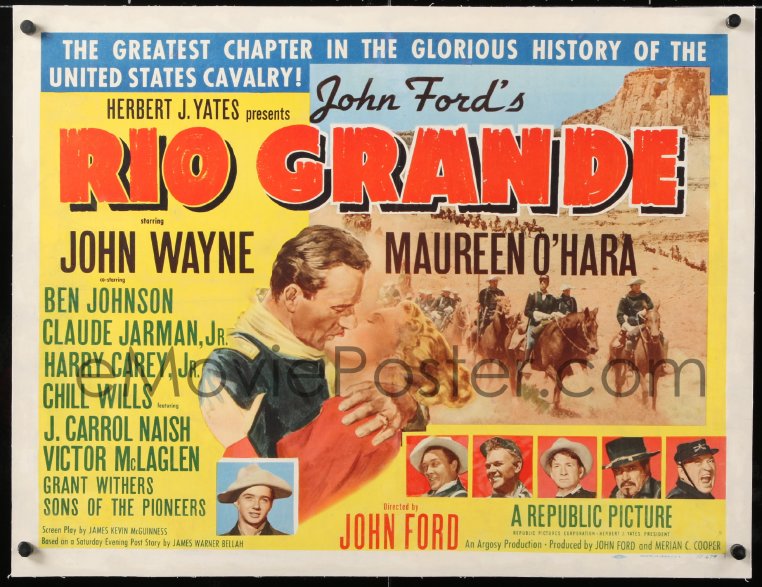
Rio Grande (1950) was released in November 1950, five months after President Truman committed American troops to fight a limited war in Korea. Image courtesy of eMoviePoster.
Kevin Brianton
Strategic Communication Senior Lecturer, Melbourne: Australia.
Westerns provided a commentary on the cold war in other ways. Film critic John Lenihan has suggested that the attitude towards Native Americans – or ‘Indians’ as they were called – in these films reflected concerns about the cold war.[1] From the end of World War II through the 1950s, westerns showed fears and concerns about communism by depicting ‘red Indians’ as allegorical communist figures. His case was based on films such as Rio Grande (1950). The film was released in November 1950, five months after President Truman committed American troops to fight a limited war in Korea.[2] Following the invasion of North Korean troops, MacArthur attempted to retake the entire Korean peninsula, but this had triggered a massive invasion by China across the Yalu river. The United States and its allies had better equipment and training but the Chinese had huge numbers of troops. The Chinese pushed the UN forces back down the Korean peninsula. They in turn were slowly forced back. The conflict became a war of attrition and MacArthur constantly demanded that he be allowed to attack the Manchurian sanctuary.[3] His plans were equally consistently blocked by Truman and it was this conflict which eventually led to MacArthur’s controversial sacking.
According to Lenihan, the political message of Rio Grande seemed clear. The apaches were constantly able to defeat the United States Army because they could cross the Rio Grande river into neutral Mexico. Colonel Kirby Yorke,[4] played by John Wayne, and his commander, wanted permission to cross into Mexico to pursue the Indians. Yorke argued that the State Department back in distant Washington did not understand what was happening. The need for military action became more pressing as three tribes gathered on the banks of the Rio Grande. His concerns mirrored MacArthur’s arguments that Manchuria was a launching place for attacks on the Korean peninsula. Eventually the General ordered Yorke to illegally attack across the Rio Grande. He says, ‘I want you to cross the Rio Grande, hit the Apache and burn him out: I’m tired of hit and run, I’m sick of diplomatic hide and seek.’[5] The political ideas in Rio Grande came from the ultra-conservative screenwriter, James Kevin McGuiness, the founding executive committee chairman of the Motion Picture Alliance for the Preservation of American Ideals.
Lenihan argued that many westerns also appealed for unanimity in the face of a threat. One key example was in Escape From Fort Bravo (1953) where Union soldiers who were escorting Confederate escapees back to their prison were ambushed by Indians. It was only by fighting together that the group were able to survive. Lenihan argued that The Outriders (1950), Rocky Mountain (1950), Two Flags West (1950), The Last Outpost (1951), Red Mountain (1951), and The Siege at Red River (1954) share the theme of Union and Confederate soldiers putting aside their differences to face the real enemy. With the resolution of the Korean conflict and an acceptance of negotiation rather than war, Lenhian argued Westerns shifted to a more liberal position reviving the tolerant themes with films such as Taza, Son of Conchise (1954), Sitting Bull (1954), Chief Crazy Horse (1955), White Feather (1956), and Walk the Proud Land (1956).[6]
Nonetheless, Lenihen’s approach is flawed. Rio Grande was more an exception because it was so clear about its political agenda. It was also a poor example to use as a starting point. Screenwriter McGuiness certainly used it as vehicle for his ultra-conservative political views about the Korean war. But the politics were a sub-plot to director John Ford’s vision of the reconciliation of a military family and this was the dominant theme of the film.
More importantly, a different selection of films shows the opposite pattern of American attitudes to the cold war. Lenihan’s case looks impressive but his examples were not popular films. It is easy to build up a different case using popular westerns. In Broken Arrow (1950), the Native Americans were depicted as sensible and willing to come to a peaceful agreement with the white man. This film was made near the peak of the red scare, yet was extremely popular. It was ninth with rentals of $3.55 million by Variety.[7] Tom Jeffords, played by James Stewart, was a cavalry scout who lived with the Apache and prevented the outbreak of a war through negotiation with their leader Cochise. When he returned to the town with the news that the ‘Indians’ can be trusted, he was almost lynched, just as those who wanted Americans to trust the communists were attacked by the McCarthyite forces. At the conclusion of the film, the Indians and the white community are living in harmony because of a treaty. Mutual respect and trust were seen as the cornerstones of a peaceful community. The screenwriter of the film was recently revealed as Albert Maltz, one of the Hollywood 10, rather than the listed Michael Blankfort.[8] It is interesting that both High Noon and Broken Arrow, the most popular westerns of the early 1950s, were directed against HUAC and its investigations.
If the Native Americans or ‘Indians’ were equated with communists, it would be logical to assume that there was a groundswell of support for negotiation in the early 1950s. Yet the most popular western of 1956 was The Searchers which depicted the Native Americans as a dangerous threat to the white race. Negotiation was not even attempted. The Searchers finished 10th at the box office according to Variety.[9] It would be more logical to construct a case using these two films to show a hardening of attitudes towards the Soviet Union from 1950 to 1956. Indeed this case appears to be stronger than Lenihan’s as few of the films discussed by Lenhinan appear in the top 20 of Variety’s listings.[10]
[1] John H. Lenihan, Showdown: Confronting Modern America in the Western Film, University of Illinois Press, Chicago, 1980, pp. 24 – 54.
[8] Phillip French, ‘Decline of the Western: The dwindling trail of a genre’, Times Literary Supplement, 18 September 1992, pp. 18. In the article, French mentions an example of the theme of communist subversion in a western where in Arrowhead (1953) a chief returns from an Eastern college – read communist training – and turns a peaceful tribe into warriors.
The Bounty Hunter (1954) can be read as a pro-McCarthyite film and as rebuttal of High Noon. Image courtesy of eMoviePoster.
Kevin Brianton
Strategic Communication Senior Lecturer, Melbourne: Australia.
The themes raised in High Noon were also picked up by those who supported the investigations. The Bounty Hunter (1954) can be read as a pro-McCarthyite film and as rebuttal of High Noon. Randolph Scott played a bounty hunter who arrived in the frontier town of Twin Peaks on the trail of three armed robbers. The townspeople resented his appearance and some with guilty secrets left town. He had no idea who the culprits were and bided his time. The townspeople want them to leave because they don’t like the past being dug up. The people then tried to buy him off but he would not be deflected from his pursuit of the criminals. The film can be read as a defence of HUAC investigators who had to burrow into the past of respectable people to uncover their dark secrets, no matter what the cost. Some of the criminals occupied high positions. One was even sheriff, but the criminals were only able to maintain their positions by blackmail and threats. By rooting out these criminal elements, true peace was attained in the town.
Director and producer Howard Hawks and actor John Wayne were disgusted by Fred Zinneman’s High Noon and the cycle it created and set out to refute it. Some of that anger can be seen in an interview with John Wayne in 1974 when asked about High Noon screenwriter Carl Foreman:
Hawks was convinced that professional law enforcement officers would refuse help, even in a desperate situation. In High Noon, Gary Cooper rejected the help of two men who offer assistance – a drunk and a kid. The retired marshal refused to help Kane because he would be a burden. In Rio Bravo, Chance chose a drunk, a kid and a retired marshal to help him against the gunfighters. For Hawks and Wayne, authority was responsible and benign. It defended the weak and attacked the guilty and the best people could do was to simply co-operate with it. It was not to be questioned or assisted, it was simply to be obeyed.[4]
What about Carl Foreman? I’ll tell you about Carl Foreman and his rotten High Noon. Everybody says High Noon is a great picture because Tiomkin and Grace Kelly were in it … It’s the most un-American thing I’ve ever seen in my life. The last thing is old Coop putting the United States marshall’s badge under his feet and stepping on it. I’ll never regret having helped run Foreman out of town … Here’s the church, supposed to be an American church and all the women are sitting on one side of the aisle, and all the men on the other. What kind of American church is that? And all those women are getting out there and fight those killers and all the men are afraid. What kind of Western town is that?[1]
Wayne was mistaken about the film, Cooper never stands on the badge. The church also has men and women sitting together on both sides. These statements indicate that Wayne may have either never seen the film or not viewed it closely. Nonetheless, having seen it or not, Wayne despised the film. Hawks, on the other hand, wasn’t as violent in his denunciation of High Noon. He said in an interview about his film:
Rio Bravo was made because I didn’t like a picture called High Noon … I didn’t think a good sheriff was going to go running around town like a chicken with his head off asking for help and finally the Quaker wife had to save him. That isn’t my idea of a good western sheriff.[2]
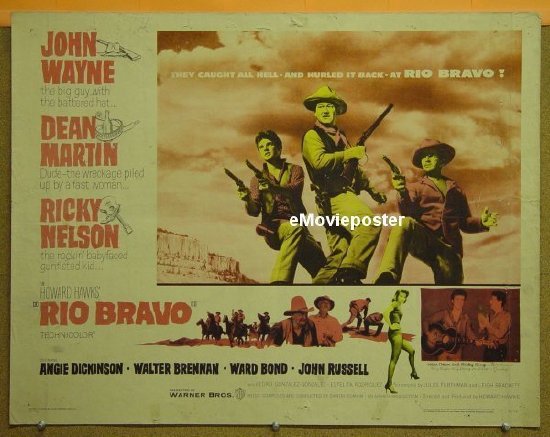
As a refutation of High Noon and its anti-HUAC sympathies, Rio Bravo was quite weak. The film was made long after the issues raised by the HUAC investigations were gone. If it was a rebuttal at all, it was a rebuttal on the weakest terms. Image courtesy of eMoviePoster.
But Wayne and Hawks were able to have their say in the Rio Bravo (1959). In the film, John T. Chance, played by John Wayne, was the sheriff of Rio Bravo who arrested Joe, the brother of a ruthless rancher Nathan Burdette. The rancher swore that he would get his brother out of jail and began to gather an army of hired guns to do the job. In one scene Chances’ friend Pat Wheeler, played by Ward Bond, asks him if he needs help.
Suppose I got them. What would I have. Some well meaning amateurs. Most of them worried about their wives and kids. Burdette has got 30 to 40 men. All professionals. The only thing that worries them is seeing their pay … All it would be doing is making more targets to shoot at. A lot of people would get hurt. Joe Burdette isn’t worth it. He isn’t worth one of whose who’d be killed.[3]
As a refutation of High Noon and its anti-HUAC sympathies, Rio Bravo was quite weak. The film was made long after the issues raised by the HUAC investigations were gone. If it was a rebuttal at all, it was a rebuttal on the weakest terms. Its conservative message of the responsibility of authority fitted in with many films of the right. Perhaps what made this film so popular was that these authority figures demanded that no freedoms be lost while the fight was on. It was ranked 8th in the 1959 with rentals of $5.2 million.[5]
The persistence of the theme of the relationship between the lone sheriff figure, the violent thereat and townspeople in Westerns from 1952 until the end of the decade showed the relationship between authority and the people was an area of tremendous concern. The answers given in the films were not consistent and came from all points of the political spectrum. The films may not have provided the answers for the audience but their popularity showed that the questions about authority and dealing with threats were being asked.
[1] Playboy May 1974 interview by Mike Parkinson in Donald Shepherd, Robert Slatzer and Dave Grayson, Duke: The Life and Times of John Wayne, Weidenfeld and Nicolson, New York, 1983, p. 244. A careful examination of the badge throwing scene shows a second badge from an earlier take buried behind his foot. It appeared that Cooper was standing on the second badge from an earlier take. Wayne may have heard about this flaw in the film second hand which could have distorted his perception.
[2] Joseph McBride, Hawks on Hawks, University of California Press, London, 1982, p. 136.
[3]Rio Bravo, (d) Howard Hawks, Jules Furtham, Leigh Brackett.
[4] This point is remarkably close to the position put by Mankiewicz against DeMille about the role of authority. Adding strength to Elia Kazan’s belief that it was the conservatives that defeated DeMille, rather than the left. Elia Kazan A Life, Doubleday, New York, 1988, p. 393.
Riding Shotgun also had anti-McCarthyism themes. Image courtesy of eMovieposter.
Kevin Brianton
Strategic Communication Senior Lecturer, Melbourne: Australia.
High Noon had many successors which took up the various themes about McCarthyism in differing ways. Riding Shotgun (1954) again looked at the political situation in allegorical terms, but with disdain for the hysteria created by McCarthy. A respected guard on the stage coach Larry Delon, played by Randolph Scott, attempted to warn the town of an impending raid on the town’s ‘Bank Club’ by a gang of criminals. Delon was almost lynched by the townspeople who believed that he was responsible for the shooting of a stagecoach. A posse was formed to chase the outlaws who were actually planning to rob the undefended town. Delon was bailed up in a building throughout the film while the town attempted to lynch him. Eventually the outlaws raided and Delon foiled the robbery and regained the town’s respect. The film was not as sharp in its criticism of the worn as in High Noon, but there were some strong scenes where Scott walked through the town with every eye on him, thinking; ‘The city had already tried and found me guilty.[1] The film was not critical of the law enforcement agencies as the deputy Sheriff was depicted as a sensible man desperately trying to see that no one gets hurt in the town’s desire to lynch Scott.
Unlike
High Noon, the film showed that the
town was willing to fight, but needed firm leadership. Without that leadership, the town could turn
into a lynch-mob and attack the innocent.
Riding Shotgun was a
conservative film that asked for respect for the traditional law enforcement,
rather than the hysteria of the mob.
Although
not strictly a western, as it was set in contemporary America, Bad Day at Black Rock (1954) was one of
the most clear cut attacks on the McCarthyite era within the genre. Bad Day
at Black Rock was directed by John Sturges, who was one of the petitioners
for Jospeh L. Mankiewicz, and produced by Dore Schary who protested against the
Waldorf Declaration. Schary would work
on the film during the day and watch the Army-McCarthy hearings at night.[2] It was clear that these events had an impact
of the filmmakers as the film was a concerted liberal attack on the McCarthyite
era.
John
J. Macreedy, played by Spencer Tracy, was a one-armed stranger who stopped at
an isolated desert town in California.
His aim was to give to a Japanese farmer a Congressional Medal of Honor,
won by his son, who served with Macreedy during the war and saved his
life. It was the first time the train
had stopped in four years and the townspeople were clearly threatened by his
presence. Macreedy stumbled across the
fact that the town’s leader Reno, played by Robert Ryan, killed the Japanese
farmer at the outbreak of the Second World War.
He described the town as being taken over by the ‘guerillas.’ The town was aware of the crime but afraid to
fight Reno who was a power-crazed racist and considered the lynching of the
Japanese farmer to be a patriotic act.
One of his henchmen Pete Wirth, played by John Ericson, said ‘We were
drunk, patriotic drunk,’ to explain the lynching.[3]
Reno
was the closest Hollywood got to a portrayal of Joseph McCarthy until the
depiction of the crazed Senator in The
Manchurian Candidate (1962). He
manipulated and terrified the people of the town with the crime. He described Macreedy as a ‘virus’ which had
given the town a fever and had to be destroyed.
Very similar to the way, McCarthy depicted communists as an infection of
the American political system. The
Sheriff, played by Dean Jagger, was ineffectual and complaint to Reno’s orders,
just as McCarthy blustered his way over the legal system. Others simply tried to ignore the crime and
remained in apathetic fear. When
Macreedy faced and defeated Reno, the town was forced to face the collective
guilt of their silence. The conclusion
of the film was optimistic as it showed the town could prosper again with the
departure of Reno, just as the American community had to realize the enormity
of the damage inflicted by the McCarthyite era before it could begin to move
forward again.
The Fastest Gun Alive continued the themes of High Noon. Image courtesy of eMovieposter.
Other films carried similar messages to High Noon throughout the 1950s. In At Gunpoint (1955) a shopkeeper played by Fred MacMurray killed a bank robber with a lucky shot. He was called a hero, but his fellow townspeople deserted him when the robbers plotted reprisals. MacMurray eventually convinced the town to fight and they defeated the outlaws when they return. In The Fastest Gun Alive (1956), the townspeople cower in a church while a gunslinger threatened to burn down the town unless their reluctant local hero cam out for a showdown. They eventually forced him out to face the villain.
In
The Tin Star (1957), a sheriff had to
stand up to a town turned into a lynch mob to re-establish the authority of law
and order. The prisoners inside his jail
were clearly guilty and it was certain they would be hanged or jailed. The film argued that the lynch mob was not
the answer. Only when the leader of the
lynchers was stared down, humiliated and then destroyed did peace come to the
town. If the mob was equated with
McCarthyism, the legal approach of the sheriff was the best way for American
society to go. The central figure was a
man similar to High Noon’s Will Kane
who was bitter and resentful about society but at the end of the film, he
picked up ‘the tin star’ to renew the fight against criminals.[4] Law and order depended on the professional
pride and determination of law enforcement officers. Without them, the weak townspeople would be
at the mercy of the bandits and agitators.
The central theme of these films was that the town by its inaction or
corruption could collapse into lawlessness.
As the 1950s drew to a close, director Jack Arnold made an interesting western called No Name on the Bullet (1959) which can be read as an anti-McCarthyite tract. Image courtesy of eMoviePoster.
As
the 1950s drew to a close, director Jack Arnold made an interesting western
called No Name on the Bullet (1959)
which can be read as an anti-McCarthyite tract.
A stranger played by Audie Murphy rode into town and registered at a
hotel. He was John Gant who made his
living goading people into a fight and then killing them in self defence. His appearance caused a slow breakdown of the
town as prominent citizens remembered guilty secrets of the past and were
afraid that he has been sent to kill them.
Old antagonisms began to rise an people committed suicide or left town
or tried to bribe Gant. The films focused on what fear can do to people. If you were Gant’s target then you were
already dead. The most effective scenes
were when a banker with a guilty secret in his past attempted to buy Gant off
the trail. But Gant would not leave the
town until his intended victim was dead.
The law enforcement officers can’t stop him as he was too deadly with
the gun, and even managed to stare down the entire town when they tried to
drive him out. The atmosphere of
paranoia and fear which pervaded the film with Gant’s arrival and Murphy’s edgy
performance as Gant make it one of the most effective successors to High Noon. At the end of the film, Gant ensured that his
target was dead, but he was wounded and rode away. He could certainly return and wreck havoc
again.
[1]Riding Shotgun Warner, (d) Andre De Toth, Tom Blackburn.
[2] Dore Schary, Heyday: An Autobiography of Dore Schary,
Berkley Books, Boston, 1969, p. 273. The
Army-McCarthy hearings proved to be the end of the political career of
McCarthy. He charged the army with
tolerating communist subversion.
Televised hearings were held before the Senate Armed Forces Committee
which left McCarthy thoroughly discredited.
For an account see William Manchester, The Glory and The Dream, Bantam, New York, 1975, pp. 700-716.
[3]Bad Day at Black Rock, John Sturges, Milliard Kaufman
[4] One of the sources for High Noon was a story called The Tin Star by John Cunningham which
appeared in Colliers on 6 December
1947. Behlmer, p. 270.
Johnny Guitar (1954) was also directed against HUAC in a different way to High Noon. Image courtesy of eMoviePoster.
Kevin Brianton
Senior Lecturer Strategic Communication, La Trobe University, Melbourne, Australia
Johnny Guitar (1954) was also directed against HUAC in a different way to High Noon. In the film, Johnny Guitar, played by Sterling Hayden, returned to this estranged lover Vienna, played by Joan Crawford, who owned a disreputable bar. A stage robbery occurred in town, and a banker was killed. The dead man’s sister Emma Small, played by Mercedes McCambridge, convinced a wealthy rancher John McIvers, played by Ward Bond, that the crime had been committed by the Dancin’ Kid, Corey ad Young Turkey, when they were innocent. Small was jealous of the Dancin’ Kid’s attraction to Vienna. The accused trio decided to rob a bank since they were being forced to flee the area anyway. Small made the bank teller swear that Vienna was involved in the robbery. In response, a posse rode to Vienna’s bar and burned it down. The posse hanged the injured Turkey who was hiding there. Eventually, the posse learned the truth about Emma and stood back while Emma and Vienna shoot it out. Vienna killed Emma and rode off with Johnny.
The plot had all the
elements of a standard western plot, even a final shootout, yet it can be read
as a political film. The outlaws can be
seen as communists who were blamed for every wrongdoing in town. Critic Michael Wilmington argued that former
gun-man Johnny, represented an ex-Communist called before the HUAC. Wilmington saw Vienna as a fellow traveller
and Emma as a vindictive witness or a politician who used the investigations to
destroy the careers of rivals. McIvers
represented big business or law enforcement authorities which, while basically
good, had succumbed to the pressure of McCarthy’s tirades. The townspeople were the American middle
class.[1]
Lynching was a key theme in Johnny guitar. Image courtesy of eMoviePoster.
Wilmington’s argument
can be taken further, Turkey was promised that he could be saved when he was caught
by the posse if he would point an accusatory figure at Vienna. For Ray and writer Yordan, this was the
dilemma of the witnesses before the HUAC investigators. The fact that he was hung was a reminder that
informing did not guarantee survival.
Critic Danny Peary contended that Emma’s attack on Vienna was similar to
the techniques used by McCarthyite investigators who assumed that social
deviance of any kind was an indication of communism.[2]
The personal political viewpoints of the actors were also interesting. Ward Bond, who was one of the leaders of the lynching party, was President for the Motion Picture Alliance for the Preservation of American Ideals, which helped HUAC weed out communists in Hollywood. Sterling Hayden, who played Johnny Guitar, testified before the committee and regretted it all of his life. Hayden wrote in his autobiography about his testimony that: ‘Not often does a man find himself eulogized for having behaved in a manner that he despises. I subscribed to a press clipping service. They sent me two thousand clips from papers, east and west, large and small, and from dozens of magazines. Most had nothing but praise for my on-shot stoolie. Only a handful – led by the New York Times – denounced this abrogation of constitutional freedom.’[3] This casting may have been deliberate or accidental. Yet the end result was to have actual participants acting out their roles in a political allegory.
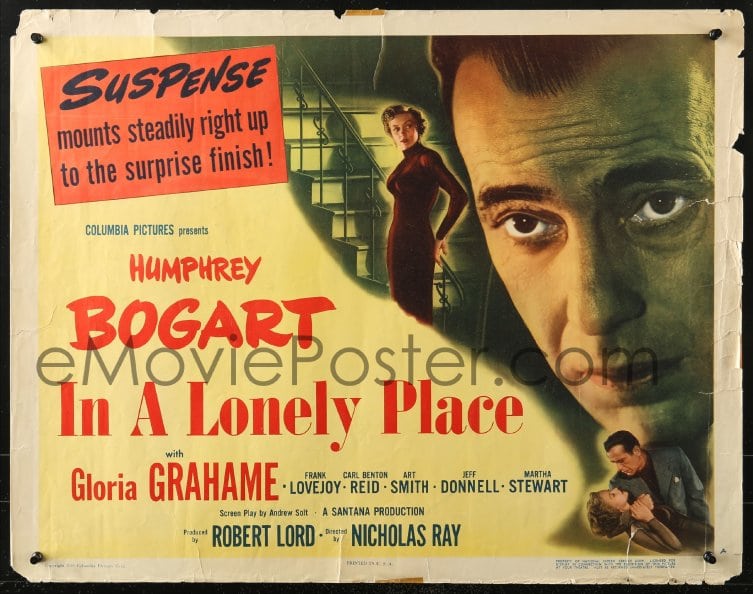
Ina Lonely Place, also directed by Ray, did not discuss the political situation in Hollywood, but it was a commentary on the HUAC-inspired witch hunt, the blacklisting and the paranoia that affected the film industry. Image courtesy of eMoviePoster.
Apart from Johnny Guitar, Ray had already attacked the investigations in In A Lonely Place (1950). James W. Palmer, writes about in ‘In a Lonely Place: Paranoia in the Dream Factory’, Literature/Film Quarterly, vol. 12, 1985, No. 3, pp. 202 – 210. The film did not discuss the political situation in Hollywood, but it was a commentary on the HUAC-inspired witch hunt, the blacklisting and the paranoia that affected the film industry. The film focused on a writer Dixon Steele, played by Humphrey Bogart, who had been rejected by the Hollywood community. Since returning from the war, he had been unable to write and his drinking and aggressive behavior had led to him become an isolated figure in the Hollywood community. At the beginning of the film, he invited a hatcheck girl back to his apartment for her to tell him the story of a book which he might turn into a movie. Dixon sent the woman home and the next morning, her body was found brutally murdered. Steele was considered to be a prime suspect by the police. After being questioned and then released by the police, Steele was further isolated by the Hollywood community who saw him as guilty. Bu the end of the film, Steele, who was a violent man, became a borderline psychotic. After succumbing to the pressure, he attacked his fiancé and his life was ruined, even though he was eventually cleared of the murder charge. Steele with his persecutions and paranoia can be read as a symbol of the Hollywood Ten.
This group were a part
of the Hollywood community until accused of the ‘crime’ of communism. Eventually they were abandoned by the
community to their own fate. Film critic
James W. Palmer noted that everybody in the film was guilty of not supporting
people in need. He wrote that the real
crime was the undermining of human trust through a process of social exclusion.
Ray’s allegorical attack against HUAC in Johnny Guitar probably would have gone over the heads of its audience of the time. No evidence exists in any reviews of Johnny Guitar that anyone considered it anymore than an interesting western with strong performances from both Crawford and McCambridge. Indeed Nora Sayre in her survey of cold war films, mentions it only in passing as a light entertainment.[4] A member of the Hollywood 10, Ring Lardner Jr. had never heard of the film,[5] although Ray has insisted that contemporary audience got the message about the lynching party being a McCarthyite investigation.[6]
Senior Lecturer, La Trobe University, Melbourne, Australia
The Westerns hold pride of place in American cinema. They retold the legends and myths of America’s frontier past and had been a feature of cinema virtually since its inception. In the 1950s, hundreds of westerns were made which dealt with many aspects of American life. It was perhaps inevitable, with the stifling of direct political criticism, and the pressing concerns of McCarthyism and communism, that westerns would take on a political dimension in the 1950s.
High Noon was one of the most important westerns of the 1950s and many films followed its pattern of a lone law officer facing a threat to the town. Image courtesy of eMoviePoster.
The
1947 investigation proved to be only a testing of the waters for HUAC. The Hollywood 10 went to prison in September
1950 and the committee re-gathered momentum to pounce on Hollywood again. The Hollywood 10’s imprisonment had increased
the power of HUAC to make it feared throughout the film industry. Director Joseph Losey told an interviewer
that ‘the most terrifying thing about the atmosphere was seeing people succumb,
and seeing all protest disappear.
Because if you did protest, you’d had it.’[1] The second HUAC investigations were to be
larger and more systematic and they destroyed the remnants of the liberal-left
in Hollywood without any effective opposition.
In the middle of these rising fears about HUAC’s return, Carl Foremen
was writing the screenplay for a western called High Noon.
The
film was about the desperate efforts of the Sheriff Will Kane, played by Gary
Cooper, to get help from the townspeople to fight Frank Miller and his gang,
who were being released from jail that day, and who had promised revenge on the
town and Kane. Miller, who Kane put in
prison for murder, had been pardoned, and his gang were gathering at train
station to meet when the train arrived at noon.
Kane approached all the town leaders for assistance to fight Miller but
they all abandoned him. The town and
church leaders demanded that he leave town, claiming that the gang would leave
the town alone if he was not there. Kane
failed in his attempts and faced the gunmen alone. After defeating the four outlaws, Kane threw
his badge onto the street in disgust at the town and left. The screenwriter wanted the audience to
equate the people of Cooper’s town with those who suddenly deserted their
blacklisted friends in Hollywood.
Kane’s
disgust equaled Foreman’s as friends humbled themselves and begged for help
from the Hollywood community without success.
Foreman had been called to testify in front of HUAC and intended to be
an un-co-operative witness. He said his friends began turning their backs on
him even though he was not a communist:
My associates were
afraid for themselves – I don’t believe them – and tried to get off the film,
unsuccessfully. They went to Gary Cooper
and he refused (to go along with them).
Fred Zimmerman, too, was very staunch and very loyal, so was out backer,
Bruce Church.
There are scenes in the
film that are taken from life. The scene
in the church is a distillation of meetings I had with partners, associates and
lawyers. And there’s the scene with the
man who offers to help and come back with his gun and asks, where are the
others? Cooper says there no others … I
became the Gary Cooper character.[2]
Foreman
depicted Hollywood society in a poor light as the threat of McCarthyism
approached. The pillars of the community
were afraid that a gunfight would jeopardise business and possible future
investment in the town and urged Kane to leave.
Their attitude was similar to the studio heads who abandoned their
employees on the slightest of pretexts to avoid bad publicity and poor box
office returns. The religious leaders
also pulled back from Kane because they cannot sanction violence. He was only offered help by only a 14 year
old boy and the town drunk and he turned down both. The retired marshal wanted to help but could
not because of his arthritis.
The
point of the film was that the town united could have easily defeated the
threat. Instead the Hollywood community
pursued their own individual selfish ends and were torn apart. The point was not lost after the film’s
release and Foreman was blacklisted for his efforts for many years. He was ‘morosely pleased’ when the message of
the film was understood by the conservatives.[3]
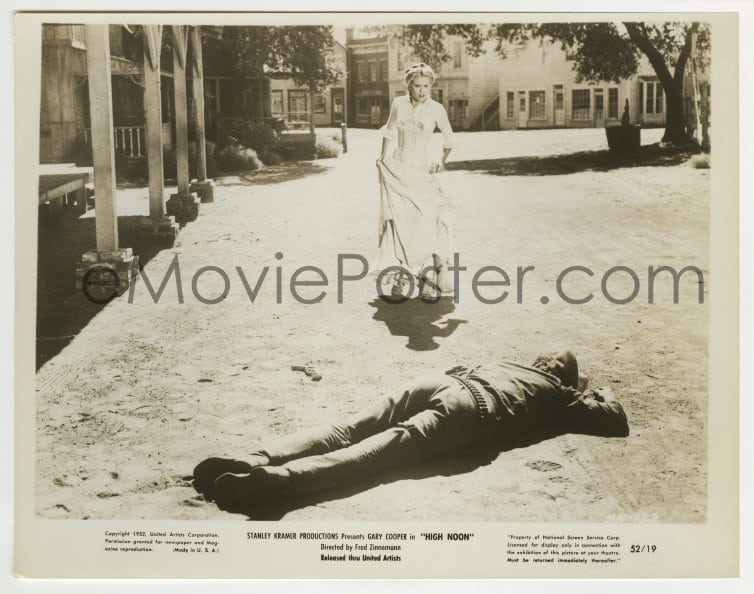
Grace Kelly supports her husband in High Noon Image courtesy of eMoviePoster.
High Noon was one of the most
important westerns of the 1950s and many films followed its pattern of a lone
law officer facing a threat to the town.
Foreman certainly had no doubts when he wrote the screenplay that the
town was Hollywood and the four men approaching represented HUAC and when the
film was released The New York Times film reviewer Bosley Crowther wrote:
It is a story that bears
a close resemblance to things that are happening today where people are
traumatised by bullies and surrendering their freedoms … (Kane) is a man with the
sense to meet a challenge, not duck and hope it will go away … The marshal can
give a few lessons to the people of Hollywood today.[4]
However,
it is doubtful whether the audience of the time saw it in that light. One of the Hollywood 10, Ring Lardner Jr, who
knew Carl Foreman, said he could see no anti-HUAC message in the film beyond
the general theme of standing up for oneself.[5] If members of the Hollywood 10, who were more
sensitive on the topic did not get the message, and knew the screenwriter, what
hope was there for the general audience.
The film had an anti-HUAC message but it is uncertain whether that
message got across to the audience.
Director Zinnemann said he did not make films to prove anything.[6]
The
film can also be read as a defence of McCarthy with a lone figure standing up against the communist threat. The heroic figure of Kane could be seen as
McCarthy desperately trying to awaken the community to the impending threat of
communism. Critic Phillip French has
also suggested that the film was about the United States reluctantly renewing
its role in world affairs.[7]High
Noon started a cycle of movies with the lone or aloof law official figure,
struggling with both the town and some form of menace on the horizon. Something in that formula clicked with the
audience and the film finished eighth in the box office for 1952.[8] The audience responded to the film but it is
unclear to exactly what they were responding.
[1] Tom Milne (ed.). Losey on Losey, Secker & Warburg, London,
1968, p. 90.
[2] Rudy Behlmer, Behind the Scenes: The Making of, Samuel French, New York, 1990, p.
276.
[3] Nora Sayre, Running Time: Films of he Cold War, Dial, New York, 1982, p. 176.
A king in New York’s attack on the destructive paranoia of McCarthyism was similar to his attack on Hitler in The Great Dictator (1940) where Chaplin used slapstick to cut his enemies down to size. Image courtesy of eMoviePoster.
Kevin Brianton
Senior lecturer La Trobe University
The only direct depiction of the HUAC investigations in a negative light came in Charlie Chaplin’s A King in New York (1957). Chaplin had been one of he earliest victims of the anti-communist hysteria and had always been a target for the American Right. Several of his films had enraged the conservatives such as Modern Times (1936) and The Great Dictator (1940). His controversial private life had added fuel to the fire of conservatives who considered him to be a moral threat to the country. An editorial in the Los Angeles Herald Express said:
Charlie Chaplin shelf
proclaimed “citizen of the world” and “man without a country,” is fast nearing
the end of the trail as far as the United States is concerned.
The complacent
self-worship of the man, in a New York press conference is amazing.
In boasting that he was
neither a patriot nor an American citizen, he said, in part:
“I am not nationalist of
any country … You might say I am a citizen of the world … I never voted in my
life … I did a great deal for the war effort … I made a speech in favour of
opening a second front in 1942 … I believe that voting for people … leads to
fascism.”
What a
moral non-eternity that Chaplin is!
In joining the ranks of
subversives who have the overthrow of the American way of life as their avowed
objective, he insults the American people, the very people who have poured
millions into his lap.[1]
The FBI had more than 1900 pages of reports devoted to Charlie Chaplin during his 50 year residency in America.[2] Just as John Jefferson’s sexual preferences in My Son John were seen as evidence of his political leanings, Chaplin’s divorces and paternity litigations were seen as pointers to his communist sympathies. Certain scenes in Modern Times comment on communist issues such as when the tramp walked down the street waving a red flag, trying to signal a driver after it fell off a truck. A communist parade turned the corner behind him and police arrest him as a communist leader. More important was his depiction of the dehumanizing nature of industrial work which Chaplin delighted in satirizing, along with bosses and police. It was these scenes and his support for issues such as a second front against the Nazis in 1942 which left him tainted as a communist sympathizer. It was in this cold war atmosphere of 1952 that United States Attorney General James McGranery rescinded Chaplin’s re-entry permit while he was travelling to London for the premiere of his film Limelight.[3]
Chaplin was to remain away from the United States for the rest of his life, apart from one visit to pick up a life achievement award at the Academy Awards in 1971. But although he was never to return, he left his thoughts on he HUAC investigations and he whole atmosphere of paranoia in his film A King in New York (1957). The film’s attack on the destructive paranoia of McCarthyism was similar to his attack on Hitler in The Great Dictator (1940) where Chaplin used slapstick to cut his enemies down to size. The exiled King Shahdov of Estrovia sought refuge in the United States where he hoped to fund his plans for the peaceful use of nuclear power. Unfortunately the crooked Prime Minister, played by Jerry Desmonde, had run off with the funds. The King and his loyal ambassador Jaume, played by Oliver Johnston, were introduced into various aspects of American culture. The King visited a progressive school and met a precocious child Rupert Macabee, played by his son Michael Chaplin, who launched into Marxist critique of society.
Chaplin was to remain away from the United States for the rest of his life, apart from one visit to pick up a life achievement award at the Academy Awards in 1971. But although he was never to return, he left his thoughts on the HUAC investigations and he whole atmosphere of paranoia in his film: A King in New York (1957). Image courtesy of eMoviePoster.
The
King later met Rupert wandering homeless in the streets because he was running
away from the Un-American Activities Committee who wanted to question him about
his parents’ loyalties. The FBI
eventually captured the boy in the King’s apartment and the King was called
before the committee. Before appearing
he was wrapped up in a fire hose and proceeded to douse the committee with
water. He was cleared of any wrongdoing and before leaving visited Rupert who
was destroyed after naming names. The
film’s subject matter was so contentious it was not shown in the United States
until 1976.[4]
The
pro-HUAC pictures were popular with the American audience. Both On
the Waterfront and The Caine Mutiny
were in the top 20 grossing films of 1954.
It is almost impossible to determine whether the main cause of their
success was their pro-HUAC message, but it does seem that conservative films
had more resonance with the American public.
Mankiewicz’s A Letter to Three
Wives was a determined attack on the McCarthyite mentality and the
anti-intellectual atmosphere of the time.
It was a popular film and part of the post-war liberal flowering of
films. The high-minded aspirations of Storm Centre did not attract an
audience. A King in New York never had a chance. Although the stinging verbal jab by Wilder on
informers in Stalag 17 struck some
kind of chord, the attacks mad on HUAC by Chaplin, Miller, Taradash had a
little, if any, impact on the American public.
They were pot shots against a well armored opponent. It is doubtful that the American Right ever felt
the sting in the lines delivered in the films.
From
the lack of popular reaction to his set of films it would seem that the
American public were more behind McCarthy and the HUAC investigations. The efforts of Hollywood’s liberal community
failed to impress the American public that the communists were victims. However, the pro-HUAC films were also
one-offs, and no cycle of films began from On
the Waterfront with the informer as hero or from the garbled political
message of The Caine Mutiny. At the close of the decade and in the early
1960s, the political tone of films became more and more anti-McCarthyite. Films such as Ben-Hur (1959), Spartacus
(1960), The Manchurian Candidate
(1962), and Seven Days in May (1964)
attacked McCarthyism in many different ways.
However, these films were looking at McCarthyism in retrospect when
controls were looser and there was little likelihood that a career could be
ended by a political statement. Even
though the anti-HUAC films did not strike a chord with the public, it is a
credit to the courage and the integrity of the filmmakers that they were made
at all.
[1] Los Angeles Herald Express 15
April 1947 printed in David Robinson Chaplin: His Life and Art, McGraw Hill,
New York, 1990, p. 546.
[2] Ibid. p. 750. A detailed summary
of the FBI’s campaign can be found in this biography.
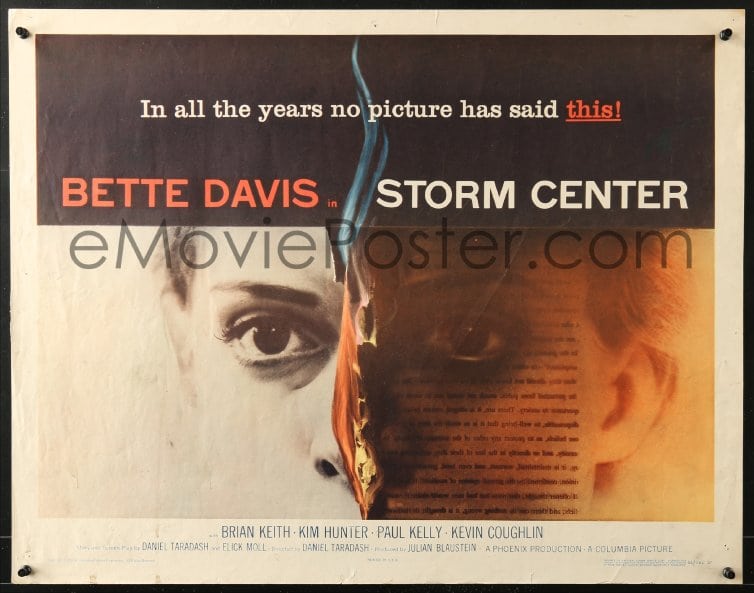
One American film which stood out clearly against McCarthyism was Storm Center (1956) which focused on a small town in America where a librarian Alicia Hull, played by Bette Davis, was dismissed for having a book called ‘The Communist Dream’ on the library’s shelves. Image courtesy of eMoviePoster
One
American film which stood out clearly against McCarthyism was Storm Center (1956) which focused on a
small town in America where a librarian Alicia Hull, played by Bette Davis, was
dismissed for having a book called ‘The Communist Dream’ on the library’s
shelves. The local council wanted the
book removed and for future decisions about questionable material to be brought
before them. She told the council:
There was a book in our
library for many years. It is still
there. It made me sick to my stomach
every time I checked it out, Mein Kampf.
Maybe we ran the risk of spreading Hitlerism but it didn’t work that
way. People read it. It made them indignant. Maybe it helped defeat Hitler? Don’t you see by keeping it in the library we
attack the communist dream? We say to
the communists, ‘We do not fear you.’ We are not afraid of what you have to
say. Tell me, would they keep a book in
a Russian library praising democracy?[1]
The
council demanded that the book be removed and she refused to withdraw a book
because ‘it has ideas we don’t like’. A
politically ambitious councilor then told her that Hull had been linked to
several communist front organisations such as the ‘American Peace Mobilization’
and the ‘Voice of Freedom Committee’ during the war. Hull denied that she was a communist and she
had resigned form the organisations when she found out they were fronts.
The
council sacked her as well as telling the press that she had former communist
affiliations. The community began to shrink
from her, just as the Hollywood community pulled away from those who spoke up
for the Hollywood 10 and its supporters.
The councilor who leaked the information prepared to use it as a
platform for further political battles ahead.
The councilor was a depiction of those politicians who used their
investigations to further their political careers. Hull was one of the victims whose liberal
sympathies were now out of step with the political conventional wisdom.
The
film also depicted the traditional American family in a less than appealing
light. One man was hideous
anti-intellectual, he resented even his wife’s fondness for music and his son’s
taste for reading. In its defence of the
little boy who liked reading books, the film may have been reacting to the
depiction of the American family in My
Son John. Provoked by his father’s
hatred of ‘pinkos’, the son in Storm Centre burned down the library. The message of the film was that stamping out
even one set of ideas – even repellent ideas – was a short step to book-burning
fascism. The film was an extraordinarily
bold statement for its time.
Director
and writer Daniel Taradash mad his position on the film clear in The New York Times.
Storm Centre is a
dangerous picture about dangerous ideas.
It is about the burning of books and assassination of character. It is about gossip and its peculiar impact on
children. It is about faith in headlines
and distrust of the intellectual. It is
about political ambition disguised as patriotism. It is about the unpredictable line of cause
and effect which can start with the banning of a book and end with the creation
of a lunatic. And on the positive side,
it is about a person who believes the best way to save a country is to be loyal
to its own traditions, rather than afraid of another’s propaganda.[2]
The
film had enormous problems despite its liberal and anti-communist message. In 1952, Mary Pickford had almost signed to
do the picture but had backed out after being approached by he anti-communist
columnist Hedda Hopper. Bette Davis
decided to take the role after it had been rejected by Barbara Stanwyck and
Loretta Young. Davis did not work for
three years after doing the film.[3] At studio insistence, screenwriter Daniel
Taradash was extremely careful to make sure that Hull acted from liberal
motives rather than communist sympathies.[4] Even so, the Catholic Legion of Decency
described it as ‘hugely propagandistic’ which offered a ‘warped, oversimplified
and strongly emotional solution to a complex problem’.[5] Taradash later included a jab at the
witch-hunt in the film Bell, Book and
Candle (1958) when Kim Novak tried to tell James Stewart about her hidden
secret and he asked her if she had done ‘something un-American’.[6] Her secret was that she was a witch.
[1]Storm Centre Columbia/Phoenix (Julian Blaustein), (d) Daniel
Taradash, Daniel Taradash, Elick Moll.
The Caine Mutiny (1954) was about a mutiny aboard a ship because of a demented captain. The first part of the film demonstrated the complete incompetence of Captain Queeg, played by Humphrey Bogart. Image courtesy of eMoviePoster
On The Waterfront was not an isolated
example of a film by the disaffected left about HUAC. The year 1954 saw the release of another
popular film which attacked those who criticised or rebelled against authority. The
Caine Mutiny (1954) was about a mutiny aboard a ship because of a demented
captain. The first part of the film
demonstrated the complete incompetence of Captain Queeg, played by Humphrey
Bogart. The films showed that his
judgment was deeply flawed and he had deep psychological problems. The aspiring novelist Keefer called him
paranoid and aroused the executive officer Maryk’s suspicion about Queeg’s
mental stability. Maryk began a medical
journal of Queeg and he had plenty of material.
Queeg was both obsessive and paranoid and few in the audience could
forget the performance of Bogart with the continuous rolling of his steel balls
in his hands. Incident builds on
incident. Queeg was cowardly, deceptive,
arrogant, evasive, and dishonest. He
finally fell apart during a typhoon and the film make it clear that mutiny was
the only way to save the ship when Queeg was incapable of giving proper orders.
Up
to this point it was clear that Queeg was in the wrong. The film then executed a reversal and
attacked the mutineers for being disloyal.
The defence attorney Greenwald, played by Jose Ferrer, by a vicious
cross examination proved Queeg’s incompetence and paranoia. Yet in the penultimate scene of The Caine Mutiny, Greenwald turned on
the crew, and in particular Keefer, for not supporting Queeg. Greenwald’s final outburst was a real jolt,
because at no time had the men failed in their duties or responsibilities or
both. The film made it clear that
Captain Queeg was too paranoid to command the ship. According to Greenwald, however, the crew was
wrong not to have followed a leader who may have killed them.
Film
historians Roffman and Purdy point out the reason for the unsettling savage
twist may have come from the film’s director Edward Dmytryk who was the only
one of the Hollywood 10 who later testified before HUAC.[1] Dmytryk went to prison for contempt of
Congress, but after being released from prison, testified before HUAC. His testimony allowed him to regain his
position in Hollywood and The Caine
Mutiny was on of his first films after his return. He later claimed that he opposed the
Hollywood 10 before going to prison, but was afraid that recanting before
imprisonment would brand him a coward.[2] The casting of Ferrer as the lawyer Greenwald
was also interesting. Like Dmytryk,
Ferrer appeared before the HUAC hearings in 1951 as a friendly witness. His testimony was described by one historian
as ‘cooperative to the point of obsequiousness’.[3]
The
film was based on a bestselling novel and a long running play The Caine Mutiny Court Martial (1953),
both of which were written by Herman Wouk, but was sharply different from them
both. In the play, which focused
entirely on the court martial trial, Queeg was depicted as a reasonable man
until the weight of evidence crushed his spirit and revealed him to be a
paranoid incompetent. Even then some
doubt remained. In the film, it was
clear from Bogart’s opening scenes that Queeg was an unstable and dangerous
leader. The film also has an important
scene where Queeg, after a cowardly display escorting marines into battle,
asked for support from his crew. The
crew continued to ostracise him through a mixture of fear of his madness and
disgust at his cowardice.
The Caine Mutiny did not contain a personal commentary like On the Waterfront, but it had clear parallels with Dmytryk’s situation. The mutiny was blamed on an intellectual writer and officer who had manipulated events for his own ends. Keefer was the left wing figure who had duped the naive liberals, Maryk and Keith into rebelling against authority. Keefer was depicted as the true enemy which made The Caine Mutiny one of he most subtle defences of the HUAC investigations and the attacks on communist subverters. The communists, as represented by Keefer, were cowardly manipulators.[4] Both the book and the play leave some area of doubt about the dubious role of Keefer in undermining Queeg. In the film, Keefer accepted that he was guilty and cowardly and all the officers accept their guilt and walk away from him.
In
more general terms, the film argued that authority should not be challenged no
matter how inept or how dangerous it became.
However, in Bogart’s memorable depiction of the insane Queeg, it was
clear that the officers had no choice.
Wouk’s message that brave little men like Queeg stopped Jews from ending
up as ‘bars of soap’ and therefore deserved the crew’s full support was lost in
the film version. When the lawyer
Greenwald condemned the men, his speech seemed unjust and unnecessary. Perhaps the film reflected he divided state
of Dmytryk’s allegiances which he described in his autobiography.
The film argued that authority should not be challenged no matter how inept or how dangerous it became. However, in Bogart’s memorable depiction of the insane Queeg, it was clear that the officers had no choice. Image courtesy of eMoviePoster.
I had long been
convinced that he fight of the Ten was political, that the battle for freedom
of thought, in which I believed completely, had been twisted into a conspiracy
of silence. I believed that I was forced
to sacrifice my family and my career in defense of the communist party, from
which I had long been separated and which I had grown to dislike and
distrust. I knew that if it ever got
down a choice between the party and our traditional democratic structure I
would fight the party to the bitter end.
On the other hand, I
would have to name names, and I knew the problems this would cause.[5]
Dmytryk
argued that he was forced by communist tactics to refuse to testify before the
HUAC and strongly objected to the uniformity.[6] When Kefer testified and lied before the
court martial hearings abandoning Merrick to his fate, the scene mirrored the
abandonment he felt when John Howard Lawson testified before HUAC. Dmytryk felt that the sympathy was ‘oozing’
away from the Hollywood 10 because of Lawson’s screaming and yelling.[7] The Caine Mutiny was a popular film and was
ranked second in rentals by Variety.[8]
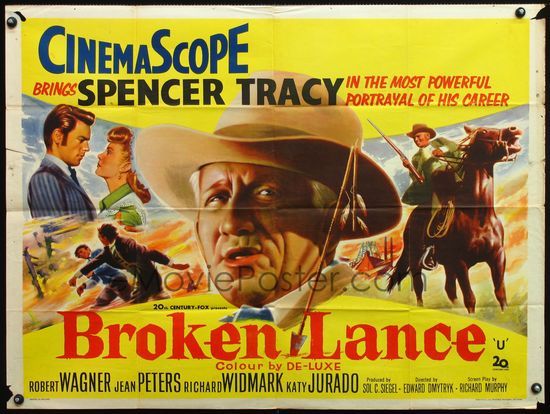
Broken Lance can be read as a defense of Dmytryk’s actions as the hero was prepared to go to jail for a noble cause and at the end of the film was welcomed back to the ranch, of which he is now owner. Image courtesy of eMoviePoster.
Dmytryk’s first effort after The Caine Mutiny was a successful western called Broken Lance (1954) in which the hero is forced to falsify evidence in a trial to ensure that his guilty father will not be sent to prison. The film can be read as a defense of Dmytryk’s actions as the hero was prepared to go to jail for a noble cause and at the end of the film was welcomed back to the ranch, of which he is now owner. The film was ranked 20th by Variety. Dmytryk’s flair for box office successes abandoned him when he came to direct Soldier of Fortune in 1955. It was about the rescue of an American taking pictures of military bases in China. The Chinese tortured him by sowing him pictures of his wife eating dinner with another man. She was actually trying to arrange his rescue. The escape was ludicrously simple. Overall, the film as anti-communist propaganda and as drama was exceptionally poor. The film did poorly at the box office despite having a big budget and the draw cards of Clark Gable and Susan Hayward.[9]
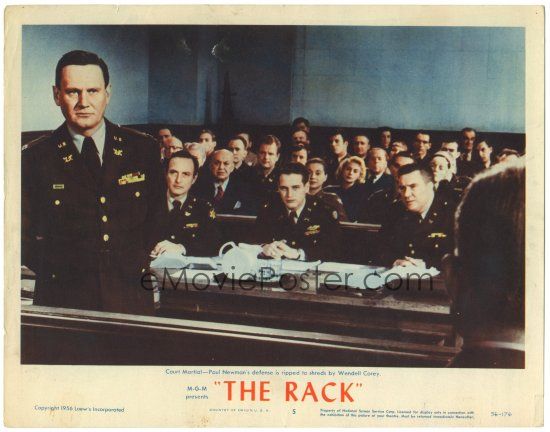
The strained logic of the Caine Mutiny can also be seen in a minor film called The Rack (1956) which dealt with the collaboration of American soldiers during the Korean War. Image courtesy of eMoviePoster.
The strained logic of The Caine Mutiny can also be seen in a minor film called The Rack (1956) which dealt with the collaboration of American soldiers during the Korean War. The film was based on a TV play by Rod Sterling. Captain Edward W. Hall, Jr, played by Paul Newman, returned from Korea accused of collaborating with the enemy. The defence of his actions rested on the mental and physical torture he was given by the communists during his internment. The communists discover that Hall had a strained relationship with his father and respected career soldier Colonel Edward Hall, Sr, played by Walter Pidgeon. For several days, he was locked in a small cellar with wet rags a denied sleep. The communists made him relive again and again his strained relationship with his father. He was told constantly that he was totally alone and no one cared for him. To be released from this torment, he must sign some leaflets. Under pressure, Hall Jr eventually cracked and collaborated with the enemy.
His
defence, however, appeared strong. The
ordeal suffered by Hall Jr was monstrous and his testimony revealed him to be a
man on he edge of a mental collapse. Yet
under questioning from the prosecution, he admitted that he could have kept on
going. In a further statement, he said
that under a torture a man came a to a critical point where he could be a saint
or a sinner. The decision to collaborate
was a simple moral choice between good and evil.
The
film argued that any soldier who collaborated was guilty of a moral crime. Hall Jr invited a guilty verdict from the
court and it was brought down on a vote of two to one. The film wrenched form being a plea for
understanding for Korean prisoners of war who collaborated to being the hardest
of hardline statements. Even under
torture, there must be no concession to the communists. Those people who willing aided the communists
had no defence under any circumstances.
It would have been difficult for
a film of the 1950s to extol or defend a collaborator with the communists. Yet by not even allowing a compassionate view
of those people who collaborated with the communists under torture, the film
certainly had no sympathy with any voluntary communist sympathisers.
[1] Peter Roffman and Jim Purdy, The Hollywood Social Problem Film: Madness,
Despair and Politics From The Depression to the Fifties, Midland, USA,
1981, p. 294.
[2] Nancy Lynn Schwartz, The Hollywood Writer’s Wars, Knopf, New
York, 1982, p. 308.
[3] Bernard F. Dick, Radiacal Innocence: A Critical Study of the
Hollywood 10, University of Kentucky Press, Lexington, 1989, p. 154.
 Barre Lynon.