The reaction to the Ten Commandments

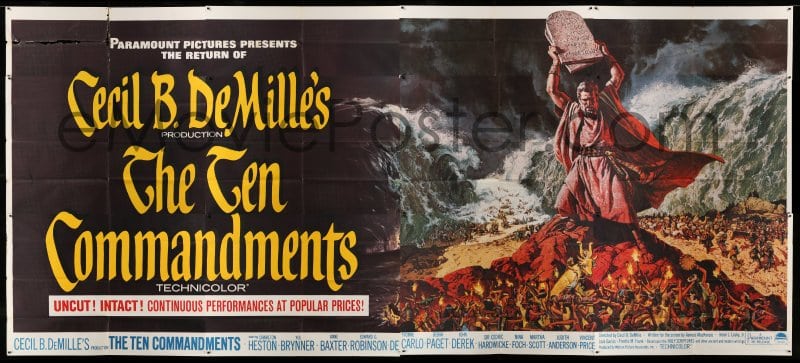
DeMille’s Ten Commandments raised issues about the cold war. Image courtesy of eMoviePoster.

In most cases, it is difficult to determine the precise reaction of the audience to a film.  However, The Ten Commandments made such a huge impact in the United States and DeMille was such a compulsive collector of every reaction to his films that it is possible by examining his archives to gauge its influence.  DeMille’s opening statement was quoted in many film reviews across the United States.[1]  Certainly his ideas about the struggle having modern resonances were well received.  For example, the Memphis Press Scimitar wrote:

In freeing the Israelites from Egyptian oppression and he establishment of government by law as embodied in the 10 commandments veteran Producer, Director Cecil B. DeMille has seen a parallel to the great 20th Century struggles between tyranny and freedom.[2]

The Houston Texas Press noted:

The timelessness of this picture in out world where men have scaled the lengths at the same time producing our modern Pharaohs and their slaves is a lesson in faith.  It shrinks the doctorial world planners down to actual size and renews our appreciation of liberty.[3]

The Boston Independent said:

As the Israeli – Egyptian impasse invites the wisdom of Solomon to resolve it and refugees flee Soviet policed Hungary, Cecil B. DeMille’s The Ten Commandments which recalls the genesis of the conflict and man’s earliest struggle for freedom … It is doubtful if there could be a more apropos commentary on the world situation than the final lines spoken by Moses. ‘Go proclaim liberty, throughout all the lands, unto all the inhabitants thereof.’[4]

The film was also discussed in newspaper editorials, where the Los Angeles Express saw its cold war undertones:

As a story of the downfall of tyranny and of the triumph of religious faith, it also may be source of inspiration to an anxious world.

The newspaper’s reviewer saw it in a similar vein:

It is really the story of man’s search for freedom from tyranny – which could apply right now to the cause of the Hungarians vs. the Russians.[5]

The theme of freedom triumphing over tyranny was repeated in hundreds of reviews and articles across the United States.[6]

The Ten Commandments had a tremendous impact on religious leaders across the United States.  It was released at the time of the Suez crisis and many Jewish leaders saw it as a vindication of the Israeli position.  But even Jewish religious leaders saw its cold war message of salvation.  Rabbi Irving Lehrman gave a sermon on ‘Moses – Hollywood’s Newest Hero’.  He said the spirit of Moses was needed today.

That spirit – of freedom and peace – is needed in Poland and Hungary whenever people are enslaved so that the world can be led back to the Ten Commandments and break the shackles of tyranny.

While Moses is dead his spirit lives on.  That spirit is needed today in London, Paris and Washington, so that the people of Israel battling the modern Pharaoh will have more faith and will be led from Egypt to the promised land of freedom and peace.[7]

William Lindsay Young of the National Conference of Christians and Jews wrote to producer Henry Wilcoxon:

It may well be that Cecil B. DeMille, through the production of the Ten Commandments, will stand out as one of the great prophets of the 20th century.  From out of the Judeo-Christian revelation he has drawn a clear and compelling picture of the relevance of this heritage for our day.  One sees, as in the brightness of noon, that when the spirit of freedom burns in the souls of men, no material force, no tyrant, can keep them in bondage.  In this beautiful screen production Mr DeMille has given us a lethal spiritual weapon that will have telling effect in the current worldwide struggle for the preservation of freedom.[8]

Christian leaders also saw the film’s political message.  Director of the Communications Division of the American Baptist Convention, R. Dean Goodwin, wrote to Ann Del Valle of Paramount Studios about the film’s probable reception in the USSR.  He wrote:

We who have lived all our lives within the framework of the Christian tradition and who believe in freedom and the dignity of man, and who believe in a moral code that is sanctioned by a Diving Being find it to understand a society which rejects all of this.  The governing powers in the Soviet Union could not afford to have a film viewed by Russian people in which one person stands on his God-given rights before the king, and in the name of God demands his rights and leads his people to freedom.  I found enough people in the Soviet Union who want such freedom that I must admit it would be dangerous to the established authorities to show “The Ten Commandments” anywhere in the Soviet Union.[9]

Other religious leaders saw it in a similar fashion.  Herschel Hedgpath of the Methodist Church wrote to Paramount executive Frank Freeman saying;

I believe that Paramount studios and Mr DeMille have made a lasting contribution to the thinking of our time … We need to come to grips with an understanding of the true nature of the basic Communist ideology and I think the picture in its clear analysis of the basic nature of dictatorship and freedom as opposing ideas in the rule of man does this clarification vey nicely.[10]

The comment which pleased DeMille the most was from the statesman Bernard Baruch who wrote a not to DeMille saying: ‘In the materialism of today, the production I was privileged to see last night is a spiritual uplift to those who yearn for liberty against tyrants.’  DeMille sought and got permission to use the quote in newspaper advertisements across the country.[11]

While The Ten Commandments may have been the most direct of the biblical epics in its anti-communism, the themes can be traced directly back to Samson and Delilah.  And the public did get the message.  A fan, Mrs R. M. King of Florida, wrote to Cecil B. DeMille saying:

What we Americans need is more religious pictures.  Such faith as Samson and Delilah would cause God to backfire Russia’s bomb and to rust the ‘iron curtain’.[12]

The major thrust of all these films was that an immoral empire would crumble into dust when faced with true religious determination.

Despite his ultra-conservative leanings, the political message of DeMille’s biblical films was far more subtle than the overt anti-communist films of the time.  He did not use them as vehicles for straight out anti-communist propaganda and their message of religious salvation against tyranny was eagerly accepted by the American people.  The popularity of biblical epics cannot possibly be attributed entirely to their anti-communist message.  Yet they did provide reassurance that God would protect his people in times of adversity.  Perhaps at the deepest level possible, these films reassured a worried American public.  If there was no physical defence to the threat of nuclear war and the communist hordes, then there was a spiritual defence.

The biblical epics provided a cultural mythology that assured the destruction of the communist empires.  The American people needed to be reassured that this growing threat would inevitable crumble.  While the anti-communist films had merely heightened fear and tension and created the impression that the communists were an implacable enemy, the biblical epics of the 1950s provided another depiction which showed them vulnerable to resistance based on spiritual values.  Empires without a moral basis may flourish for a while but they would wither in time because of its absence.  The image that communism was doomed, or damned, was highly reassuring to audiences.  These films advocated views which were remarkably similar to those held by the State Department Secretary John Foster Dulles and many other conservative political leaders.  The unrivalled popularity of these films in the 1950s shows that Dulles’s ideas were deeply ingrained throughout the United States.


[1] Some examples include Galveston Texas News, 7 March 1957, New York Herald Tribune, 2 October 1956, New York Journal American, 30 September 1956, Buffalo Evening News, 10 January 1957, Arizona Republican, 24 February 1957, Press-Telegram, 1 August 1957, Livermore (Calif) News, 24 December 1957, The Sunday Denver Post, 27 January 1957, 7 February 1957, Daytona Beach Morning Journal 6 February 1957, Chicago American, 20 October 1956, Indianapolis Star, 30 January 1957, Baltimore Sun, 20 October 1956, Michigan Battle Creek Enquirer and News, 10 October 1957, Detroit Independent, 25 October 1957, Tell City Independent News, 18 January 1956, The Witness, (Dubuge, Iowa), 2 January 1956, New Beacon (Mass), 16 April 1958.  Scrapbooks 171 – 188 Cecil B. DeMille Archives.

[2] Memphis Press Scimitar, 7 March 1957, Scrapbook 218, Cecil B. DeMille Archives.

[3] Houston Texas Press, 8 February 1957, ibid.

[4] Independent Boston, 21 November 1957, Scrapbook 216.

[5] Los Angeles Express, 15 November 1957, Scrapbook 214.

[6] Among other newspaper articles with similar themes were the Houston Chronicle, 7 February 1957, Houston Post, 3 February 1957, 10 February 1957, Texas Gazette, 16 July 1957, Omaha World Herald, 1 March 1957, Attica NY News, 20 December 1956, New York Herald Tribune, 4 November 1956, NY News, 11 November 1956, New York Morning Telegraph, 9 November 1956, NY Times, 11 November 1956, NY World Telegraph and Sun, 9 November 1956, Buffalo Evening News, 12 December 1956, Buffalo Courier Express, 23 October 1956, Buffalo Jewish Review, 21 December 1956, Jamestown (NY) News, 18 April 1957, Cincinnati Time-Star, 21 December 1956, Columbus Dispatch, 7 March 1957, Cleveland Plain Dealer, 26 November 1956, Newark Advocate, 14 July 1957, Bisbee Daily Review, 26 March 1958, Arizona Daily Star, 3 March 1957, Phoenix Gazette, 6 March 1957, Arkansas Gazette, 10 February 1957, LA Herald Express, 25 October 1957, LA Valley Times, 28 October 1956, Telegraph Tribune, 1 August 1957, Los Angeles Times, 5 January 1957, Los Angeles Herald Express, 15 November 1956, Datona Beach Morning Journal, 6 February 1956, Miami Herald, 16 December 1956, Florida Times-Union, 6 February 1957, Orlando Sentintal, 29 January 1957, St Petersburg Times, 26 January 1957, Pensacola Standard, 7 February 1957, Atlanta Journal and Constitution, 20 January 1957, Chicago American, 21 November 1957, Evansville Courier, 26 June 1957, Indianapolis Star, 30 January 1957, Boston Sunday Herald, 12 August 1956, Christian Science Monitor, 13 November 1956, Detroit Times, 22 November 1956, Kansas City Jewish Chronicle, 25 October 1957,Kansas City Star, 14 February 1957, Monroe Morning World, 4 July 1952, Boston Daily Record, 4 May 1957, New Beacon (Mass), 16 April 1958, Malden Press, 2 May 1958, Birmingham News 7 October 1956, Phoenix Gazette, 9 October 1956, and St Petersburg Times, 26 January 1957.  Derived scrapbooks in the Cecil B. DeMille archives. 

[7] Miami Herald, 16 December 1956, Box 724, Folder 21, Cecil B. DeMille Archives.

[8] William Lindsay Young to Henry Wilcoxon, 27 September 1956, Box 720, Folder 3, Cecil B. DeMille Archives.

[9] R. Dean Goodwin to Ann Del Valle, 24 October 1958, Box 720, Folder 3, Cecil B. DeMille Archives.

[10] Herchel H. Hedgpath to Frank Freeman, 11 January 1957, Box 720, Folder 30, Cecil B. DeMille Archives.

[11] Bernard M. Baruch to Cecil B. DeMille, 6 October 1956, Box 214, Folder 1, Cecil B. DeMille Archives.  The advertisement appeared in the Los Angeles Times, 12 November 1956 and across the United States.

[12] R.M.King to Cecil B. DeMille, 10 March 1950, Box 632, Folder 4, Cecil B. DeMille Archives.

The Ten Commandments (1956) – part two

DeMille directs Brynner in the 1956 version of The Ten Commandments. Image courtesy of eMoviePoster.

Kevin Brianton, Adjunct Senior Research Fellow

La Trobe University, Melbourne, Australia.

The Ten Commandments focused on the spiritual strength of the Israelites which eventually overpowered the military might of the Egyptian empire.  The film opened with scenes of clouds and the narrator saying:

And God said let there be light and behold, there was light.  And from this light, God created life on earth.  And man was given dominion over all things.  And the power to chose between good and evil.  But each sought to do his own will, because he saw not the light of god’s law.  Man took dominion over man.  The conquered were made to serve and conqueror.  The weak were made to sere the strong and freedom was gone from the earth.[1]

The film then moved to a scene of endless lines of Hebrew slaves dragging massive blocks across the ground with Egyptian guards cracking whips.  The Egyptians were cruel and vicious toward their Jewish slaves.  No end existed to the plight of the Israelites.  In one scene the narrator said of the Jewish slaves:

Day after day, year after year, century after century, bondage without rest, toil without reward, these are the children of misery, the afflicted, the helpless and the oppressed.[2]

Joshua, played by John Derek, asked his girlfriend, ‘Is life in bondage better than death’ and Sayre pointed out that it echoed the phrase, ‘Better dead than red.’[3]  The phrase was repeated throughout the film.

The film detailed the rise of Moses who became the deliverer of the Jews.  To escape being killed by the Egyptians, who were hunting for the famed infant deliverer, his mother placed him in a basket on the Nile.  The basket floated down the Nile and was eventually picked up by the childless Pharaoh’s childless daughter who adopted him.  He was favourite and seemed certain to take the throne upon his death.[4]  He eventually learned of his Hebrew background, renounced his Egyptian past and was forced to become a slave building the pyramids.  Moses could not stand the poor treatment and fought with an Egyptian overseer after which he was banished to die in the desert.

In the desert, Moses attained great spiritual wisdom and power and then returned to Egypt.  He gave a demonstration of his new powers and demanded that the new Pharaoh ‘let my people go.’  DeMille wrote in his autobiography that when Moses stood before the Pharaoh and said the ‘divine demand’, it was a depiction of the same forces that ‘confront one another in the world today.’[5]  When Rameses refused, Moses prophesied that seven plagues would visit upon Egypt.  The Pharaoh scoffed at Moses and his prophesies and Egypt was then subjected to one plague after another.  After suffering the seven plagues, the Pharaoh still refused to let the Jews leave Egypt.  He announced to his soldiers that the first born of every Jewish family should die.  Before he could act, Moses prophesied that an Angel of Death would visit Egypt killing the first born of every family.  The Jewish people were saved by dabbing lamb’s blood over their doors.  Every first born child died including the son of the Pharaoh.  The distraught Pharaoh finally succumbed to this overwhelming pressure to let the Jewish slaves go free.  In the response Moses says:

Tomorrow we go forth a free nation, where every man shall reap what they shall sow, where no man may kneel except in prayer …[6]

With phrases like ‘free nation’, and ‘reap what they will sow’ the links are made between the Israelites and the Americans.  The Pharaoh, on the other hand, sounded like a Marxist when he snapped, ‘You prophets make the Gods, so that they may prey on the minds of men.’[7]

After the Israelites had begun their walk towards the promised land, the Egyptian Pharaoh decided that he wanted to destroy them.  He sent out his magnificent army in pursuit of the defenceless Jews.  The famous climax of the film had Moses dividing the Red Sea while the Egyptians were held back by a pillar of fire.  The fire subsided and the army chased the fleeing Israelites across the floor of the Red Sea.  When the lase Jew had crossed the Red Sea, the waters were sent crushing in on the Egyptian Army and all were destroyed.  Rameses returned back to his palace, shattered, bewildered and beaten.  He slumped into his throne and said ‘Their god is God.’  The slaves had defeated the masters.

The rest of the film was an anti-climax after the Red Sea scenes.  Moses ascended Mount Sinai to accept the ten commandments.  He found when he retuned that his people had begun following some pagan religious sect.  God’s punishment was swift and merciless, as Moses hurled the ten commandments at the idolaters and set off an earthquake which engulfed the pagan worshippers.  One of the strongest themes of these films was that those who did not follow God’s rules would be punished.  The Israelites were forced to wander for forty years before finding their promised land.

The film concluded by Moses dying with the promised land in sight.  Actor Charlton Heston noted that the last line ‘Go proclaim liberty throughout all the lands unto the inhabitants thereof,’ were the words inscribed on the Liberty Bell.[1]  The bell was a treasured relic of the American Revolution which was rung on 8 July 1776 to announce the adoption of the Declaration of Independence.  DeMille was trying to create a direct link between the struggles of the Israelites and the American War of Independence in the minds of the audience.  From the first scene to the last, DeMille was using the story of Exodus as a modern political statement.

The Ten Commandments was a remake of his highly successful 1923 film, yet there are significant differences between the films.  The original film told the story of Exodus as a prologue to the main feature which focused on the importance of the commandments in daily life.  The 1923 version also contained the Christian message of redemption for sinners which the 1956 version lacked.


[1] Transcribed interview with Charlton Heston, 16 August 1955, Box 12, Folder 18, Cecil B. DeMille Archives, Brigham Young University, Provo, Utah, USA.  The phrase is from Leviticus 25:10.

[1] Ten Commandments (d) Cecil B. DeMille, (w) Aeanas Mackenzie, Jesse L. Lasky Jnr., Jack Garris, Frederic M. Frank
[2] ibid.

[3] Nora  Sayre, Running Time, p. 204.

[4] DeMille was scrupulous in his research on The Ten Commandments and the idea of Moses being a Pharaoh has recently been raised by historian Ahmen Osman in Moses: Pharaoh of Egypt: The Mystery of Ankehenaten Resolved, Paladin, London, 1990.

[5] Hayne, Autobiography, p. 377.

[6] Ten Commandments op cit.

[7] ibid.

A Man Called Peter: politicising religion

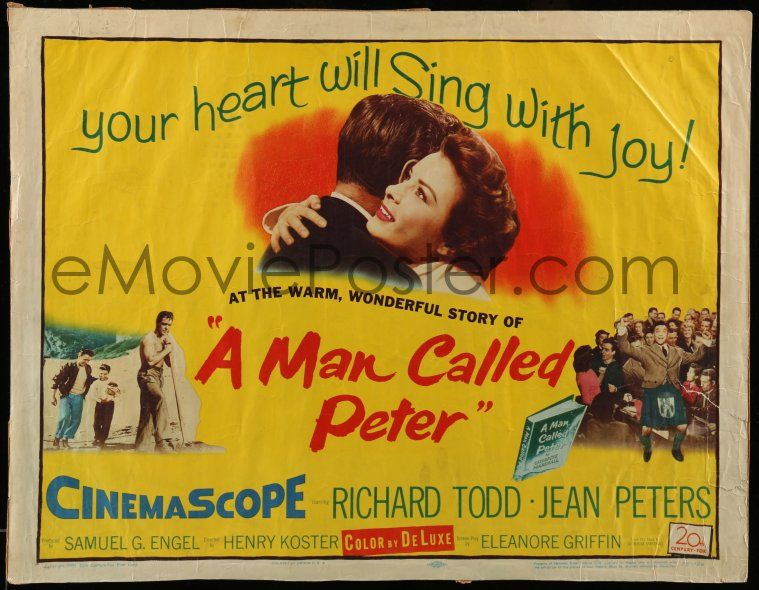
A Man Called Peter (1955) blurred the lines between politics and religion. Image courtesy of eMoviePoster.

Dr Kevin Brianton, Adjunct Senior Research Fellow

La Trobe University, Melbourne, Australia.

The links between the Israelites and the United States were discussed in A Man Called Peter (1955) which was a very popular film.[1]  It detailed the rise of Dr Peter Marshall, a Presbyterian minister from Scotland, who became chaplain for the United States Senate.  The film was a collection of Marshall’s sermons strung together with the story of his rise and near perfect marriage.  Near the conclusion of the film, he delivered a sermon on Elijah and the threat of the God Baal to the nation of Israel.

The leaders of ancient Israel, including the King, had come together to make a great decision.  It was a national emergency.  Elijah, the prophet, had summoned them to meet on Mount Carmel to settle no less a question than who they should worship.  William Penn has said that “Men must be governed by God, or they will be ruled by tyrants.”

Here then was a Hebrew prophet facing the very same issue and making his people face it with him.  They all knew the history of the nation.  How God had led their fathers out of bondage into a new land of pioneers.  How his holy law had been rewritten into the nations constitution.  How the ten commandments had become the bill of rights – and a declaration of “dependence”.  But something in the nation’s life had begun to fade.  Moral decay had set in.  They had begun to love things more than principles.  They had become materialists.  And materialism had a God called Baal.  Now, Elijah saw the danger.  He saw what would happen if the moral fibre of the nation was weakened.[2]

Marshall then went on to explain the defeat and the death of the prophets of Baal by Elijah at Mount Carmel.  He followed the sermon with a call for a modern day Elijah to come to the United States to stare down the false ‘demi-gods’ of today.  The teachings of Baal were not mentioned in the Old Testament and it was Marshall’s own interpretation that it was a materialistic faith.  Marshall said that the choice was between being ruled by God or tyrants, to either follow God or ‘follow Baal to hell’.[3]

Marshall argued that the United States had a choice between either the Lord or the materialistic faith of Baal.  Furthermore, following the God Baal would undermine the moral fibre of the nation.  Marshall linked the Israelites’ struggles with those of the United States.  The Jewish people were depicted as pioneers and the ten commandments as their bill of rights.  When he referred to the holy law being written into the nation’s constitution, it was difficult to tell if he was taking about the United States or Israel.  The sermon on Elijah and the Baal was a strong political statement with cold war overtones.  The United States must follow the laws of God or it would lurch into communism, it was either God or materialistic tyranny.  To the audience of 1955, that was a simple choice between communism and God.

The actual interpretation of Baal as a materialistic faith is at odds with most biblical scholarship which sees it as fertility cult which competed against Judaism.[4]  It is also clear that the sermon was deliberately chosen as a political message by the screenwriter.  It is not mentioned in either the biography by his wife or in the published collection of his sermons.[5]  The screenwriter must have hunted out this sermon quite deliberately and selectively.  Marshall’s published sermons rarely touch on political issues, although according to his wife Catherine, Marshall wanted God to influence the individual legislators in their decisions.[6]

The director Koster constantly cut to the faces of three Senators who were listening closely to the sermon.  To make sure that the audience was aware of the moral strength of Marshall’s political arguments, Koster linked Marshall with the figure of President Abraham Lincoln throughout the film.  He preached in Lincoln’s old church and in another scene, he drove reverently past the Lincoln memorial.  Marshall also called upon the figure of Lincoln to support him in debates against parishioners.  This was done to give his theological statements added political weight.  It appeared that his efforts were not lost.  The powerful film columnist Hedda Hopper in 1957 placed A Man Called Peter seventh in the top ten films of all time.[7]  This reverence indicated that the film made a great impression at the time of its release, even though it is now largely forgotten.


[1] Cobbett Steinberg, Reel Facts: The Movie Book of Records, Vintage, New York, 1982, p.

[2] A Man Called Peter, (d) Henry Koster, (w) Eleanore Griffin.  William Penn (1644-1718) was an English Quaker who helped establish the colony of Pennsylvania.

[3] Ibid.

[4] Karen Armstrong, Holy War: The Crusades And Their Impact on Today’s World, Anchor, New York, 1992, p. 11.

[5] The sermon is not mentioned in Catherine Marshall, A Man Called Peter: The Story of Peter Marshall, Fontana, Glasgow, 1978 on which the film was based or in Marshall’s published collection of sermons in Cathy Marshall (ed.). Mr Jones, Meet the Master, Fontana, London, 1964 (1949)

[6] Marshall, A Man Called Peter, p. 226.

[7] Los Angeles Times 3 January 1959 printed in Steinberg, p. 184.

The Robe’s successors: Demetrius and the Gladiators and the Egyptian

Dr Kevin Brianton, Adjunct Senior Research Fellow

La Trobe University, Melbourne, Australia.

The Robe and its politics was used extensively by evangelist Billy Graham.  Before a tour of a new country such as New Zealand or Australia, he would send out tightly organised advance parties.  These highly efficient men would tell ministers and church groups to screen The Robe as it was a ‘tract for our times’.[1]  It appeared that The Robe was used as an inducement to see Billy Graham documentaries such as Battleground Europe, The Mighty Fortress and Eastward to Asia.  Graham often discussed communism in his sermons and he saw the world as divided into two camps: communist and the west.  He believed only a revival of faith would avert a nuclear holocaust which he saw as a biblical judgement for the United States’ sins.[2]

The film’s sequel Demetrius and the Gladiators (1954) continued the theme of doomed empire by documenting the downfall of Caligula.  The film focused on Demetrius who was torn between Roman decadence as represented by the seductive Messalina, wife to the Emperor’s nephew Claudius, and the austerity of the Christian faith.  Caligula was shaken by the way the Christians met their death in The Robe and demanded that Christ’s robe be found.  Soldiers searching for the robe started a fight with Demetrius who was captured and condemned to become a gladiator.  His Christian ethics prevented him from killing and Caligula ordered that tigers tear him apart.  Demetrius defeated the tigers and earned the respect of the Roman crowd.

The film’s sequel Demetrius and the Gladiators (1954) continued the theme of doomed empire by documenting the downfall of Caligula. Image courtesy of eMoviePoster.

After his victory, Demetrius turned away from Christianity after he prayed to God that a Christian girl be saved form being raped by his fellow gladiators.  When she was apparently killed, he rejected the Christian faith and embarked on a career of gladiator by killing several men in one session.  For his efforts, Demetrius was freed by Caligula provided that he rejected his Christian vows.  Caligula says ‘to join the Romans, he must revile and reject Jesus’.[3]  Demetrius replied:

There is no other God but Caesar.  There is no other power greater than his, in this world or any other.[4]

The lines were a reflection of Kennan’s belief that communism was religion.  Throughout these films, it was either Christianity or Caesar, there was no middle ground.  Just as in the cold war, there was only good and evil, right and wrong, the United States and the USSR.  And just as Kennan saw communism as religion for communists, the tyrant Caligula saw himself as a God.

But Demetrius retained some hidden strengths despite his fall from grace.  Claudius observed about him that:

He has something that Rome has lacked since the early days of the republic.  Something to believe in.  Faith … In my family, we Caesars have killed and buried it, strange if the memory of a dead Jew should continue it.[5]

Demetrius was brought back into line by St. Peter who returned him to the proper path with news that the Christian girl was still alive.  Demetrius prayed for her recovery and regained his faith.  The empire of Caligula then began to crumble against the spiritual armour of Demetrius.  Caligula was killed when he tried to have Demetrius executed and the saner rule of Claudius began.  The film reflected the view of the conservatives that Christianity would overcome tyranny.  The ‘memory of a dead Jew’ could defeat an empire.

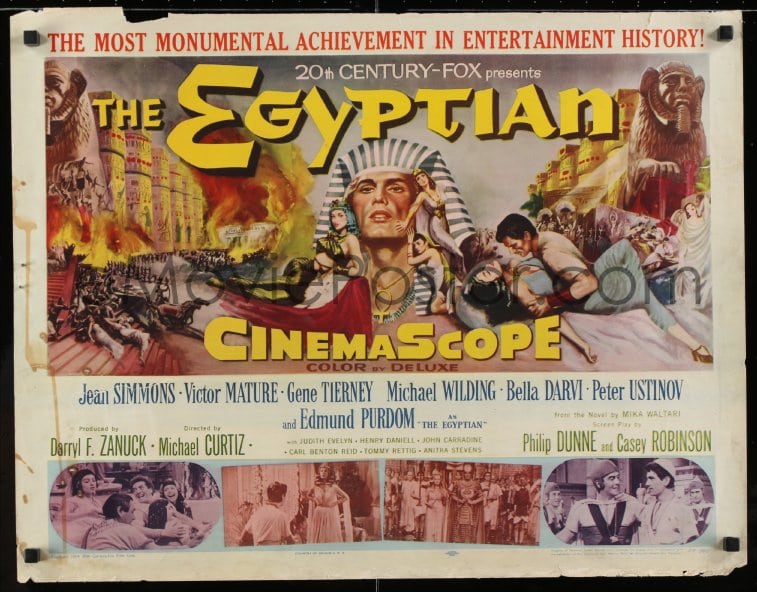
The Egyptian (1954) had the same these of a doomed empire.  The film opened with contemporary shots of the ruins of the Egyptian empire on the Nile.  The narrator said: ‘Today, the glory of ancient Egypt is ruins and dust.’  The film was about the rise, fall and redemption of a physician who wanted to know the meaning of life and to treat the poor.  After studying as a doctor, he tried to save the life of a man praying in the desert to the ‘one god’.  The man was the Pharaoh and he was made his personal physician.  After seeing the cruelty of the powerful, he abandoned Egypt for many years.  He returned to warn Pharaoh about the dangers of the Hittites and their new iron sword.  The military want to strike against the Hittites before they grew too strong, while the Pharaoh refused to condone violence.  The physician was talked into poisoning the Pharaoh to save Egypt.  While dying, the Pharaoh talked about a man coming later who would tell the truth about God and bring right to the world.

The Egyptian (1954) had the same these of a doomed empire. Image courtesy of eMoviePoster.

The physician realised he had made a mistake in murdering the Pharaoh which allowed a military tyrant to take the throne.  The Hittites were quickly destroyed and the physician was put on trial where he told the Pharaoh:

You will go to war and win a battle.  You will conquer and not know it is defeat.  You will raise Egypt to glory and watch her die.  We live in the twilight of our world, … and you will be its sunset.  Nations rise only to fall.  Kings build mighty monuments to only have them crumble into dust.  Glory flees like a shadow, all these things have the seeds of death in them.  Only a thought can live.  Only a great truth can grow and flourish and a truth cannot be killed.

… A good man is better than a bad man.  Justice is better than injustice.  The man who uses mercy is superior to those who uses violence.  Though the later call himself Pharaoh and master of the earth.  We have but one master the God that made us all.  Only his truth is immortal.  And in his truth all men are equal and no man is alone.[6]

The film’s conclusion had virtually the same conclusion as Demetrius and the Gladiators with the religiously strong individual deriding the all-powerful tyrant before being sentenced.  The tyrant’s empire was condemned to destruction.  The true kingdom was based on a religion yet to be unveiled.  The final credit blazed across the screen ‘THESE THINGS HAPPENED THIRTEEN CENTURIES BEFORE THE BIRTH OF CHRIST’ ensuring that the audience got the message about who was the true figure of religious salvation.


[1] Remark by Professor John Salmond on 22 March 1991.  Professor Salmond was a journalist with a New Zealand newspaper and he covered the Billy Graham tour in 1959.  For more details on the detailed and extensive preparations for Billy Graham’s tours read S. Baggage, & Ian Siggins, Light Beneath the Cross: The Story of Billy Graham’s Crusade in Australia, The World’s Work, Kingswood & Melbourne, 1960.

[2] Mark Silk, Spiritual Politics, p. 65.  Grahams’ outlook was discussed in the section on When Worlds Collide.  After Graham’s highly successful Los Angeles revival in 1949, Cecil B. DeMille was rumoured to have offered Graham a screen test.  See Stephen, J. Whitfield, The Culture of the Cold War, John Hopkins University Press, Baltimore, 1991, p. 78. Graham returned the compliment by calling DeMille ‘A prophet in celluloid’, USA, Box 14, Folder 1, Cecil B. DeMille Archives.

[3] Demetrius and the Gladiators, (d) Delmer Daves, (w) Phillip Dunne.

[4] Ibid.

[5] ibid.

[6] The Egyptian (d) Michael Curtiz, (w) Philli Dunne.

David and Bathsheba and The Robe continue the anti-Communist theme

Dr Kevin Brianton, Adjunct Senior Research Fellow

La Trobe University, Melbourne, Australia.

Several films had the same theme of the doomed empire and the final triumph over tyranny.  For the Christians, Jesus would become an avenging political figure who would march forward to right the wrongs of the tyrannical Romans.

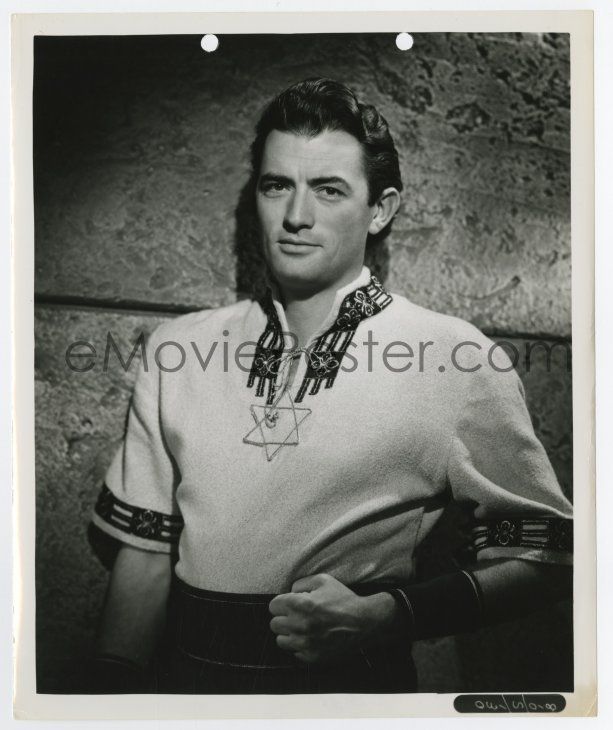
David and Bathsheba, the 1951 Henry King Biblical religious romantic adultery epic melodrama. Gregory Peck played the adult David who had abandoned his religious path and suffered the consequences.

Similar points had been made in David and Bathsheba (1951) after King David committed adultery and Israel was laid waste with famine.  When David begged for mercy, the drought was broken and order was restored.  Disregarding God’s laws was a recipe for disaster.  Even though the film focused on David’s later life, it managed to depict his fight with Goliath in one of the closing scenes.  Armed only with a slingshot.  David went out to face the massive giant single handed.  The invincible Goliath was dispatching Israelites at will.  It appeared that David had no chance of success and he mist die like all the other challengers.  But he was full of true spiritual strength and used a slingshot to hurl a rock into Goliath’s skull.  The monster fell to the ground dead and the Israelite army stormed over the enemy.  The physically weak, but spiritually strong, had overcome the mighty forces arrayed against them.

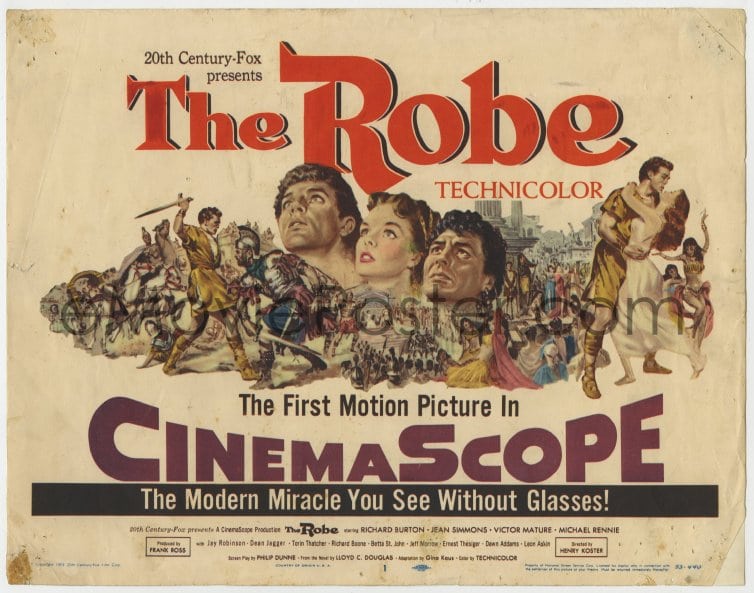
The Robe (1953) made an enormous impact when it was released, which was partly due to it being the first cinemascope picture.  This process meant that audiences could see a massive image spread across a wide screen, however, the novelty value alone was not going to attract an audience.  Cinemascope was an attempt by the studios to counter the growing threat of television to box office returns.  However, the studios were not going to invest their millions in a new process for little return.  It appears clear that The Robe was a deliberate choice for the new process by the studio heads because they knew it would be guaranteed a box office return if it followed the formula set by its predecessors.

The Robe (1953) made an enormous impact when it was released, which was partly due to it being the first cinemascope picture. 

The robe was that worn by Christ when he was crucified.  It was won by a young Roman tribune gambling with other soldiers in charge of the Crucifixion.  Beyond the retelling of the biblical story, the event had other resonances for the Hollywood community.  Before calling for an investigation into Hollywood, Mississippi congressman John Rankin spoke of the crucifixion as part of the communist struggle.  He claimed that communism was based on the hatred of Christianity.

Remember that communism and Christianity can never live in the same atmosphere.  Communism is older than Christianity.  It is the curse of the ages.  It hounded and persecuted the Saviour during his earthy ministry, inspired his crucifixion, derided him in his dying agony, and then gambled for his garments at the foot of the cross; and has spent more than 1900 years trying to destroy Christianity and everything based on Christian principles. [1]

Rankin’s remarks were made in 1945.  The comments would have been well known in Hollywood as the speech was one of the first calls to investigate communism in radio, television and the film industry.  No evidence exists that it directly influenced the Robe’s screenwriters.  However, given the strong links between religion and politics in the cold war, it is clear that even a straight retelling of the Gospel had political connotations.

After being guilt ridden over the Crucifixion, the tribune passed the robe to his slave Demetrius who had been converted to Christianity.  Demetrius told his Roman tribune master that their empire was cursed because of the Crucifixion of Christ.  The Roman empire was once again depicted as doomed.  Emperor Tiberius Caesar foresaw the decline of the Roman empire in these terms.

When it comes.  This his how it will start.  Some obscure martyr in some forgotten province.  The madness infecting the legions, rotting the empire.  It will be the finish of Rome … This is more dangerous than any spell … It is man’s desire to be free.  It is the greatest madness of them all.[2]

Man’s desire to be free would eventually overcome the strength of the Roman empire.  The desire was linked with Christian strength and courage.  The formula of Samson and Delilah, Quo Vadis, and David and Bathsheba was being followed again.

The Robe’s credited screenwriter Phillip Dunne was a strong opponent of the HUAC and the blacklist, and was a founding member of the Committee for the First Amendment.[3]  In his autobiography, he revealed that the writer of the uncredited first draft of The Robe was Albert Maltz, one of the Hollywood Ten.[4]  Either Dunne or Maltz managed to place a jab at HUAC within the film.  The tyrant Tiberius Caesar was constantly asking for the names of Christians.  ‘Names.  I want the names.’ he says.[5]  The writers were equating the tyranny of Rome with HUAC.[6]

If the empire desires peace and brotherhood among all men, my king will be on the side of Rome.  But if the empire and the emperor wish to pursue the course of aggression and slavery that has bought agony and terror and despair to the world.  If there’s nothing to hope for but chains and hunger, then my king will march forward to right those wrongs.  Not tomorrow sire, your majesty might not live to see the establishment of his own kingdom.[7]

The film had the same theme of the doomed empire and the final triumph over tyranny.  For the Christians, Jesus was an avenging political figure who would march forward to right the wrongs of the tyrannical Romans.

The Robe was used extensively by evangelist Billy Graham.  Before a tour of a new country such as New Zealand or Australia, he would send out tightly organised advance parties.  These highly efficient men would tell ministers and church groups to screen The Robe as it was a ‘tract for our times’.[8]  It appeared that The Robe was used as an inducement to see Billy Graham documentaries such as Battleground Europe, The Mighty Fortress and Eastward to Asia.  Graham often discussed communism in his sermons and he saw the world as divided into two camps: communist and the west.  He believed only a revival of faith would avert a nuclear holocaust which he saw as a biblical judgement for the United States’ sins.[9]


[1] Congressional Record, 91, part 6, 17 July 1945, p. 7337.

[2] The Robe, (d) Henry Koster, (w) Phillip Dunne.

[3] Remark by Ring Lardner Jr. at Australian Film Institute Public Seminar on 26 March 1991.  Mr Lardner, one of the Hollywood 10, said that when he was dismissed from Twentieth Century Fox, that Dunne and director George Seaton offered to walk off the lot with Lardner in protest.  Lardner replied that the protest would be futile unless it was 60 people involved.  (From notes taken by writer at seminar.)

[4] Dunne also talked about Maltz’s role in The Robe in McGilligan , Pat. (ed.). Backstory: Interviews with Screenwriters of Hollywood’s Golden Age, University of California Press, London, 1986, p. 164.

[5] The Robe (d) Henry Koster, (w) Phillip Dunne.

[6] The same idea re-emerged in a stronger fashion in Ben-Hur (1959).  The Roman General Massala, played by Stephen Boyd, demands that Jewish leader Judah Ben Hur, played by Charlton Heston, name the names of those who would resist Rome:

BEN-HUR…(I’ve) spoken against violence, against insolence.  Most of the men I’ve talked to agree with you.
MASSALA:Oh not all.
BEN-HURNo … not all.
MASSALA:Who does not agree?
BEN-HURThey’re resentful and impatient.
MASSALA:Who are they? … Yes, Judah who are they?
BEN-HURWould I retain your friendship if I became an informer.
MASSALA:To tell us the names of criminals is hardly informing.
BEN-HURThey are not criminals, they are patriots.

Ben Hur’s director William Wyler was one of the 25 directors who signed the petition for Joseph Mankiewicz, who had been publically outspoken against the HUAC hearings and was under conservative attack.  It is interesting to not that Ben-Hur was one of the few biblical films where the allegory appears to be directed against fascism rather than communism.  The Jews and Arabs are derided by Massala as a ‘conquered race’ and he sees Rome as a superior power.

[7] The Robe, (d) Henry Koster, (w) Phillip Dunne.

[8] Remark by Professor John Salmond on 22 March 1991.  Professor Salmond was a journalist with a New Zealand newspaper and he covered the Billy Graham tour in 1959.  For more details on the detailed and extensive preparations for Billy Graham’s tours read S. Baggage, & Ian Siggins, Light Beneath the Cross: The Story of Billy Graham’s Crusade in Australia, The World’s Work, Kingswood & Melbourne, 1960.

[9] Mark Silk, Spiritual Politics, p. 65.  Grahams’ outlook was discussed in the blog on When Worlds Collide.  After Graham’s highly successful Los Angeles revival in 1949, Cecil B. DeMille was rumoured to have offered Graham a screen test.  See Stephen, J. Whitfield, The Culture of the Cold War, John Hopkins University Press, Baltimore, 1991, p. 78. Graham returned the compliment by calling DeMille ‘A prophet in celluloid’, USA, Box 14, Folder 1, Cecil B. DeMille Archives.

Salome continues theme of opposing Communist regimes

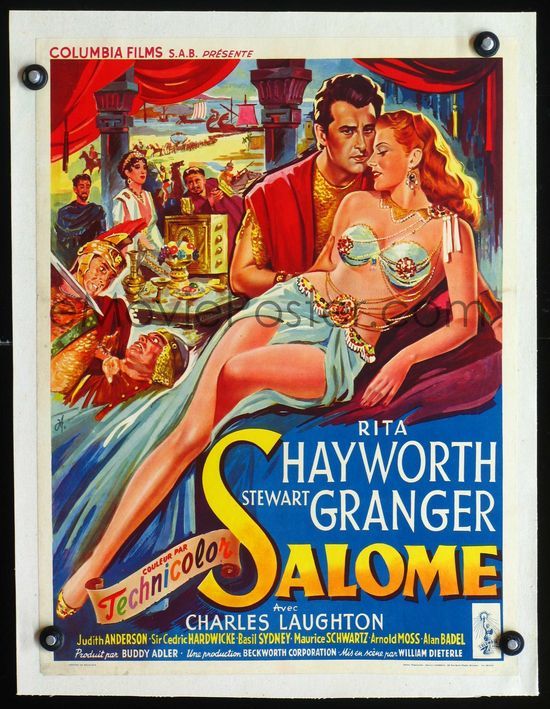
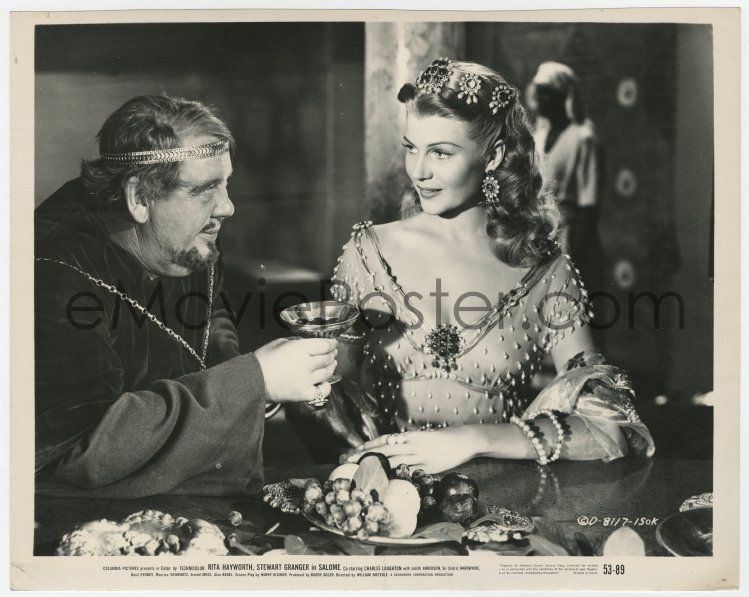
Salome (1953) was a variation on a similar theme or religious opposition to communism concentrating on Princess Salome of the Judean King Herod’s court. image courtesy of eMoviePoster.

Dr Kevin Brianton, Honorary Associate

La Trobe University, Melbourne, Australia.

Salome (1953) was a variation on a similar theme of religious opposition to communism concentrating on Princess Salome of the Judean King Herod’s court.  Herod was liked to Roman rulers in the opening titles and the screenwriter depicted him as one of their puppets.  The film opened with John the Baptist preaching to a small group of people that Herod’s kingdom was corrupt.

The had of the lord will fall upon the king and queen.  Be calm by friends, righteousness shall rise like a mighty river, truth shall be clear as crystal.  Repent.  Cease to do evil, learn to do good.  Relive the oppressed, seek righteousness for his love will be with you as a morning dew and you will blossom as a rose.[1]

One of Herod’s agents then sped away to warn the Queen that John the Baptist was preaching ‘sedition’.  The basic formula of the biblical epics had already been set.  The Romans were corrupt and powerful and were opposed by the righteous but apparently powerless Jews.  When John the Baptist was confronted by the Roman troops, he told his followers ‘to let your faith be your shield’ and then vented his rage at them.

The message of Salome was directed at those rulers who did not follow God’s laws and for the audience of the 1950s that could only mean the communist rulers.  Image courtesy of eMoviePoster.

Tyrants of Rome.  Those who live in hatred and spite shall vanish from the earth when Roman spears will be ground into dust.  The consumers will be consumed.  You will be destroyed.[2]

Further on he denounced Rome and its puppets:

For verily, I say unto you, the kingdom of heaven can be found here on earth if we live like the children of God and not like beasts of prey as those who rule you now.  People of Galilee, Herod is an alien king.  He is descended form a desert tribe of heathens.  He was not born in the faith of our fathers.  He makes a mockery of the Ten Commandments.  Rulers who do not observe the law of God can only bring disaster to the people.[3]

The final sentence was the exact point that John Foster Dulles would make in his Watertown speech.  Not only was communism morally wrong, but eventually it would lead its people to disaster.

When John the Baptist confronted Herod in Salome at his show trial, he continued his verbal assault on the Roman Judean kingdom.

HEROD:Then you would have another king in my place.
BAPTIST:One that would rule with goodness, justice and mercy.
MINISTER:You admit allegiance to someone other than his majesty.
BAPTIST:The one I acknowledge is above the kingdom on earth.
MINISTER:Mightier even than Caesar?
BAPTIST:He is the king of kings.  He makes all the Caesars in the heavens tremble.  He will raise the yoke form the oppressed, right all wrongs, bring a day of judgement upon all the evil ministers of the world… He is the messiah.[4]

Jesus was depicted as a political figure and his appearance meant political as well as religious freedom, as it made the physical and moral decline of Rome certain.  The soldier Claudius made this observation when he argued with the Judean Governor Pontius Pilate.

CLAUDIUS:Rome cannot go on as it has, ruling with a sword and a whip.  If we are to survive, we must recognise that a new force has come into the world.
PILATE:A new force?
CLAUDIUS:The religion of this prophet.  It will bring hope to the conquered, it will bring peace to all men by teaching all how to live in peach with his neighbours.  This is a faith that will march across the world and win them as Rome could only conquer.
PILATE:Caesar is the only faith for a Roman.[5]

As this was prior to the crucifixion, Claudius must be considered to be one of the greatest predictors of historical events of all time.  Pilate’s statement that ‘Caesar is the only faith for a Roman’ reflected the Kennan belief that communism was a religion, rather than a political philosophy.  If the film is read as a political allegory of the communists, it implied that communism was doomed.  The message of the film was directed at those rulers who did not follow God’s laws and for the audience of the 1950s that could only mean the communist rulers.  To maintain some semblance of historical accuracy, Herod was left cursed with the thought the he would die in agony


[1] Salome, (d) William Dietrele, (w) Harry Kleiner, Jerry Lasky Jnr.

[2] Ibid.

[3] Salome, op cit.

[4] Salome, op cit.

[5] Salome, op cit.

Other approaches of Science Fiction to the fears of the 1950s

Jules Verne science fiction was popular in the 1950s. Image courtesy of eMoviePoster.com.

Kevin Brianton

Senior Lecturer, La Trobe University, Melbourne, Australia.

Not all of the popular science fiction films of the 1950s were commenting on communism.  Journey to the Centre of the Earth, 20,000 Leagues Under the Sea and Creature from the Black Lagoon had little to say about the twin fears of nuclear devastation or the communist threat.  The two top grossing science fiction films of the decade were based on novels by 19th century French novelist Jules Verne whose work was popular during the 1950s in America.  Around the World in 80 Days (1956), based on one of his novels, was also an extremely popular film and was only beaten by The Ten Commandments (1956) as the biggest grossing film of that year.

The films based on Verne’s books attracted American audiences for far different reasons.[1]  Verne saw the United States as a model for development for the future of the world.  His books were full of fantastic journeys and inventions.  He saw the United States as a country of technical and economic progress.  It may have been his positive vision of technology and United States society that helped his popularity.[2]  Nonetheless, it was a vision of technological developments of the past.  A period when such development was not threatening.  Even so, 20,00 Leagues Under the Sea had a contemporary message with Captain Nemo attempting to end warfare by sinking all warships of all nations.  The films ended as a mushroom cloud hung over Nemo’s destroyed island, an image that could have meant nuclear weapons to an audience of 1954.

Creature from the Black Lagoon focuses on the sexual intentions of the creature lurking beneath the deep for a woman scientist and appeared to lack any political dimension. Image courtesy of eMovieposter.

Of the others listed, Creature from the Black Lagoon focuses on the sexual intentions of the creature lurking beneath the deep for a woman scientist and appeared to lack any political dimension.  The film was an exception as it was humans that were invading the creature’s lagoon.  The central conflict was between the scientists who wanted to capture and study it and those who wanted it to be left in peace.  The creature was no threat as it lived isolated form the world.  Critic Frank D. McConnell has argued that ‘we glimpse in The Creature the central evasion of energy, the central fear of the life-force itself which underlay the witch-hunts and HUAC purges.’[3]  These films were, however, the exceptions , as most popular science fiction films dealt with themes of nuclear annihilation or communist invasion.

The films often had religious themes.  When the crazed scientist in The Fly (1958) is told ‘It’s like playing God,’ the audience knew he was in for trouble for his blasphemy.[4]  And at the end of the film, he was devoured by a spider.  Religion and science were often in conflict in science fiction films, with some kind of apocalyptic revenge for science that had gone beyond natural boundaries.  When realizing the horror that has befallen mankind form the nuclear tests in Them! (1954), Dr Medford, played by Edmund Gwenn, mumbled quietly in biblical terms:

And there shall be destruction and darkness come upon creation and the beast shall reign over the earth.[5]

The beasts that had been unleashed by the scientists were nuclear weapons or communists armed with nuclear weapons.  Perhaps the clearest example came from Forbidden Planet (1956) which was based on the idea that humanity’s moral nature had not kept pace with its technological development.  Given complete power, mankind would destroy itself.

The religious ideas contained in the science fiction films were bleak.  War of the Worlds, When Worlds Collide, The Fly and Them! were depressing views of the nuclear future.  They reflected a great deal of unease about the development of science and a general belief that it had gone too far.  Presbyterian Minister Peter Marshall, who was the subject of the film A Man Called Peter said in a sermon that progresses had its limits.

These latest inventions and discoveries have made war more terrible, and while they have given us many conveniences and comforts, they have made life more complicated.

                        peace more difficult

                                    and the human heart more troubled…

Everyone agrees that we have far more advances in the scientific world than we have made in the world of morals and ethics.

Spiritually, we have not kept pace with or progress in the realm of science and invention.[6]

Some of these films had an anti-nuclear edge to them.  The fear of communism was great in these films but it was also mixed with a fear of nuclear weapons themselves.  It is interesting to note that the monsters which mutated from nuclear sites or escaped form nuclear laboratories were located in or near the United States, not the USSR.

Science fiction films may have been intended to only be simple entertainment, but thy reflected the concerns of a decade.  King called it that ‘paradoxical trick’ of unleashing a community’s fears and then having them destroyed.[7]  That release occurred when ‘the thing’ was electrocuted or the giant ants were incinerated.  In their own way, science fiction films released American audiences from those fears.  They offered reassurance to the fearful American public when it was faced with terrifying enemies with great powers.  The release provided by science fiction may have been only momentary, but it is clear by the popularity of these films that the public wanted and got that release.


[1] For a discussion of the popularity of Verne in America see Ray Bradbury’s introduction ‘The Ardent Blasphemer’ to Jules Verne, 20,000 Leagues Under the Sea, SF Collectors Library, Corgi, 1975, pp. 1-12.

[2] For a discussion of Verne’s views on the United States see Jean Chesneaux, The Political and Social Ideas of Jules Verne, Thames and Hudson, 1979, pp. 150 – 164.

[3] Frank D. McConnell, ‘Song of Innocence: The Creature form the Black Lagoon’ in Michael T. Mardesen, John G. Nachbar, Sam L. Groff. (ed.). Movies as Artifacts: Cultural Criticism of Popular Film, Nelson-Hall, Chicage, 1982, p. 216.

[4] The Fly TCF, (d) Kurt Newmann, (w) James Clavell.

[5] Them! op cit.

[6] Cathy Marshall, (ed.). Mr Jones, Meet the Master: Sermons and Prayers of Peter Marshall, Fontana, 1964, (1949), p. 62.  The sermon was delivered between 1946 and 1949.

[7] King, Danse, p. 28.

Sexual and political tension in I Married A Monster From Outer Space

Kevin Brianton

Strategic Communication Senior Lecturer, La Trobe University, Melbourne: Australia.

I Married A Monster From Outer Space (1958) was one of the final efforts in the alien subversion cycle.  The film had many of the elements of Invasion of the Body Snatchers.  Aliens had been quietly taking over the bodies of people of a small American town.  The central takeover was that of Bill Farell, played by Tom Tryon, who was newly married to Marge, played by Gloria Talbott.  Marge suspected something was seriously wrong with Bill.  She followed him into the woods to find that he was meeting with his fellow aliens.  Marge tried to contact Washington, but the operator told her all the lines were down, and so she then tried to leave town, but was stopped by a police roadblock.  The aliens had taken over the police force and even her godfather had been replaced.  Eventually she convinced Dr Wayne of her story and he formed a posse to enter the woods.  After a brief struggle, they released the real townspeople who had wires attached to their heads to feed the aliens with their memories.  The aliens were destroyed and order was returned.

I Married a Monster from Outer Space reflected the themes developed in Invasion of the Body Snatchers.
Image courtesy of eMoviePoster.

The plan of the aliens was to mate with earth women and eventually take over the world. There is a clear amount of sexual tension. The above image shows the power less female in the hands of the ugly alien. Again communism is a form of seduction, close to a form of rape.  It was a subtle variation on the themes of Invasion of the Body Snatchers.  The aliens were once again ruthless and emotionless.  They killed when under any kind of threat.  The alien double for Bill even strangled a puppy.  The key scenes in the film were Marge’s attempts to tell people about the aliens.  She found the authorities overtaken by the aliens.  It was perhaps notable that it was the townspeople who freed themselves without the assistance of Washington.  The pattern was repeated less successfully in a number of other science fiction films and it even spawned a short lived television series called The Invaders.

Them! and nuclear fears

The themes of fears of nuclear weapons, communist subversion and invasion were continued in Them! (1954). Image courtesy of eMoviePoster.com.

Kevin Brianton

Strategic Communication Senior Lecturer, Melbourne: Australia.

Subversion, literally having the political ground taken away from you is a constant theme in American political culture. “The Paranoid Style in American Politics” is an essay by American historian Richard J. Hofstadter, first published in Harper’s Magazine in November 1964; and it served as the title essay of a book by the author in the same year. The book dealt with these ideas, which he related back through American history.

The Communist threat shown in the film starts right away with the film’s title card in Them! (1954), the only thing in colour for the entire run of the film, the word Them! which is in brilliant red. Then of course, there is the hive mind, of the ants, and the fact that they now threaten the American way of life! The fears of nuclear weapons, communist subversion and invasion were continued.  It is one film that deals with an amalgam of fears. The film began with a girl in shock, wandering through the desert.  The only thing she would said was ‘Them!’[1]  Police searched the desert and discovered that several people had been killed or were missing and that great damage had been done to houses, cars and caravans.  The local cop on the case, Sergeant Ben Peterson, played by James Whitmore, was soon joined by FBI agent Robert Graham, played by James Arness, and scientists Dr Harold Medford, played by Edward Gwenn, and his daughter Robyn, played by Joan Weldon.  Giant mutant ants, products of nuclear bomb testing were ravaging the area.  Peterson, Graham and Medford found and burned out a nest of ants in the desert.  But the queen ants had already escaped and they were traced to the sewers of Los Angeles.  In the finale, the Peterson and Graham searched the sewer for two boys who were trapped inside.  The boys were rescued and the ants were burnt to death.

In one scene, Dr Medford lectured members of the senior armed forces on the danger of the ants:

Apart form man, … ants are the only creatures on earth that make war.  They campaign.  They are chronic aggressors and they make slave labourers of captors, they don’t kill.  None of the ants previously seen by men were little more than an inch in length.  Most are considerably under that size.  But even the most minute of them have an instinct for talent and industry and social organisation and savagery that makes man look feeble by comparison.[2]

He then continued on about the problems of failing to eradicate the ants:

… Unless these queens are located and destroyed before they establish more colonies and heaven knows how many more queens, out man goes as he dominant species within a year.[3]

It is tempting to simply replace the word ‘ant’ or ‘queens with ‘communist’ and the word ‘man’ with ‘United States’, and the word ‘species’ with ‘nation’.  Near the conclusion of he film, the people of Los Angeles were told of their peril:

By direction of the President of the United States, the Governor of the State of California and the Mayor of Los Angeles in the interests of public safety is hereby declared martial law … Curfew is at 1800 hours.  Any persons on the street or outside their quarters by 6 pm will be subject to arrest by military police.  Now for the reasons for this most drastic decision.  A couple of months ago in the desert of New Mexico, a colony of giant ants were discovered.  They are similar in appearance and character to the household ant you are familiar with.  Except they are mutated, ranging in size from more than 12 feet in length.  The New Mexico colony was destroyed but two queen ants escaped.  One has been accounted for and destroyed, but the other has not yet been found.  It is now known to have established a nest in the storm drains beneath the streets of Los Angeles.  It is not known how long or how many of these lethal monsters have hatched.  Maybe a few, maybe thousands.  If new queen ants have hatched and escaped this nest other American cities may be in danger.  These creatures are extremely dangerous.  They have already killed a number of persons.  Stay in your homes.  I repeat stay in your homes.  Your personal safety, the safety of the entire city, is dependent on your full co-operation with the military authorities.[4]

The links between communism and the ants were quite clear.  If they were not destroyed, they would crush the United States.  There was no room for compromise or doubt.  As a scientist, Dr Medford was now firmly in step with the military and there was a need for the suppression of civil rights to fight the monsters.  Before the news became public, one man was a witness to the ants in flight and was locked up in an insane asylum by the Government before he could tell his story to the public.  A doctor asked when could the man be released and was told: ‘The Government will tell you when he is well.’[5]  Individual liberties were quickly forfeited involuntarily when faced with the threat form the ants.  To survive, you must fully co-operate with the military authorities.  That implied co-operation with HUAC or any other government organisation.  A constitutional or human right could not be weighed against survival.

The image of nests of ants festering beneath American cities waiting to lash out and destroy the American way of life was unsettling. Image courtesy of eMoviePoster.com.

The image of nests of ants festering beneath American cities waiting to lash out and destroy the American way of life was unsettling.  All was the same on the surface, but a threat existed which grew steadily beneath normal life.  These threats were spreading from city to city. The only way to thwart these dangers was to fully co-operate with the all –knowing authorities.  These authorities may diminish civil liberties, constitutional rights, even human rights, but that is because the threat was so near and so dangerous.  Them! Was one of the most explicit statements by the American Right about communist menace within the science fiction genre.  It stated that the way to fight the communist menace within the United States was to curtail personal freedoms in order to safeguard the nation.

Despite it extreme views, Them! Had a strong anti-nuclear theme.  At its conclusion, Dr Medford, his daughter Robyn and FBI agent Robert Graham watched the burning embers of the giant ants.

ROBERT GRAHAM:If these monsters got started as a result of the first atomic bomb, what about all those others that have been exploded since.
ROBYN MEDFORD:I don’t know.
DR MEDFORD:Nobody knows, Robyn.  When man invented the atomic age, he opened a door to new world.  Who knows what we will eventually find in that new world.[6]

The camera panned over the heads of the crowd towards the burning flames coming from the ant bodies.  It was a chilling ending and touched the other central concern of the time – the fear of nuclear weapons.  It was the scientists who had unleashed this new force in the world and it was the scientists and the military who worked in concert to smash it.  To finish the film with a shot of flames underlined where the director Douglas thought nuclear weapons would take the world; into the fire.

  It was the scientists who had unleashed this new force in the world and it was the scientists and the military who worked in concert to smash it. Image courtesy of eMoviePoster.

[1] Them! Warner, (d) Gordon Douglas, (w) Ted Sherdeman.

[2] Them! Op cit

[3] Them! Op cit.

[4] Them! Op cit.

[5] ibid.

[6] Them! op cit

Communist subversion in alien films of the 1950s: It came from Outer Space and Invaders from Mars

It Came From Outer Space was the last major science fiction to depict a liberal scientist with solutions and the authorities as dangerous.  It also began a minor cycle of films where aliens take over or replace people’s bodies. Image courtesy of eMoviePoster.

Kevin Brianton

Strategic Communication Senior Lecturer, Melbourne: Australia.

Intermingled with the fear of Russian invasion was the dread of communist subversion.  It Came from Outer Space (1953) was one of the first films to focus on it – but in a curious manner.  Patricia Bosworth would later writer in the New York Times on 27 September 1992 that sometime “the anti-Communist message was disguised as science fiction, with aliens from outer space serving as metaphors for the Soviet menace. There were movies like the ponderously mediocre “It Came From Outer Space…”  An alien craft crashed in the desert witnessed by an astronomer John Putnam, played by Richard Carlson.  He told people, but was not believed.  The alien simply needed time and workers to get their spacecraft operating again and were not a threat.  The aliens replaced local people with alien doubles to avoid detection while they moved around.  The doubles behaved almost identically to the humans but were expressionless.  Although the intentions of the aliens in this films were essentially benign – or rather indifferent – the film did touch on the fear that was to be raised frequently that the community could be subverted from within by alien forces.  Just as, supposedly, the American community could be subverted by communism.

The community reacted with McCarthyite paranoia when the truth about the aliens emerged.  A lynch mob was formed because people fear what they ‘do not understand’.[1]  The lynchers tried to destroy the aliens, however, Putnam intervened and the aliens departed before any real fighting began.  It Came From Outer Space was the last major science fiction to depict a liberal scientist with solutions and the authorities as dangerous.  It also began a minor cycle of films where aliens take over or replace people’s bodies.

Invaders from Mars began a cycle of Communist subversion films. Image courtesy of eMoviePoster.

Invaders from Mars (1953) had a similar theme but featured malign aliens.  Directed by a respected designer William Cameron Menzies, the film began in a home which was happy and secure with an adventurous and intelligent son David, played by Jimmy Hart, and doting parents.  The boy witnessed a Martian landing on the outskirts of town.  No one believed what he had seen and his mother dismissed it as a nightmare, although his father George McLean said he should report it to the rocket base where he worked as ‘There have been rumours’.[2]  George McLean was later captured by the Martians and emerged from their craft as an impersonal man with a cold stare.

His son sensed the changes and saw that the town was slowly being taken over and he tried to warn the authorities.  In distress, David had run to a police station for help as more and more people were being controlled by the aliens.  A friendly desk sergeant listened amused to his story while the child demanded to see the chief.  The chief appeared and it was clear that he was also under the control of the Martians.  The chief ordered him to a jail cell while he waited for his parents.  The fundamental values of American society were breaking down.  The American child could no longer rely on his family or traditional authority figures.  The tension only increased when it was obvious that both David’s parents were controlled by the Martians when they came to pick him up.  The law was corrupt and even the family has been corrupted by the aliens.  One of the strongest scenes in the film was when a young girl returned home, after being captured by the Martians, and then burned the house down.  The Martians had dehumanized the community.

The picture was one of the earliest examples of the alien invasion cycle where a small town was terrorized and subverted by an external force.  This force could take over any loyal citizen and put them under its control.  The parallel between the Martians and communists were quite clear.  The communists could destroy a healthy community by subversion by taking control of certain sections.  They aimed at controlling people in high places such as police chiefs, rocket scientists and generals.  The people who were overtaken quickly become compliant to the will of their masters and followed any order.  The Martians also intended to rip apart the family as children would burn down houses and parents would destroy their children.  The key idea was that individuals had lost their free will to a greater and malign power.


[1] It Came From Outer Space (d) Jack Arnold, (w) Harry Essex.

[2] Invaders From Mars Edward L. Alperson, (d) William Cameron Menzies, (w) Richard Blake.