In Jet Pilot, John Wayne played an American pilot who takes the Russian defector on a tour of American military bases and demonstrated the United States military prowess. Image courtesy of eMoviePoster.
While the mood of the United States was anti-communist, cinema depicting the politics was not popular. Perhaps one of the main reasons for the failure of the anti-communist message in American cinema was the amount of studio interference in these films. There were often trivial reasons for the failure of the films.
Director Joseph Von Sternberg was listed as the director of Jet Pilot, which begun production in 1950, and was finally released in 1957, and was produced by Howard Hughes. Von Sternberg had been Hollywood directorial royalty in the 1930s, but his fortunes had declined by the early 1950s. RKO had already flopped with I Married A Communist and The Whip Hand, and its third attempt at anti-communist propaganda almost failed to get a release. The plot was about a Russian pilot, played by Janet Leigh, who defected to the United States. John Wayne played an American pilot who takes the Russian defector on a tour of American military bases and demonstrated the United States military prowess. He then faked a defection to feed false information to the Russians. The pair fell in love and she helped him escape back to America. Von Sternberg loathed the picture and resented the amount of studio interference.
“I was told, step by step, day by day, movement for movement, word for word, precisely what I was to direct … My name is on the film as director, and there are other names also to which are given credit are just as shadowy, but the names of all those who had a finger in the celluloid pie are mercifully omitted.”[1] Studio interference played a key role in the poor quality of these films particularly at RKO.
The Big Lift (1950) was one of the few anti-communist films with a liberal view of the world.
Image courtesy of eMoviePoster.
Not
all anti-communist films were unbalanced in their approach. The Big
Lift (1950) was one of the few anti-communist films with a liberal view of
the world. It focused on the story of the
Berlin Airlift in 1949 when the Russians blockaded the city and the western
allies began supplying Berlin with all its needs from the air. It was depicted as dangerous work and the
film showed a quiet confidence in America in dealing with the communists. The airlift was physically and mentally
demanding on aircrews who were forced to work long hours to supply the city
with food and coal.
One
of the airmen, Danny MacCullough, played by Montgomery Clift, spent a day in
Berlin and travelled through the Russian sector to see the life of ordinary
Berliners. Russian soldiers searched a
railway carriage for smugglers and one man informed on a women for smuggling
coffee. The coffee was confiscated and
the Russians left. The crowd in the
train was about to vent its anger on the man, when he revealed that he was a
carrying a huge parcel of coffee and gave the woman, twice the amount she was
smuggling. The Russians were shown as
strong but think-headed and easy to deceive.
In a separate incident another American airman Hank, played by Paul Douglas, debated the merits of the American system with a critical communist. She said that American democracy was a farce as the results were determined by big business. Hank argued that in the 1948 election, President Truman was written off by the newspapers and just about everyone else. But in the end, Truman was elected by the people, despite what a big business and the papers were saying. This was an interesting scene as it was one of the few where the merits of communism and capitalism were actually debated. The debate was slanted against the communists, but it was clear that writer and director George Seaton was not afraid of communism and felt it could be dealt with through intelligent debate and, if necessary, through the sensible use of force. At a later time, he spoke about his research for this film, and of being held by the Communists for 56 hours on a dirty train with his wife and daughter after attempting to enter Berlin. Seaton quoted the organizer of the airlift General Lucius D. Clay, who said that if we “resort to totalitarianism to defeat totalitarianism we have lost our democratic soul by doing it.” Seaton’s film even contains some comedy which was lacking in other anti-communist films of the period. Seaton’s effort would be the final liberal statement from Hollywood on communism for some time. The film was ranked at 91st by Variety for 1951.[2]
The anti- communist plots of some films were often absurd. In Tokyo Joe (1949), a plot to return Japanese militarists was described as ‘communist inspired and communist directed’. This ludicrous idea was either a last minute rewrite of the script or a dubbing of the original soundtrack. From internal evidence I the film, it appeared as though the words were dubbed at some late stage. The voice of the General talking to Humphrey Bogart goes oddly deep while this was being said. The words were also spoken when the camera was focused on Bogart. This suggests dubbing as it would be difficult to synchronise the General’s mouth movements with his speech. In either event, the communist element plays no logical part in the film at all. Communism was not mentioned again.
[1] Joseph von Sternberg, Fun In A Chinese Laundry, Secker &
Warburg, London, 1965, p. 282.
[2] Variety, 3 January 1951. A film called Destination Moscow is listed at 88th. The film is not listed in Halliwell’s Film
Guide, 5th edn, Paladin, London, 1986, but it would be reasonable to
conclude that it was an anti-communist film.
The Red Menace looked at the links between illicit sex and communism.
Kevin Brianton
Senior Lecturer, La Trobe University
The apparent links between illicit sex and political subversion were a central theme of many anti-communist films. In The Red Menace (1949) directed by R.G. Stringsteen, an ‘impressionable young man’ called Bill Jones was seduced and indoctrinated by a communist agent. He was angry about being cheated in a land deal. He was then taken to a demonstration against a local real estate agent which was orchestrated by communist agitators to become violent. As the crowd attacked the real estate office, the violent demonstration was broken up by the police. The narrator said:
The introduction of
Bill Jones to communist strategy; a misguided young man fallen under the spell
of Marxian hatred and revenge. Unaware
of that he is only the tool of men who would destroy his country. The signs [of the demonstrators] don’t tell
of a whole wide Marist racket intent on spreading dissension and treason.[1]
Two
days later, Bill Jones was taken along with other recruits to introductory
classes at workers school where he was taught Marxist principles, strategy and
tactics. The narrator said the classes
explain the basis of communism.
It teaches that man is
the product of natural forces which are constantly changing. There are no positive values, no external principles
of right and wrong. Actually it is the
old doctrine of atheism sugar-coated with highbrow terms. It says that men cannot be responsible to
anyone except the totalitarian socialist state and yet the American communist
party claim that they do not wasn’t to overthrow the government by force.[2]
Towards
the end of the film, Bill Jones comes to his senses and decides to quit the
party, but his communist girlfriend Anna Petrovka cannot because she had signed
in her immigration papers that she was not a communist. The Party need only
send her card to the immigration department and she would be deported back to
Eastern Europe. The studios were once
again sending out the message that those who are involved in the communist
party could never leave.
Yet
the irony was that the communist party in Red Menace seemed to be more
interested in stomping on any deviation than in subverting the United
States. One member was murdered after
leaving the party, another committed suicide when forced to recant that Marxism
was based on Hegel’s writing, and another broke down and confessed to murder
after almost three minutes of mild questioning by immigration officials about
illegally entering the country. One
member refused to attack an ex-member in their newspaper and then left the
party. Another was influenced by the
speech of her priest and returned to her family. The two remaining communists that we see were
about to be arrested by the police. The
communist party appeared to be absolutely useless.
Despite
these major organisational flaws, social problems were worsened by the
communists. The audience was told that
the greedy real estate agent would be dealt with, but that it ‘takes
time’. The communists promised a
speedier solution, but it was merely a trap to recruit people to the
party. They also claimed to be against
racism, but call Italians “Mussolini spawned dago’s’ and Blacks ‘African
Ingrates’. The communists admitted that
they were merely using people’s suffering to further their own cause.
The
only real solution to the communist threat was religion, as one priest in the
film said:
God isn’t very popular
in some countries, just as he wasn’t in a lot of countries which are now
dead. The atheistic systems are always
based on hatred. Race hatred when they
are Nazi, class hatred when they are communist.[3]
According to the priest, ‘the best way to defeat communism is to live Christianity and American democracy everyday.’[4] These ideas woudl re-emerge with the biblical epics, whihc wer far more popualr than the overt anti-communist films..
[1]The Red Menace, (d) R.G. Springsteen, Albert LeMond, Gerald
Gerharty.
Senior Lecturer, Strategic Communication, La Trobe University
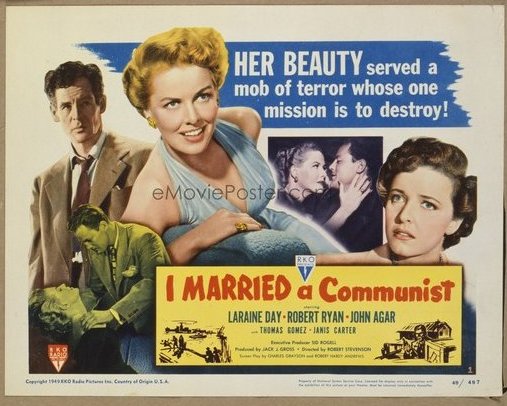
I Married a Communist was one of the most distinctive of the early anti-communist films. Image courtesy of eMoviePoster.
The initial failure of anti-communist films deterred some filmmakers. A Hollywood producer John Sutherland scrapped plans for anti-communist film Confessions of an American Communist after he found that exhibitors were ‘indisposed towards films touched with propaganda’.[1] But the major studios were not deterred and a series of anti-communist films followed in 1949 including The Red Menace, The Red Danube and I Married a Communist.
I Married a Communist or Woman on Pier 13 (1949) was one of the
most distinctive of the early anti-communist films. It was the second of Howard Hughes’ attempts
at an anti-communist film,[2] and was an important film
for RKO, as the New York Times noted, because it signaled the switch at the
studio from its traditional liberal views Hughes’ ultra-conservative values.[3] The film was beset with production problems,
the screenwriters had to ensure its attacks on communist unions were not seen
as attacks on all unions. Making the
distinction was proving difficult. The
writers had to create a story about industrial unrest on dockyards without ever
mentioning the word ‘strike’. Instead
they had to contend with ‘walk-out’, or ‘work stoppage’ or ‘tie-up’. Actors Merle Oberon and Paul Heinreid were
pressed into appearing in the film and then walked out.[4]
The
film was also used as a political barometer for RKO directors. Joseph Losey along with 13 other directors
were offered the job before it was picked up by Rovert Stevenson. Losey told that the film was the ‘touchstone
for establishing who was a “red”’.
Directors were offered I Married a
Communist and if they turned it down, they were blacklisted. Nicholas Ray was also one of the directors
offered the film. He began working on
sets and on the script thinking that the film was so idiotic that it would
never be made. When he realized that it
was going to be produced, he walked off the set.[5] Ray later claimed that he told Hughes that
the film was a ‘loser’ and wanted nothing to do with it.[6]
After
its first disappointing commercial screenings, the film was retitled The Woman on Pier 13, in the hope that a
hint of sex and mystery on the waterfront would attract the crowds.[7] Despite the screenwriting problems about unions,
the film was, in large measure, a smear campaign against the head of the West
Coast Longshoreman’s and Warehousemen’s Union Harry Bridges. The union leader was born in Australia and
FBI head J. Edgar Hoover tried hard and failed to have him deported.[8] The choice of Bridges as a target by the
studio may also have been made because of the links between the ILWU and the
Hollywood’s 10’s Dalton Trumbo who had been a noted supporter of the union
leader for many years.[9] In return, the ILWU had also been a strong
promoter of the Hollywood 10.[10] The ultra-conservative director Cecil B.
DeMille had said that Harry Bridges should be in jail and wanted laws to stop
him from having a ‘stranglehold on a critical American industry’.[11]
The
film focused on Brad Collins, played by Robert Ryan, who played a reformed
communist. He was blackmailed by his
former colleagues who threatened to tell his wife and employer of his communist
and criminal past. Ryan, who worked for
the waterfront management, was forced to prolong a litter union dispute on the
waterfront. His brother-in-law Don Lowry
was indoctrinated by the communists to lead the waterfront union towards
confrontation. The communists acted by
manipulating key agents in sensitive positions.
With agents in management and in the union, the communists inflamed and
prolonged an industrial dispute which caused economic damage to the United
States. They did this because Moscow had
ordered that the docks had to be ‘tied up for 60 days’.[12] Eventually Lowry became aware of he communist
plans and was killed by them. Angered by
Lowry’s murder, Ryan fought and exposed the communist ring, but while regaining
his honour, he lost his life.
Throughout
the film, the structure of the Communist Party was not made clear; the leader
Thomas Gomez took his orders from a shadowy figure on a telephone. The appearance of this shadowy figure who
directed operations from behind the scenes, and who was never caught, was one
of the consistent images in anti-communist films. The figure appeared to be rich and wealthy; a
member of the establishment. The film
implied that communists were present throughout society and their senior
officials occupied high levels of power.
This hinted that the officials were connected with the Democrat administration.
Former
communist membership could be an instrument of blackmail. If Ryan’s communist past – which included
murder – were discovered, he was told he would lose both his wife’s love and
his career at the shipyards. This was a
clear attack on those Hollywood radicals who defended their party membership on
the grounds of a youthful indiscretion.
Party membership was a lifetime commitment, regardless of the intentions
of the individual. Once a member of the
party, it took an extreme act of contrition to remove the taint. I
Married a Communist can be read as Hollywood’s version of its own internal
politics. The hysterical tone of the
films and the slimy depiction of communists was a reflection of how the moguls
saw the communist threat. In one scene,
an FBI informer was killed by the communists and this was a calculated insult
to those who refused to testify.
Informing on communists was depicted as an act of bravery. Those who attempted to purge themselves of
their past were the only ones who could be free from the taint of communism,
just as those who did not recant before the various committees could ever again
be trusted.
Exploration
of the reasons for becoming a communist were confined to those weak-minded
young men who were seduced – both literally and metaphorically – by
communists. The script of I Married A Communist claimed that one
party member can indoctrinate a thousand Americans.[13] The means of indoctrination looks to be
sexual in nature. Critic Nora Sayre has
noted that there was a common figure running through the anti-communist films
called ‘the Bad Blonde’. The role of the
blonde was to seduce ‘impressionable’ young men into joining the Party.[14] Certainly as the communist agents Nixon[15] and Christine discussed
indoctrination of Lowry in I Married A Communist, they equated it with
seduction.
INTERIOR
DARKROOM-NIGHT
We begin on
Christine’s hands rinsing a short piece of Leia film in tray-pull back as she
hands the film to Nixon, who slips it in viewer and studies it closely.
CHRISTINE: (in moment) Important?
NIXON: (continues
studying film) Very. As a matter of
fact, it’s what I’ve waited for – for he last eight months. (still studies film while questioning) How
close is young Lowry to his brother-in-law?
CHRISTINE:
Very close. Why?
NIXON: (still studies
film) In that case – I’ve changed my
mind about him. Continue with his
indoctrination. I’ll inform headquarters
you personally guarantee he’ll be delivered for use when and if he’s
needed.
Christine takes this
with mingled reaction: pleasure about Don, puzzlement about Nixon’s new
purpose. She smiles answering:
CHRISTINE: (with
slight mockery) Why – that will be a very interesting assignment- that I will
enjoy very much.
He gives
her an unreadable side-look – hands strip of film to her.
NIXON:
Destroy it.
She drops film I tray
– takes bottle of chemical from shelf.
Nixon exists. Christine pours
acid on film. Fumes and vapor rise. She still smiles – about herself and Don.[16]
Anti-intellectualism
was another theme of I Married a
Communist. In one scene, communist
agent Nixon reminded Brad Collins of his communist past.
Nixon
sits – opens briefcase – rummages through folders.
NIXON: (during this
action) I’m a student of contracts.
They’re what makes this country of ours fabulous to the rest of the
world. (finds what he seeks) On one hand, we have Bradley Collins – the great
success story. On the other – here I
have the record of a very unsuccessful young man named Frank Johnson.
Brad shows no visible
reaction – asks:
BRAD:
Who’s he?
NIXON: He was typical
of the lost generation – produced by the 30’s.
He left school – ambitious, strong, intelligent – hunting a job, to make
his start up ladder. Unfortunately –
there were no jobs.
BRAD:
(calmly) Why tell me about him?
NIXON: I’m coming to
that – Mr. Collins. (consults documents) Embittered – and violent by nature –
Frank Johnson joined the Young Communist League – then became a full fledged
member of the Party… (seem to skip through document – hitting only the salient
details).. Party card listed Frank J… Agit-prop activities, strikes in New
Jersey … Very prominent in strong-arm work .. Then suddenly – broke all
connections with the Party and disappeared … Reason unknown.
He stops – puts folder
down – removes spectacles in a gesture we’ll learn is characteristic. With spectacles off, Nixon is a changed man:
cold, hard, the complete “intellectual”
NIXON:
(continued) … Or was unknown until now…[17]
For
these screenwriters being an intellectual was to be suspect, and being ‘the
complete “intellectual” was to be a communist.
[2] The first was a film called The Whiphand (1951) which was originally
on Nazis but had the focus changed to communists because of Hughes’ ownership
of RKO.
[5] Tom Milne (ed.). Losey
on Losey, Secker & Warburg, London, 1968, pp. 73 – 76.
[6] Michael Goodwin and Naomi Wise,
No. 6. ‘Nicholas Ray: Rebel!’ Take One,
5 January p. 11.
[7] Andrew Velez (ed.). Robert
Stevenson’s The Woman on Pier 13, RKO Classic Screenplays, Frederick Ungar,
New York, 1976. From introduction by
Andrew Velez. No page Number.
[8] Harry Bridges was the president
of the International Longshormen’s and Warehousemen’s Union. He is remembered for leading a strike in 1934
on the West Coast which eventually became a general strike. The Congress of Industrial Organizations
expelled the ILWU on the grounds of communist domination. Bridges never denied his sympathy for
communist and radical causes, but always denied being a party member. Curt Gentry, J. Edgar Hoover: The Man and His Secrets, Norton, New York, 1991,
pp. 245 – 264.
[9] Bernard F. Dick, Radical Innocence: A Critical Study of the
Hollywood Ten, Universtiy Of Kentucky Press, Lexington, 1989, p. 219.
[11] Keep Faith, a speech before the
American Legion Convention, Dinner Kay Auditorium, Miami, Florida, 15 October
1951, Box 212, Folder 1, Cecil B. DeMille Archives, Brigham Young University,
Utah, USA.
[14] Nora Sayre, Running Time: Films of the Cold War, Dial, New York, 1982, p. 81.
[15] The script refers to the
communist leader as being Nixon, but the final cast list gives the name as
Vanning. It may have been changed to
avoid confusion with HUAC member, later US President, Richard Nixon. As the screenplay refers to him as Nixon, this
name will be used.
Senior Lecturer, La Trobe University, Melbourne, Australia
The anti-communist crusade of the movie moguls began when they signed the Waldorf Declaration on 24 November 1947 which was the same day that Congress met to approve the HUAC contempt citations.
The anti-communist crusade of the movie moguls began when they signed the Waldorf Declaration on 24 November 1947 which was the same day that Congress met to approve the HUAC contempt citations. The declaration was supported by the Motion Picture Association of America, the Association of Motion Picture Producers – the studio heads – and was signed at the Waldorf-Astoria Hotel in Manhattan.[1] They voted to sack any employee who would not say under oath that he or she was not a communist. This meant that the Hollywood 10 were sacked without compensation. The studio heads also voted to refuse to employ any person with communist beliefs.[2]
The
Waldorf declaration was the action of men who were quite prepared to sacrifice
their political independence of financial gain.
Attacking the communists did not appear to be a high price to pay; after
all it was only a small group of writers who were being sacked. Moverover, the spirited resistance against
the HUAC-style investigation in 1941 was done at a time when Roosevelt was
firmly entrenched in power. The
political pendulum had swung to the right and the studios were attempting to
appease their new political masters.
The
Hollywood 10 soon lost most of its support when many in the Committee for the
First Amendment dropped their backing for the group. Some believed that they also could also lose
their jobs and others thought the Hollywood’s 10’s behavior before the
committee as unforgivable, and support for the group began to fade quickly in
the film industry.[3] In subsequent HUAC investigations, there was
little or no effective organised opposition.
The
HUAC investigations were, in part, a reaction to the Roosevelt years and the
close relationship of the film industry with its administration. But there were other links between the HUAC
investigators and Hollywood. The film
industry had encouraged the myth that America was the unblemished ‘good guy’ of
world politics, it now had to reap some of the bitter fruits of that wartime
propaganda. The myth helped give
Americans a feeling of infallibility which assisted in their massive war
effort. In fostering the belief that to
fight America was to do wrong, the films of the Second World War helped create
the mental framework for the cold war.
The adjustment from Nazi Germany to communist Russia as the Untied States
central enemy was surprisingly swift.[4] But it did raise some nagging problems. If America was always right, and Russia was
wrong, why was the United States allied to the country in the first place?
The
answer for the American right – and in particular the HUAC investigators – was
a vast conspiracy stretching from Russia, to the White House, onto communist
screenwriters in Hollywood. Historian
Richard Hofstadter has written about the attractiveness of the conspiracy
theory to Americans and its frequent explosions in American life.[5] A common theme of these theorists was that
small groups with outside backing were seeking to control the United States by
nefarious means. Conspiracy theories
were a well established part of American political culture and they flourished
during the uncertain post-war period.
According to the conspiracy theorists, the Roosevelt administration had
a long term plan to undermine capitalism in order to bring the economy under
the control of the Federal Government and to pave the way for socialism or
communism. HUAC Investigator Robert E.
Stripling believed that Hollywood was in danger of falling under the control of
communists, just as other industries had already done.[6]
The
scapegoats for the conspiracy theorists were the communist and left-wing
writers who worked on the ‘praise Russia’ films of the Second World War. Screenwriter Howard Koch had been ordered by
Warner to make Mission to Moscow and is efforts had been praised by Warner.[7] Koch was subpoenaed but did not testify, he
placed full page ads in the Hollywood trade papers saying that he was not and
had never been a communist, but reserved the right not to say it to HUAC.[8] Koch’s strong liberalism had shown out in
films such as In This Our Life (1942)
and his talent in Sergeant York
(1941) Casablanca (1943), and Letter From an Unknown Woman (1947). His efforts counted for nothing and his
refusal to answer HUAC’s questions, on the principle of his constitutional
rights meant that he did not work in Hollywood for another 12 years. The studio heads were not interested in
Justice, they were interested in scapegoats and Koch was one of those
blacklisted as a result.
For
other members of the Hollywood 10, there were more sinister motives for their
blacklisting. Action in the North
Atlantic screenwriter John Howard Lawson was a central figure in the formation
of the Screenwriters Guild. Eradicating
him would also relieve the studio heads of a radical and determined union
leader. Ring Lardner Jr had always been
a thorn in the side of the ultra-conservative Hollywood leaders. In November 1945, Lardner wrote a long,
highly critical and funny article for Screenwriter on the ultra-conservative
Cecil B. DeMille where he relentlessly attacked and satirized the director and
his politics. He focused sharply on the
Cecil B. DeMille Foundation for Political Freedom writing:
All policy and action
are determined by the self perpetuating board of directors, yet every rank and
file member is assured his political freedom to read and listen to whatever
pronouncement Mr DeMille is moved to make.[9]
He
described the foundation as essentially a right-wing organisation which had
attacked the rights of unionists to make a united stand. The editor of Screenwriter was Dalton Trumbo and the managing editor was Gordon
Kahn. All three became member of the
Hollywood 19. The article was specially
transcribed the DeMille and left in his papers in a file on background
information on communists for his autobiography.[10] DeMille was often accused by his political
opponents of providing names to HUAC and it seems clear that the selection of
Lardner, Trumbo and Kahn was no accident: Hollywood’s right-wing was exacting
revenge.
Many
have argued that it was the economic decline of Hollywood which forced the
studio heads to retreat so vigorously.[11] However, he moguls had opposed intervention
strongly before the war. It was not
economic pressures which drove them to make the Waldorf declaration. The year 1947 was the second most successful
year for the cinema in its history.[12] There was a slight dip from the figures for
1946 which had been a record year for the industry, but they were not under
savage pressure. Anti-trust legislation
and television were on the horizon, but in general the motion picture industry
was sound. The Waldorf declaration and
the consequent blacklisting was a personal failure of nerve by the studio heads
to fight the HUAC investigations.
The
studio heads did not realize that the declaration opened the way for constant
sackings and suspicion. In trying to get
a quick fix to a complex problem, the studios had allowed themselves to be held
hostage by any patriotic organisation which called any actor, director or
writer a communist and promised to picket a film carrying their name. These organisations were extremely demanding. When a person was named as a communist by a
patriotic organisation of some description, the studio heads either had to get
the person concerned cleared through certain channels or have them blacklisted. Red Channels was one example of the
publications circulating at the time which itemized the various offences of
actors and writers supposedly in communist from organisations. The evidence was often wafer thin, but as the
introduction to Red Channels showed the editors were not interested in
subtleties.
The information set
forth in the following report is taken for records available to the
public. The purpose of this
complications is threefold. One, to show
how communists have been able to carry out their plan of infiltration of the
radio and television industry. Two to
indicate the extent to which many prominent actors and artists have been
inveigled to lend their names, according
to these public records, to organisations espousing Communist causes. This, regardless of whether they actually
believe in, sympathize with, or even encourage actors or artists from naively
lending their names to Communist organizations or causes in the future.[13]
The
Waldorf Declaration and the acquiescence of the studio heads to the HUAC
investigators opened the way for chaos in the filmmaking industry. Blacklisting could occur for being a member
of a political group, attending a meeting or signing a petition. The Blacklisting of an actor was not a one
way street. His or her name could be
cleared by approaches to the various agencies concerned. Certain shadowy figures during the blacklist
era made a living attempting to clear people so that they could return to
work. Indeed some groups would cast
aspersions on a person’s character and then offer to redress the balance. This led to a continuing round of clearances
of actors and writers through various organisations. Blacklisted writers could also still write
for the studios using fronts to submit their scripts. People were told to avoid blacklisted people
or at least not to meet them in public.[14]
The
third phase of the crusade against communism was the release of a series of
anti-communist films. Actor Adolphe
Menjou, one of the friendly witnesses before the HUAC hearings, demanded that
the studios produce anti-communist films.
I believe it would be
an incredible success… I think it would be a very wonderful thing to see one
made. I would like to see a picture of
the Bulgarian situation; … I would like that shown to the American public to see
communism as it actually is. I would
like to see the brutal beatings, the stabbings and killings that go on through
Europe… We showed many anti-Nazi pictures.
I see no reason why we do not show anti-communist pictures.[15]
The
studios responded quickly to Menjou’s call.
The first anti-communist film to roll out of the studios was Ninotchka which was re-released by MGM
in November 1947. Earlier the State
Department had been so impressed with the film’s anti-communist message that it
helped release it in Italy to help undermine the Italian communists in 1946
elections.[16]
Ninotchka was quickly followed
by The Iron Curtain which was
released by RKO in May 1948.[17] The title of the film was the image for
Churchill’s famous speech of an iron curtain descending across Europe which he
made on 5 March 1946.[18] This film was similar in style to the
successful Confessions of a Nazi Spy
released before the war, and it also shared the same writer in Martin
Krims. The film concentrated on the
defection of a Russian clerk Igor Gouzenko, played by Dana Andrews, who
defected in Canada. Even with its
novelty value, and the huge publicity of the HUAC hearings, the film was ranked
64th in the year’s rentals.[19]
[1] Otto Friedrich, City of Nets, Headline, London, 1986, p.
332.
[2] Phillip French, The Movie Moguls, Penguin, Harmonsworth,
1969, p. 154. Producers Sam Goldwyn,
Walter Wagner and liberal Dore Schary opposed the declaration.
[3] Barry Norman, Talking Pictures: The Story of Hollywood,
Hooder and Stoughton, London, 1987, p. 205.
[4] Les K. Alder and Thomas G.
Paterson, ‘Red Fasciasm: The Merger of Nazi Germany and Soviet Russia in the
American Image of Totalitarianism, 1930s-1950s, ‘American Historical Journal,
vol. 75, no. 4, April 1970, pp. 1059 – 1061. Alder and Paterson discuss how
easily the substitution from Germany to Russia occurred as a totalitarian
enemy.
[5] Richard Hofstadter The Paranoid Style In American Politics and
Other Essays, Jonathan Cape, London, 1966, pp. 3 – 40.
[6] Robert E. Stripling, The Red Plot Against America, Bell,
Pennsylvania, 1949.
[7] Jack Warner to Howard Koch,
November 24, 1942, Howard Koch Collection, Wisconsin Center for Film and
Theatre Research in David Culbert (ed.). Mission
to Moscow, Wisconsin Warner Bros Screenplay Series, University of Wisconsin
Press, Wisconsin, 1980, pp. 264 – 265.
[9] Ring Lardner Jr., ‘The Sign of the Boss’, The Screen Writer,
November 1945, pp. 1 – 12. Transcript in
Box 29, Folder 7, Cecil B. DeMille Archives, Brigham Young University, Provo,
Utah, USA. The Cecil B. DeMille
Foundation for Political Freedom was formed to campaign for right-to-work laws
and against communist infiltration.
DeMille set up the foundation when he refused to pay one dollar to the
American Federation of Radio Artists to fight right-to-work legislation on the
California state ballot in 1944. The
foundation was closed soon after his death in 1959.
[10] Other names in the files include
writers Albert Maltz, Sidney Buchman, and John Howard Lawson who were all
blacklisted. Edward G. Robinson and
Elmer Bernstein were described as not communist. Actor Howard Da Silva was also described a
‘commie’ out to get DeMille. All
appeared before HUAC. Box 29, Folder 7, Cecil B. DeMille Archives.
[16] Dorothy Jones, ‘Communism and the Movies’ in John Cogley,
Report on Blacklisting, The Fund For The Republic, New York, 1956, p. 300.
[17] For a complete discussion of the
film see Daniel J Leab, ‘The Iron Curtain
(1948): Hollywood’s First Cold War Movie’,
Historical Journal of Film, Radio and
Television, Vol 8, No. 2, 1988, pp. 153 – 188.
[18] Rhode, Robert James (ed.), Winston S. Churchill: His Complete Speeches
1879 – 1963, Chelsea, London, 1974, p. 7285.
[19]Variety, 5 January 1950 estimated that the film made $2 million in
rentals. No other 1949 anti-communist
made the lists.
Senior Lecturer, La Trobe University, Melbourne, Australia
Ayn Rand wrote The Screen Guide for Americans for the Motion Picture Alliance of American Ideals
The MPAPAI’s efforts were reinforced by the studio heads’ desire to crush the studio unions and the obtain political favour with the emerging Republican and McCarthyite forces. The efforts of the alliance were not wasted. The conflict between the ultra-conservatives and the radicals came to a head at the HUAC hearings into communist involvement in Hollywood on 20 October 1947. The Washington-based committee planned to interview both communist and anti-communist witnesses for the next 10 days.
In
January 1947, studio head Jack Warner had received a Medal of Merit from the
Federal government for his work in government training films, yet in October
his studio was being investigated for subversion.[1] With the Republicans in control of Congress
since the 1946 elections, it was clear that the political pendulum was moving
toward the right and Hollywood was one of the first targets. The committee lined up several
ultra-conservative leaders in Hollywood to begin the investigation.
HUAC
has also subpoenaed 19 Hollywood producers, directors and writers as unfriendly
witnesses. Eleven of these had worked
for Warner Brothers, the studio which produced the most wartime propaganda and
had aligned itself with the Roosevelt administration. The studio had also been prominent for its
‘social conscience’ films of the 1930s.[2] The HUAC investigations had a special reason
for singling out the Warner Brothers studio, for its film, Mission to Moscow, as it was based on the work of Davies, a
prominent member of the Roosevelt administration. If they could establish a link between the
White House and the production of the pro-Russian pictures of the Second World War,
it could cause the Truman administration enormous political damage, the type
that was to occur later with the Alger Hiss trial.
Studio
head Jack Warner assured the committee that no subversive propaganda had ever
made it to the screen, not even in Mission
to Moscow. He was initially
forthright in his defence of his studio.
Warner told the committee that if making Mission to Moscow in 1942 was a subversive activity, then so too
were ‘the American Liberty ships and naval conveys which carried food and guns
to Russian allies’.[3] Warner defended Mission to Moscow as being necessary because of the danger that
Stalin would make a treaty with Hitler if Stalingrad fell. Such an alliance would lead to the
destruction of the world.[4] The film was designed to cement the friendship
between the USSR and the United States in a desperate time.
Following
studio heads Jack Warner and Louis B. Mayer came novelist Ayn Rand, who was
considered by the committee to be an expert witness on the Soviet Union. Her expertise was derived from her Russian
origins and right-wing views. Rand
viewed Song of Russia for the committee and described at length its
inaccuracies, failings and lies. Her
criticism of the film clustered around the depiction of Russian peasant life..
She said that at least three and a half million, possibly seven million people,
had died from starvation in the drive to collectivization of farms and the film
makes no mention of them.[5] Rand said the depiction of Soviet village
life was ridiculous. Women were dressed
in attractive blouses and shoes. She
said if any person had the food shown in the film in the Ukraine, they would
have been murdered by starving people attempting to get food.[6] Rand summed up her position on pro-Russia
films like Song of Russia saying it was
unnecessary to deceive the American people about the Soviet Union.
Say it is a
dictatorship, but we want to be associated with it. Say it is worth being associated with the
devil, as Churchill said, in order to defeat another evil which is Hitler. There may be a good argument for that. But why pretend that Russia is not what it
was.[7]
The
hearings were highly unpopular at this state and the New York Times wrote in an editorial saying that the investigation
was unfair and could lead to greater dangers than it was fighting.[8] In Hollywood, the Committee for the First
Amendment was formed by writer Phillip Dunne, directors John Huston and William
Wyler and actor Alexander Knox to oppose censorship of films and to prevent a
blacklist.[9]
The
group had a massive backing and took out huge advertisements in trade
newspapers. The Committee for the First
Amendment wanted the Hollywood 19, as they were known, to take the first
amendment, and do nothing else. Instead,
when the unfriendly witnesses were called they tried to answer the committee’s
questions in their own way which led to shouting matches in the hearings. The first unfriendly witness, screenwriter
John Howard Lawson, attempted to yell down the committee saying it was on trial
before the American people. When he was
finally dragged from the stand, he set a precedent for the remaining
witnesses. Other witnesses were simply
asked if they had ever been a member of the Communist Party. When they failed to answer, they were charged
with contempt.
On
the 19 subpoenaed, ten were called before the committee and refused to testify
citing constitutional rights of privacy and freedom of political thought and
association. Screenwriter and playwright
Bertolt Brecht denied all knowledge of the communist party and later fled the
country. For unknown reasons, Chairman
Parnell Thomas cancelled the hearings before the remaining nine were heard.
The
Hollywood 10, as they became known, were sent to prison for contempt of
congress and the rest were blacklisted from work in Hollywood.[10] The group, along with most legal experts at
the time, believed that their contempt charges would be overturned in the
Supreme Court on the constitutional ground of the right to hold private
political beliefs.[11] Unfortunately for the Hollywood 10, two
liberal judges died before their cases were heard and they were replaced by
conservatives. The deaths changed the
political composition of the Supreme Court which then backed the contempt
citations. This decision by the Supreme
Court opened the legal door for the McCarthyite era. People were now in the position of taking
either the fifth amendment protecting them against self incrimination and
facing blacklisting and other harassment, or informing on people with communist
views.
[2] Richard Maltby, ‘Made for Each
Other: The Melodrama of Hollywood and the House Committee on Un-American
Activities’ in Phillip Davies and Brian Neve, (eds.). Cinema, Politics and Society in America, Manchester University
Press, Manchester, 1981, p. 87.
[3] US Congress, House Committee on
Un-American Activities, Hearings
Regarding the Communist Infiltration of the Motion Picture Industry, 80th
Congress, 1st sess., 20 October 1947, vol. 1169 (5) p.10.
[9] The signatories to the Committee
for the First Amendment were Larry Adler, Stephen Morehouse Avery, Geraldine
Brooks, Roma Burton, Lauren Bacall, Barbara Bentley, Leonardo Bercovici,
Leonard Berstein, DeWitt Bodeem, Humphrey Bogart, Ann and Moe Braus, Richard
Brooks, Jerome Chodorov, Cheryl Crawford, Louis Calhern, Frank Callender, Eddie
Canto, McClure Capps, Warren Cowan, Richard Conte, Norman Corwin, Tom Carlyle,
Agnes DeMille, Delmar Davesm Donald Davies, Spencer Davies, Donald Davis,
Armand Deutsch, Walter Doniger, I.A.L. Diamond., L. Diamond, Muni Diamond, Kirk
Douglas, Jay Dratler, Phillip Dunne, Howard Duff, Paul Draper, Phoebe and Harry
Ephron, Julius Epstein, Phillip Epstein, Charles Einfeldm Sylvia Fine, Henry
Fonda, Melvin Frank, Irwin Gelsey, Benny Goodman, Ava Gardner, Sheridan Gibney,
Paulette Goddard, Michael Gordon, Jay Goldberg, Jesse J. Goldburg, Moss Hart,
Rita Hayworth, David Hopkins, Katherine Hepburn, Paul Heinreid, Van Heflin,
John Huston, John Houseman, Marsha Hunt, Joseph Hoffman, Uta Hagen, Robert L.
Joseph, George Kaufman, Norman Krasna, Herbert Kline, Michael Kraike, Isobel
Katleman, Arthur Lubin, Mary Loss, Myrna Loy, Burgess Meredith, Richard
Maibaum, David Millerm Frank L. Moss, Margo, Dorothy McGuire, Ivan Moffat,
Joseph Mischel, Dorothy Matthews, Lorie Niblio, N. Richard Nash, Doris Nolan,
George Oppenheimer, Ernest Pascal, Vincent Price, Norman Panama, Marion
Parsonnet, frank Partos, Jean Porter, John Paxton, Bob Presnell Jr., Gregory
Peck, Harold Rome, Gladys Robinson, Francis Rosenwald, Irving Rubine, Irving
Reis, Stanley Hubin, Slyvai Richards, Henry C. Rogers, Lyle Rooks, Norman and
Betsy Rose, Robert Ryan, Irwin Shaw, Richard Sale, George Seaton, John Stone,
Allan Scott, Barry Sullivan, Shepperd Sturdwick, Mrs Leo Spitz, Theodore
Strauss, John and Mari Shelton, Robert Shapiro, Joseph Than, Leo Townsend, Don
Victor, Bernard Vorhaus, Billy Wilder, Bill Watters, Jerry Wald and Cornel
Wilde. Myron C. Fagan Documentation of Red Stars in Hollywood printed in Gerald
Mast The Movies in Our Midst: Documents in the Cultural History of film in
America, 2nd edn., Oxford University Press, New York, 1979, p. 549.
[10] The Hollywood Ten were
screenwriters John Howard Lawson, Alvah Bessie, Dalton Trumbo, Lester Cole,
Albert Maltz, Samuel Ornitz, Ring Lardner Jr; the writer-producer Herbert
Biberman; the writer-producer Adrian Scott; and the director Edward Dymytryk.
[11]Hollywood on Trial, (d) David Helpern Jr, Annie Resman.
Senior Lecturer, La Trobe University, Melbourne, Australia
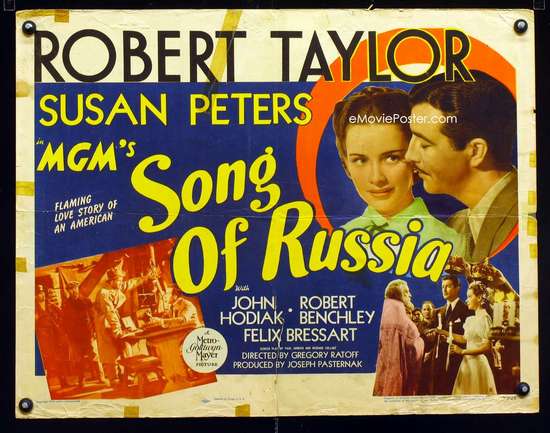
The conservative Ayn Rand viewed Song of Russia for the committee and described at length its inaccuracies, failings and lies. Her criticism of the film clustered around the depiction of Russian peasant life. Image courtesy of eMoviePoster.
The MPAPAI’s efforts were reinforced by the studio heads’ desire to crush the studio unions and the obtain political favour with the emerging Republican and McCarthyite forces. The efforts of the alliance were not wasted. The conflict between the ultra-conservatives and the radicals came to a head at the HUAC hearings into communist involvement in Hollywood on 20 October 1947. The Washington-based committee planned to interview both communist and anti-communist witnesses for the next 10 days.
In
January 1947, studio head Jack Warner had received a Medal of Merit from the
Federal government for his work in government training films, yet in October
his studio was being investigated for subversion.[1] With the Republicans in control of Congress
since the 1946 elections, it was clear that the political pendulum was moving
toward the right and Hollywood was one of the first targets. The committee lined up several
ultra-conservative leaders in Hollywood to begin the investigation.
HUAC
has also subpoenaed 19 Hollywood producers, directors and writers as unfriendly
witnesses. Eleven of these had worked
for Warner Brothers, the studio which produced the most wartime propaganda and
had aligned itself with the Roosevelt administration. The studio had also been prominent for its
‘social conscience’ films of the 1930s.[2] The HUAC investigations had a special reason
for singling out the Warner Brothers studio, for its film, Mission to Moscow, as it was based on the work of Davies, a
prominent member of the Roosevelt administration. If they could establish a link between the
White House and the production of the pro-Russian pictures of the Second World War,
it could cause the Truman administration enormous political damage, the type
that was to occur later with the Alger Hiss trial.
Studio
head Jack Warner assured the committee that no subversive propaganda had ever
made it to the screen, not even in Mission
to Moscow. He was initially
forthright in his defence of his studio.
Warner told the committee that if making Mission to Moscow in 1942 was a subversive activity, then so too
were ‘the American Liberty ships and naval conveys which carried food and guns
to Russian allies’.[3] Warner defended Mission to Moscow as being necessary because of the danger that
Stalin would make a treaty with Hitler if Stalingrad fell. Such an alliance would lead to the
destruction of the world.[4] The film was designed to cement the friendship
between the USSR and the United States in a desperate time.
Following studio heads Jack Warner and Louis B. Mayer came novelist Ayn Rand, who was considered by the committee to be an expert witness on the Soviet Union. Her expertise was derived from her Russian origins and right-wing views. Rand viewed Song of Russia for the committee and described at length its inaccuracies, failings and lies. Her criticism of the film clustered around the depiction of Russian peasant life. She said that at least three and a half million, possibly seven million people, had died from starvation in the drive to collectivization of farms and the film makes no mention of them.[5] Rand said the depiction of Soviet village life was ridiculous. Women were dressed in attractive blouses and shoes. She said if any person had the food shown in the film in the Ukraine, they would have been murdered by starving people attempting to get food.[6] Rand summed up her position on pro-Russia films like Song of Russia saying it was unnecessary to deceive the American people about the Soviet Union.
Say it is a
dictatorship, but we want to be associated with it. Say it is worth being associated with the
devil, as Churchill said, in order to defeat another evil which is Hitler. There may be a good argument for that. But why pretend that Russia is not what it
was.[7]
The
hearings were highly unpopular at this state and the New York Times wrote in an editorial saying that the investigation
was unfair and could lead to greater dangers than it was fighting.[8] In Hollywood, the Committee for the First
Amendment was formed by writer Phillip Dunne, directors John Huston and William
Wyler and actor Alexander Knox to oppose censorship of films and to prevent a
blacklist.[9]
The
group had a massive backing and took out huge advertisements in trade
newspapers. The Committee for the First
Amendment wanted the Hollywood 19, as they were known, to take the first
amendment, and do nothing else. Instead,
when the unfriendly witnesses were called they tried to answer the committee’s
questions in their own way which led to shouting matches in the hearings. The first unfriendly witness, screenwriter
John Howard Lawson, attempted to yell down the committee saying it was on trial
before the American people. When he was
finally dragged from the stand, he set a precedent for the remaining
witnesses. Other witnesses were simply
asked if they had ever been a member of the Communist Party. When they failed to answer, they were charged
with contempt.
On
the 19 subpoenaed, ten were called before the committee and refused to testify
citing constitutional rights of privacy and freedom of political thought and
association. Screenwriter and playwright
Bertolt Brecht denied all knowledge of the communist party and later fled the
country. For unknown reasons, Chairman
Parnell Thomas cancelled the hearings before the remaining nine were heard.
The
Hollywood 10, as they became known, were sent to prison for contempt of
congress and the rest were blacklisted from work in Hollywood.[10] The group, along with most legal experts at
the time, believed that their contempt charges would be overturned in the
Supreme Court on the constitutional ground of the right to hold private
political beliefs.[11] Unfortunately for the Hollywood 10, two
liberal judges died before their cases were heard and they were replaced by
conservatives. The deaths changed the
political composition of the Supreme Court which then backed the contempt
citations. This decision by the Supreme
Court opened the legal door for the McCarthyite era. People were now in the position of taking
either the fifth amendment protecting them against self incrimination and
facing blacklisting and other harassment, or informing on people with communist
views.
[2] Richard Maltby, ‘Made for Each
Other: The Melodrama of Hollywood and the House Committee on Un-American
Activities’ in Phillip Davies and Brian Neve, (eds.). Cinema, Politics and Society in America, Manchester University
Press, Manchester, 1981, p. 87.
[3] US Congress, House Committee on
Un-American Activities, Hearings
Regarding the Communist Infiltration of the Motion Picture Industry, 80th
Congress, 1st sess., 20 October 1947, vol. 1169 (5) p.10.
[9] The signatories to the Committee
for the First Amendment were Larry Adler, Stephen Morehouse Avery, Geraldine
Brooks, Roma Burton, Lauren Bacall, Barbara Bentley, Leonardo Bercovici,
Leonard Berstein, DeWitt Bodeem, Humphrey Bogart, Ann and Moe Braus, Richard
Brooks, Jerome Chodorov, Cheryl Crawford, Louis Calhern, Frank Callender, Eddie
Canto, McClure Capps, Warren Cowan, Richard Conte, Norman Corwin, Tom Carlyle,
Agnes DeMille, Delmar Davesm Donald Davies, Spencer Davies, Donald Davis,
Armand Deutsch, Walter Doniger, I.A.L. Diamond., L. Diamond, Muni Diamond, Kirk
Douglas, Jay Dratler, Phillip Dunne, Howard Duff, Paul Draper, Phoebe and Harry
Ephron, Julius Epstein, Phillip Epstein, Charles Einfeldm Sylvia Fine, Henry
Fonda, Melvin Frank, Irwin Gelsey, Benny Goodman, Ava Gardner, Sheridan Gibney,
Paulette Goddard, Michael Gordon, Jay Goldberg, Jesse J. Goldburg, Moss Hart,
Rita Hayworth, David Hopkins, Katherine Hepburn, Paul Heinreid, Van Heflin,
John Huston, John Houseman, Marsha Hunt, Joseph Hoffman, Uta Hagen, Robert L.
Joseph, George Kaufman, Norman Krasna, Herbert Kline, Michael Kraike, Isobel
Katleman, Arthur Lubin, Mary Loss, Myrna Loy, Burgess Meredith, Richard
Maibaum, David Millerm Frank L. Moss, Margo, Dorothy McGuire, Ivan Moffat,
Joseph Mischel, Dorothy Matthews, Lorie Niblio, N. Richard Nash, Doris Nolan,
George Oppenheimer, Ernest Pascal, Vincent Price, Norman Panama, Marion
Parsonnet, frank Partos, Jean Porter, John Paxton, Bob Presnell Jr., Gregory
Peck, Harold Rome, Gladys Robinson, Francis Rosenwald, Irving Rubine, Irving
Reis, Stanley Hubin, Slyvai Richards, Henry C. Rogers, Lyle Rooks, Norman and
Betsy Rose, Robert Ryan, Irwin Shaw, Richard Sale, George Seaton, John Stone,
Allan Scott, Barry Sullivan, Shepperd Sturdwick, Mrs Leo Spitz, Theodore
Strauss, John and Mari Shelton, Robert Shapiro, Joseph Than, Leo Townsend, Don
Victor, Bernard Vorhaus, Billy Wilder, Bill Watters, Jerry Wald and Cornel
Wilde. Myron C. Fagan Documentation of Red Stars in Hollywood printed in Gerald
Mast The Movies in Our Midst: Documents in the Cultural History of film in
America, 2nd edn., Oxford University Press, New York, 1979, p. 549.
[10] The Hollywood Ten were
screenwriters John Howard Lawson, Alvah Bessie, Dalton Trumbo, Lester Cole,
Albert Maltz, Samuel Ornitz, Ring Lardner Jr; the writer-producer Herbert
Biberman; the writer-producer Adrian Scott; and the director Edward Dymytryk.
[11]Hollywood on Trial, (d) David Helpern Jr, Annie Resman.
For Whom the Bells Tolls (1942) enraged the book’s author Hemingway so much that he threatened to give a press conference to denounce the film Image courtesy of eMoviePoster.
When the HUAC hearings began on 20 October 1947, the conservative director Sam Wood, who was president of the MPAPAI. Wood argued: “There is a constant effort to get control of the Guild. In fact, there is an effort to get control of all unions and guilds in Hollywood. I think our most serious time was when George Stevens was president; he went in the service and another gentleman took his place, who died, and it was turned over to John Cromwell. Cromwell, with the assistance of three or four others, tried hard to steer us into the Red river, but we had a little too much weight for that.” Sam Wood had a gentle-looking face that belied an almost obsessive anti-Communism: he made his children swear anti-Communist affidavits or face being disinherited. He had started his career as an assistant to Cecil B. DeMille in 1915, and these long-time colleagues were now strong anti-Communist allies. Wood had become a respected filmmaker in his own right, directing films such as A Night at the Opera (1935) and Goodbye, Mr. Chips (1939). His failure to win an Academy Award for his often highly successful films fostered enormous personal spite toward liberals whom he felt were out to discredit him. His strident anti-Communism is thought to have contributed to his death by a heart attack in 1949. Wood and other friendly witnesses had one clear message: Communists were present in Hollywood and were working day and night to wrest control of the industry. When he came to direct a film touching on communism, his political views were on display. For Whom the Bells Tolls (1942) was one film which went against the trend of flattering the communists during the Second World War. The film was an adaption of Hemingway’s novel about an American who joined partisan fighters in the Spanish Civil War. Conservative director Sam Wood and Paramount studios changed the word fascist to nationalist throughout the script. Wood’s one concession to the political situation was a short speech by Gary Cooper who said that the Nazis and the Fascists were just ‘much against democracy as they are against the Communists. The fascists were testing weapons to get a “jump on the democracies”’.[1]
The screen version enraged its author Ernest Hemingway so much that he threatened to give a press conference to denounce the film.[2] Critic James Agee in his review of the film for The Nation said there had been denials of political interference in the film from the Franco Government, the Catholic Church and the State Department. Agee saw the film as depicting Spain as a battleground between ‘dirty communists’ and German Nazis. The political slant of the film may have also stemmed from its original ultra-conservative director Cecil B.DeMille who was strongly considering making the film until 1942, when he handed back the rights to Paramount pictures. He wrote in autobiography that he had screenwriter Jeanie MacPherson work on the project for six and a half months. [3]
The Office War Information reviewer said it would hinder the war effort as it showed chinks in the alliance through its depiction of splits within the loyalist camp.[4] The film was the first cinematic hint that the conservatives in Hollywood were not happy with the depiction of Russia in wartime cinema.
Sam Wood gave full vent to those conservative opinions through the Motion Picture Alliance for the Preservation of American Ideals (MAPAI) two years later, of which he was the founding President. The alliance declared war against Hollywood’s radicals when it stated its principles in 1944. The group claimed that it was in sharp revolt against the rising tide of ‘communism, fascism and kindred beliefs’. It resented the takeover of Hollywood by ‘communists, radicals and crack-pots’. The group demanded that communists and other extremists be removed from the film industry because they were perverting the screen with un-American ideas and beliefs. It pledged to fight with every possible resource any attempt to ‘divert the screen from the free America which gave it birth. The MPAPAI members were Walt Disney, Cedric Gibbons, Norman Taurog, Louis D. Lighton, Clarence Brown, George Bruce, James K. McGuiness, Borden Chase, Victor Fleming, Arnold Gillespsie, Frank Gruber, Bert Kalmar, Rupert Hughes, Frank Nible Jr., Cliff Reid, Casey Robinson, Howard Emmett Rogers, Harry Ruskin, Morrie Ryskind, King Vidor, Robert Vogel and George Waggner. [5] The alliance followed up the declaration with a lobbying campaign in Washington which rekindled Martin Dies; enthusiasm for an investigation of Hollywood for communist subversion.
The
MPAPAI’s efforts were reinforced by the studio heads’ desire to crush the
studio unions and the obtain political favour with the emerging Republican and
McCarthyite forces. The efforts of the
alliance were not wasted. The conflict
between the ultra-conservatives and the radicals came to a head at the HUAC
hearings into communist involvement in Hollywood on 20 October 1947. The Washington-based committee planned to
interview both communist and anti-communist witnesses for the next 10 days.
[1]For Whom the Bell Tolls, (d) Sam Wood, Dudley Nichols, quoted
by James Agee in The Nation, 24 July
1943, in James Agee, Agee on Film,
Grosset & Dunlop, New York, 1969, pp. 46 – 49.
[2] Ian Hamilton, Writers in Hollywood 1915 – 1951,
William Heinemann, London, 1990, p. 179.
[3] Agee, pp. 46 – 49. See Donald Hayne (ed.) The Autobiography of Cecil B. DeMille, W.H. Allen, London, 1960, pp. 344 – 345. The remaining synopses are in Box 1038, Folder 1, Cecil B. DeMille Archive, Brigham Young University, Provo, Utah, USA.
[4] Clayton R. Koppes and Gregory
Black, Hollywood Goes to War: How
Politics, Profits and Propaganda Shaped World War II Movies, Free Press,
New York, 1987, p. 71. According to Variety, 3 January 1944, it was also the
most popular film of 1943.
[5] A copy of the statement of principles is printed in Nancy Lynn Schwartz, The Hollywood Writer’s Wars, Knopf, New York 1982, p. 206.
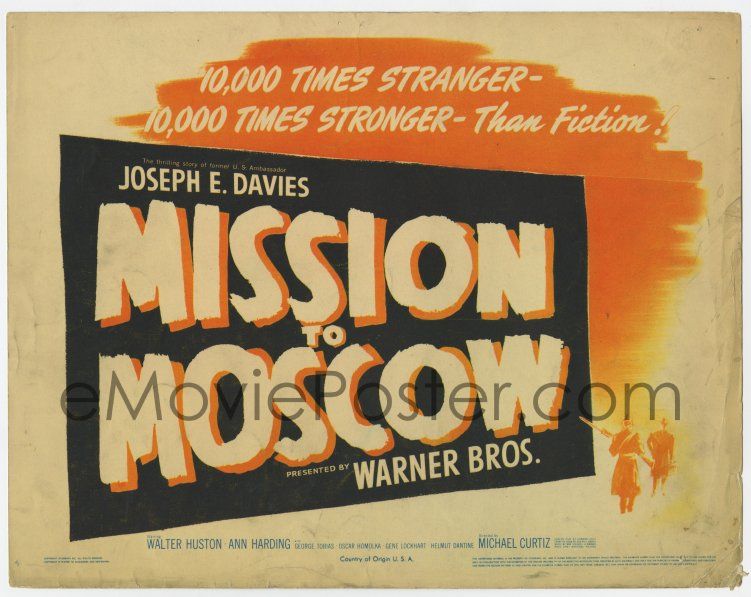
Mission to Moscow glorified Stalin at a time when the United States desperately wanted to maintain the alliance with the Soviet Union. It was despised by J. Edgar Hoover. Image courtesy of eMoviePoster.
While popular films showed there was deeply felt anti-communism in the United States in the 1930s , there was no expressed desire to lurch to fascism. Perhaps the sentiments of the American people were best summed up in the popular Frank Capra film You Can’t Take It With You which was released in 1938. In the film, a fatherly figure commented on the latest developments in politics.
Communism fascism, voodooism … Everybody got isms
these days… When things go badly, you go and get yourself an ism… Nowadays they
say, ‘Think the way I do or I’ll bomb the hell out of you.’[1]
When the United States
entered the war, Hollywood’s film output changed tack. Many films were made which praised the effort
of the Russian armies. The scripts for
these films were often written by communist or leftist writers such as John
Howard Lawson, Lillian Hellman, Howard Koch or Paul Jarrico. These films were filled with praise for the
heroic efforts of the Soviet army and people.
The presence of left leaning and communist writers involved in
pro-Russian footage, in American cinema was to provide the fuel for the
conspiracy theorists of the right after the cold war had set in.
The most controversial
of these films was Mission to Moscow
(1943) which was based on the autobiography of the United States Ambassador to
the Soviet Union Joseph E. Davies. The
film glorified Stalin at a time when the United States desperately wanted to
maintain the alliance with the Soviet Union.[2] The film glossed over Stalin’s disastrous
collectivization of peasants and it also accepted the Stalinist line on the
show trials of the 1930s. Adjusting and
simplifying history was a time-honored Hollywood tradition, but Mission presented a gross distortion.[3] As film historian David Culbert has observed
the Soviet purge trials asked people to believe that the Soviet equivalents of
the American Secretary of State, the Secretary of Defense, the Chief Justice of
the Supreme Court, and chairman of the Joint Chiefs of Staff had all plotted
against their country.[4]Mission
to Moscow showed only one trial, that of Nikolai Bukharin, who was a strong
ally of Lenin in the Russian revolution and supported Stalin against Trotsky
after Lenin’s death. He broke with
Stalin after opposing the collectivization of the Kulaks and attempted to
overthrow Stalin through the Central Committee of the Party. In March 1938, Bukharin was put on trial in
Moscow with other prominent Bolsheviks and subsequently shot.[5]
All of Hollywood’s
skills were needed to sell the message of a benign Russia to the American
public. Warner Bothers allocated the top
talents of director Michael Curtiz and screenwriter Howard Koch, who were riding
high on their success of Casablanca. In the trial scene, Nikolai Bukharin made his
final speech at his trial in Mission to
Moscow where he admitted collusion with the fascists:
CLOSE SHOT
BUKHARIN
As he speaks to the
courtroom with deep feeling and sincerity.
BUKHARIN:
For three months I
refused to testify – then I decided to tell everything. Why?
Because while in prison I made an entire re-evaluation of my past. For when you ask yourself, ‘If you must
die, what are you dying for?’ an absolutely black vacuity rises before you
with startling vividness… My hope is that this trial may be the last severe
lesion in proving to the world the growing menace of Fascist aggression and
the awareness and united strength of Russia.
It is in the consciousness of this that I await the verdict. What matters is not the personal feelings
of a repentant enemy, but the welfare and progress of our country.[6]
Film producer Robert
Bruker later claimed that he wanted some ambiguity in the trial scenes but
Davies insisted that the accused be depicted as guilty traitors and
Trotskyists.[7] Davies’ own book contains some concerns about
the trials which the film entirely lacked.
Off the record, one is admitted, to wit: that the
occasion was dramatized for propaganda purposes. It was designed: first, as a warning to all
existing and potential plotters and conspirators within the Soviet Union;
second, to discredit Trotsky abroad; and third, to solidify popular national
feeling in support of the government against foreign enemies Germany and
Japan. During the trial every means of
propaganda was employed to carry to all parts of the country the horrors of
these confessions.[8]
Davies’ more balanced
assessment was disregarded during the film.
Extremely wild assertions were made about the role of Stalin’s exiled
rival Leon Trotsky who was linked to both Hirohito and Hitler in their plans to
invade Russia. Immediately after the
scene with Bukharin, the action crossed to the German embassy in Oslo where
Leon Trotsky was plotting with German Minister of Norway. The Nazis abandoned Trotsky because of the
bungling of his plot against Russia. The
film managed to turn one of the fiercest and most persistent critics of
fascism, Leon Trotsky, into a Nazi pawn.
But the scene had actually been toned down from an earlier version of
the script by novelist Erskine Caldwell where after the trials of Bukharin,
Hitler met with Trotsky.
HITLER: We are not ready for this turn of
affairs. You have completely bungled the
work you were supposedly directing with judicious ability. That forces us to withdraw our hand completely
for the minute. That means Russia will
be able to buildup its army and augment its supplies of war materials. You are trying to force us to act in Russia
before we are ready!
TROTSKY: No, no, Herr Hitler. This is all an unfortunate accident. You know I am in perfect accord with your
plans.[9]
The Office of War
Information was ecstatic in its praise of the film. They described it as a ‘magnificent
contribution to the Government’s motion picture program as a means of
communicating historical and political material in a dramatic way.’ It said that the presentation of the Moscow
trials was a high point and:
Should bring understanding of Soviet international
policy in the past years and dispel the fears which many honest persons have
felt with regard to our alliance with Russia.
The clarity and conviction with which this difficult material is
presented is a remarkable achievement for the screen and should do much to lay
the ‘ghosts of fascist propaganda’ which still haunt us and delay the forgoing
of that international unity which is essential to the winning of the war and the
peace.[10]
The OWI said the film
would help create a friendly relationship between the Soviet Union and the
United States. The Office gave the film
immediate release for domestic and international markets.
The film was
disturbing because it was not only historical drivel but contradicted Davies’
own reports form the time as well as his own book. At the time, he described the trials with
terms like ‘horror’ and ‘terror’ and it was clear that he had not been hoodwinked.[11] Davies was not a fool and had previously had
a career as a Wisconsin lawyer who had made his fortune representing Standard
Oil. Yet when he introduced the film, he
must have been aware of the misrepresentations, and distortions contained
within it. Davies even had the nerve to
call upon his ‘sainted mother as an ordained minister of the gospel’[12] to add weight to his
claims that it was historical truth. He
also claimed that:
No leaders of a nation have been so misrepresented
and misunderstood as those in the soviet government during those critical years
between the two world wars. I hope that
my book will help correct that misunderstanding in presenting Russia and its
people in their gallant struggle to preserve the peace until ruthless
aggression made war inevitable.[13]
Davies accepted the
distortions of his own book and had a fair amount of say in the production of
the film.[14] Screenwriter Howard Koch later wrote that
Davies was annoyed by the fact that actor Walter Huston did not look like
him. He told this to director Michael
Curtiz who replied that Roosevelt, Kalinin, Churchill and Litinov were famous
men while Davies was not. After a stony
silence, Davies told Curtiz that he was well known, with thousands of
friends. To cool down the situation,
Davies was permitted to personally introduce the film.[15] The incident showed that Davies had a fair
amount of his own self-image tied up in the film and wanted it to depict film
as a hero mixing with the ‘Great Men’ of the day.
United States
diplomats were embarrassed by the film when it was shown to Stalin and other
Soviet officials on 24 May 1943.
Ambassador William Standley reported to the Secretary of State that
Stalin had sat silently through its presentation and grunted once or
twice. He wrote that the glaring
historical discrepancies provoked resentment from the Soviet officials and that
its depiction of the 1930s trials meant that it would not be released in the
USSR. He felt that the film would not
contribute to a better understanding between the countries.[16] Davies, by contrast, thought that the picture
was well received by both Stalin and Molotov.[17]
When it was released
in the United States, the film was heavily criticised in many quarters. In a massive letter, published on the
editorial page of the New York Times
professor John Dewey from Columbia University, who headed a commission into the
Russian trials of the 1930s, wrote that Mission
to Moscow was the first instance of ‘totalitarian propaganda for mass
consumption’ in the United States. Dewey
described the film as propaganda which falsified history through distortion,
omission or pure invention of fact.[18] He claimed that the film falsified not only
the trials, but Davies’ own reports to the State Department and his comments in
letters of the time.[19]
A small group of
academics and writers also condemned the picture.[20] The group argued that the film falsified
history, distorted Davies’ own book, glorified Stalin’s dictatorship and had
serious implications for American democracy.
The group said that:
(Mission to Moscow) corresponds in every detail with
what the Kremlin would like the American people to think about its domestic and
foreign policies. It denounces British
appeasement of Hitler, but the appeasement of the Stalin-Hitler pact is glossed
over as… realism! It shows half the map
of Poland in flames when Hitler attacks but the other half, invaded by the Red
Army appears unaffected. The invasion of
Finland is presented as anti-fascist action.[21]
Many film critics were
even less impressed. Writing for Nation,
influential critic James Agee said the film was almost ‘the first Soviet
production to come from a major American studio.’ He described the film as a:
Mishmash; of Stalinism with New Dealism with
Hollywoodism with journalism with opportunism with shaky experimentalism with
mesmerism with onanism, all mosaicked into a remarkable portrait of what the
makers of the film think the American public think the Soviet Union is like – a
great glad two-million bowl of canned borscht, eminently approved by the
Institute of Good Housekeeping.[22]
While the film was
made to simply serve the war needs of the United States in 1943, it did raise
some disturbing questions about the propaganda of the Second World War. Many people colored their world view by what
they saw on the screen and Hollywood had to at least take some critical
distance. The film recorded a modest return
of $1.2 million in rentals according to Variety. This was much lower than other pro-Russian
films such as Action in the North
Atlantic which made $2.6 million and North
Star which made $2.8 million in the same year.[23]
The FBI director J Edgar Hoover was deeply concerned about
communism, but felt constrained during the war, as the Soviet Union was an ally
against Germany and later against Japan. The release of Mission to Moscow, with its pro-Stalin message,caused uproar, with the Republicans attacking the film industry
for doing the bidding of the Roosevelt administration.[24]
The FBI reacted to the release of the film by beginning a comprehensive surveillance
of the film industry, ranging from scrutiny of industrial issues, the political
activities of directors, actor and writers, through to the content of films. At one point in 1944, Hoover
demanded a report by the 15th of each month on the infiltration of Hollywood by communist
agents and ideas.[25]
[1]You Can’t Take It With You, (d) Frank Capra, Robert Riskin.
[2] The publication of Mission to
Moscow in 1943 became part of an internal wrangle within the State Department
between those who were suspicious of Stalin’s motives and those like Davies who
felt he could be negotiated with in the post war world. See Daniel Yergin, Shattered Peace: The Origins of the Cold War and the National Security
State, Houghton Mifflin Company, Boston, 1977.
[3] George MacDonald Fraser argues
that, as a rule, Hollywood was very accurate in its presentation of the
past. See George MacDonald Fraser, The Hollywood History of the World,
Michael Joseph, London, 1988.
[4] David Culbert, Our Awkard Ally: Mission to Moscow
printed in O’Connor, John E., Jackson, Martin A. (eds) American History/American Film: Interpreting the American Image,
new exp edn, Continuum, New York, 1988, p. 124.
[5] Alan Palmer (ed.), The Penguin Dictionary of Twentieth Century
History 1900 – 1978, Penguin, Harmindsworth, 1962, pp. 63 – 64.
[6] David Culbert, (ed.). Mission to Moscow, Wisonsin/Warner Bros Screenplay Series, University of Wisconsin Press, Wisconsin, 1980, pp 159 – 160.
[10] Report, Hollywood Office, Bureau
of Motion Pictures, Office of War Information, April 29, 1943, Box 1434, Entry
264, Record Group 208, Office of War Information Records, Archives Branch,
Washington National Records Center, Suitland, Md in Culbert, Mission, p. 257.
[15] Howard Koch, As Time Goes By, Harcourt Brace
Jovanovich, New York, 1979, pp. 125 – 126.
[16] Telegram form Ambassador William
Standley to Secretary of State, May 25, 1943, Box 68, President’s Secretary’s
file, Franklin D. Roosevelt Library, Hyde Park, NY. In Culbert, Mission, p. 262.
[17] Letter from Joseph Davies to
Harry M. Warner, May 24, 1942, box 13, Joseph E. Davies Papers, Manuscript
Division, Library of congress, Washington DC in ibid p. 261.
[18]New York Times, 9 May 1943.
Letter signed by John Dewey and Suzanne La Folette.
[20] Form letter, Dwight MacDonald et
al. to ‘Dear Friend,’ May 12, 1943, NAACP MSS, Manuscript division, Library of
Congress, Washington DC in Culbert, Mission
pp. 257 – 259.
[21] Form letter, op cit, in Culbert,
Mission, p. 259.
[22] Nation May 22, 1943 in Agee, Agee on Film, Grosset &
Dunlop, New York, 1969, p. 37.
[24]Hollywood Reporter, 15 April 1943. The
publication of the book Mission to Moscow
in 1943 had become part of an internal wrangle within the State Department
between those who were suspicious of Stalin’s motives and those such as the
author Soviet Ambassador Joseph E. Davies, who believed the Soviet could take
its place in the world community. FBI Director J. Edgar Hoover remained on the
side of those who distrusted Stalin and his motives. J Edgar Hoover to SAC Los
Angeles – 21 June 1943, Volume 1, COMPIC 100 -138784. For a full account of the
politics of Mission to Moscow see David
Cuthbert, “Our Awkward Ally: Mission to Moscow,” 1988, printed in John E.
O’Connor, and Martin A Jackson, (eds) American History/American Film:
Interpreting the American Image, New expanded edition, Continuum, New York, 1988. See
Daniel Yergin, Shattered Peace: The Origins of the Cold War and the National Security
State, Houghton Mifflin, Boston, 1977.
[25]Variety 4 January 1944. Hollywood Reporter, 15 April 1943. The publication of the book Mission to Moscow in 1943 had become part of an internal wrangle within the State Department between those who were suspicious of Stalin’s motives and those such as the author Soviet Ambassador Joseph E. Davies, who believed the Soviet could take its place in the world community. FBI Director J. Edgar Hoover remained on the side of those who distrusted Stalin and his motives. J Edgar Hoover to SAC Los Angeles – 21 June 1943, Volume 1, COMPIC 100 -138784. For a full account of the politics of Mission to Moscow see David Cuthbert, “Our Awkward Ally: Mission to Moscow,” 1988, printed in John E. O’Connor, and Martin A Jackson, (eds) American History/American Film: Interpreting the American Image, New expanded edition, Continuum, New York, 1988. See Daniel Yergin, Shattered Peace: The Origins of the Cold War and the National Security State, Houghton Mifflin, Boston, 1977. FBI report, 29 April 1944, COMPIC – PSM.
A small cycle of films with anti-communist themes began with the most famous and popular of these films being Ninotchka, which was made in 1939. Image courtesy of eMoviePoster.
Against the background of the Stalinist show trials and the Nazi-Soviet pact, there were strong anti-communist and anti-Russian sympathies in the United States. A small cycle of films with anti-communist themes began with the most famous and popular of these films being Ninotchka, which was made in 1939. Communist emissary Ninotchka was given some vicious lines by screenwriters Charles Brackett, Billy Wilder and Walter Reisch. She spoke of the recent show trials in Russia. ‘The last mass trials were a great success. There are going to be fewer but better Russians’.[1] Played by Greta Garbo, Ninotchka was a humorless Soviet emissary sent to Paris to check up on three bungling bureaucrats who were doing little to negotiate the return of the Russian Royal jewelry. She found the bureaucrats were enjoying the high life and she fell for the charms of the American Melvyn Douglas. After returning to Russia, she found that her mail was censored, and she was unhappy with the communist system. She was later sent to Constantinople where she was reunited with Douglas and true love triumphed.
The
depiction of Russian life in Ninotchka was hard and bitter. In her small room, she talked to her friend
Anna:
ANNA:
Are you expecting someone?
NINOTCHKA:
A few friends … just a little
dinner party.
ANNA:
What are you serving?
NINOTCHKA:
An omelet.
ANNA (puzzled):
An omelet! Aren’t you living a little above your
ration?
NINOTCHKA:
Well, I have saved up two eggs
and each of my friends is bringing his own so we’ll manage.
ANNA:
It just goes to prove the
theory of our State. If you stand
alone it means a boiled egg but if you’re true to the collective spirit and
stick together you’ve got an omelet.
(Devilishly) That reminds me … have you heard that latest they’re
telling about the Kremlin?
At this moment a
door to one of the adjourning rooms opens and GURGANOV, a middle-aged man
with sour stool pigeon expression, walks quietly through the room to another
door, talking in the girls with one sly glance and giving the impression that
not only his eyes but ears are open.
ANNA breaks off her remark.
ANNA (whispering):
I’ll tell you later. (after GURGANOV has disappeared into the
other room she continues) That
Gurganov, you never know whether he is on his way to the washroom or the
Secret Police.[2]
Ninotchka was a gentle satire on the Russians and it was clear that they were not regarded as a serious threat.The cinema of the period reflected a society which was anti-communist but did not regard communism as more than a remote foreign tyranny. Ninotchka kicked off a minor cycle of anti-communist films which included He Stayed For Breakfast (1940), Comrade X (1940), and Public Deb Number One (1940). In Comrade X, directed by conservative King Vidor, a communist woman was forced to flee from Russia because she was too idealistic for the Stalinist powers. The power game within the Russian administration was one police chief knocking off another police chief. The Russians were depicted as nothing more than bumbling fools. When Hollywood again targeted the Russians in the late 40s, the films would tell a far different story. When Studio head Louis B. Mayer was interviewed by HUAC, he used Ninotchka as an example of the fine anti-communist cinema produced by his studio. He claimed that the film greatly annoyed communists by kidding them.
[1] Charles Brackett, Billy Wilder
and Walter Reisch, Ninotchka, The MGM
Library of Film Scripts, Viking, New York, 1972, p.24.
Sergeant York (1941) was the film which finally raised the ire of the isolationists in Washington. Image courtesy of eMoviePoster.
The 1930s were not an easy time for political players in the left or right. While Roosevelt remained a popular President, the economic carnage of the depression meant that political certainties began to fade. During the 1930s, both liberal and conservative political certainties started to crumble in the face of the Great Depression and the rise of fascism. Communism seemed to offer a solution to many.The tone of films such as Gabriel Over the White House (1933) often verges on the hysterical. There was a faint desperation in the political solutions offered by both the left and the right, verging on despair. A political consensus did emerge in the United States after Pearl Harbor, when it was shaken out of its isolationist stupor and became a reluctant ally of the Soviet Union to fight Nazi Germany. While Fascism appeared rampant in Europe, American cinema was mute on the topic.
The political censorship of the production code meant for a long time almost no anti Nazi or fascist films were made in Hollywood during the 1930s. While fascism rose in Europe, isolationism was a strong and formidable force in the United States. The possibility of a war in Europe or Asia, redoubled the efforts of isolationists to stay out of the war. The isolationists were particularly strong in the Republican Party, which constantly goaded the Roosevelt administration that it was seeking an unnecessary war. The isolationists also had considerable support across the Untied States.
Sergeant York (1941) was the film which finally raised the ire of the isolationists in Washington. It was based on the life of First World War hero Alvin York and was launched with an amazing amount of fanfare, even by Hollywood standards. The Astor theatre in New York was decorated with 15,000 flashing red, white and blue lights. York was marched down Broadway with an escort of First World War soldiers to a premiere attended by Roosevelt, General John ‘Black Jack’ Pershing and other dignitaries. Roosevelt enjoyed the film and welcomed Alvin York to the White House following the screening. The army used the occasion to give out recruiting material.[1]
The
film followed the transformation of a devout Christian pacifist in to a war
hero. York represented the dilemma of
America in many ways. It was a nation
which clearly did not want to fight in Europe, but in the end, found it had to
do so. In a key scene, York wrestled
with his conscience over the commandment “Thou shalt not kill.’ After failing to register as a conscientious
objector, he went to boot camp where he was recognised as a crack shot. After spending a day and a night debating the
conflicting demands of country and God, he read the verse form the Bible about
rendering unto Caesar what belongs to Caesar and decided to travel to France.[2] The film was one of the most popular of the year.[3]
The
success of this and other pro-interventionist films, finally sparked the
isolationists into action. On 1 August
1941 Senator Gerald Nye attacked Hollywood for plunging America into war fever.
When you go the
movies, you go there to be entertained…And then the picture starts – goes to
work on you, all done by trained actors, full of drama cunningly devised…Before
you know where you are you have actually listened to a speech designed to make
you believe that Hitler is going to get you.[4]
Nye
reasoned that the Roosevelt administration wanted to glorify war and British
actors and directors wanted to lure America into the war. With Europe dominated by the Nazis, the major
diplomatic issue of the time was whether America should intervene in the European
war. Roosevelt had committed America to
the Lend Lease program and the isolationists feared that it would slowly drag
the United States into the war. Time pointed out the Senate
investigative committee was ‘stuffed with die-hard isolationists.’ The committee was not even established by any
Senatorial vote.[5]
If
the isolationists had proven their case, it would have meant the introduction
of federal legislation to control Hollywood’s film content. The industry responded with a forthright
defense headed by the former Republican party presidential aspirant Wendell
Willkie who fired off a press release where he denounced Nye as un-American and
questioned the legality of the hearings.
The committee demanded that Hollywood product films showing both sides
of the dispute and Willkie responded:
This, I presume, means
that since Chaplin made a laughable caricature of Hitler, the industry should
be forced to employ Charles Laughton to do the same on Winston Churchill … the
motion picture industry and its executives are opposed to the Hitler regime …
we make no pretence of friendliness to Nazi Germany.[6]
Warner
bothers studio head Harry Warner was even more blunt. Sergeant York was: ‘a factual portrayal of
one of the great heroes of the last war … If that is propaganda, we plead
guilty.’[7]
A
remarkable contrast exists between the Senate investigation of 1941 and the
HUAC investigations six years later. The
Hollywood industry was vigorous in its defense.
Accusations were not taken lying down and were thrown back at the
committee. Under pressure, the committee
bungled by not being thoroughly prepared for the investigation. While facing tight questioning from Senator
Ernest McFarland, Nye admitted that he had not seen some of the films. Nye also confused the plots and titles of
films and could only make weak attacks on the films he could remember.[8] The hearings became a disaster for the
isolationists who were forced to abandon the whole issue after Japan bombed
Pearl Harbour on 8 December.


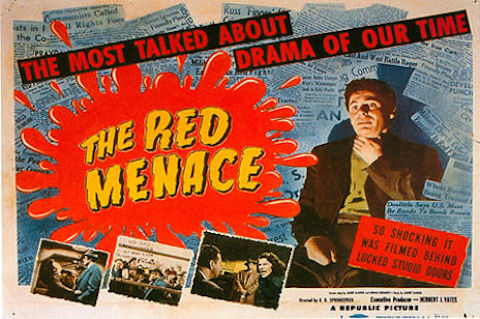
 Albert LeMond, Gerald
Gerharty.
Albert LeMond, Gerald
Gerharty.