Kevin Brianton, Adjunct Senior Research Fellow, La Trobe University
This year’s Scandinavian Film Festival in Australia witnesses the release of two Norwegian historical dramas about the Second World War. The first film is Quisling: The Final Days, directed by Erik Poppe, a psychological study of Nazi collaborator Vidkun Quisling’s final days and execution. The second is Number 24, directed by John Andreas Andersen, based on the real-life story of World War II resistance fighter Gunnar Sønsteby.

Poppe’s film, which had the Norwegian title of Quislings Siste Dager, adopts an uncompromising approach to historical drama, confining itself almost entirely to Quisling’s prison cell during his 1945 trial and execution. The director uses many visual metaphors of confinement, such as bars, shadows, and tight compositions. His claustrophobic character study of Quisling examines the psychological collapse of infamous collaborator Vidkun Quisling, whose surname is now a byword for traitor. Quisling’s psychological intensity comes from psychosis, which we see through his pastor, Peder Olsen, who is played by the understated Anders Danielsen Lei.

The film has one central predecessor in Downfall (2004), famous for its mesmerising central performance of Bruno Ganz as Adolf Hitler as the Third Reich begins to disintegrate. In both Downfall and Quisling: The Final Days, directors Oliver Hirschbiegel and Erik Poppe explore the psychology of fascist collaborators in their final moments. Both films employ claustrophobic storytelling to explore how authoritarian figures confront impending defeat, not with remorse, but with escalating denial.
In the German film, the physical structure of Hitler’s world is under assault from Russian artillery as he disintegrates. Downfall depicts Hitler’s last days in the Führerbunker, and during the film, Bruno Ganz’s portrayal reveals a tyrant oscillating between rage and delusion. Downfall shows the Nazi regime’s apocalyptic end through multiple perspectives, while Quisling sets apart its subject, making his isolation a metaphor for moral bankruptcy. Similarly, Quisling traps its protagonist in a prison cell. We, basically, only see Quisling through the eyes of his reluctant pastor, Peder Olsen. Yet the differences between the films are revealing. In a similar mould to Ganz, Gard B. Eidsvold produces a serpentine Quisling convinced of his noble actions, despite all evidence to the contrary. He is even escorted to the graves of those whom the Nazi regime slaughtered and remains unmoved. Eidsvold’s performance reveals a deeply deluded bureaucrat clinging to his self-image as Norway’s misunderstood saviour. The film’s power does not grant Quisling either redemption or even a dramatic breakdown – he meets his fate still mired in denial. “I am innocent,” he shouts to his executioners. Quisling almost personifies Hannah Arendt’s concept of the “banality of evil.” A mediocre and limited man at best, entirely out of his depth.
As a result, they illuminate fascism’s twin pathologies of megalomania and bureaucratic cowardice. The films illustrate how corrupting systems can influence individuals – and how those individuals, when cornered, often choose self-delusion over reckoning. Both films reject redemption arcs, instead showing how ideology distorts reality until death. Stylistically, the films share a commitment to psychological realism over spectacle. Downfall’s bunker and Quisling’s prison cell become microcosms of collapsing worlds, with tight framing emphasizing entrapment.
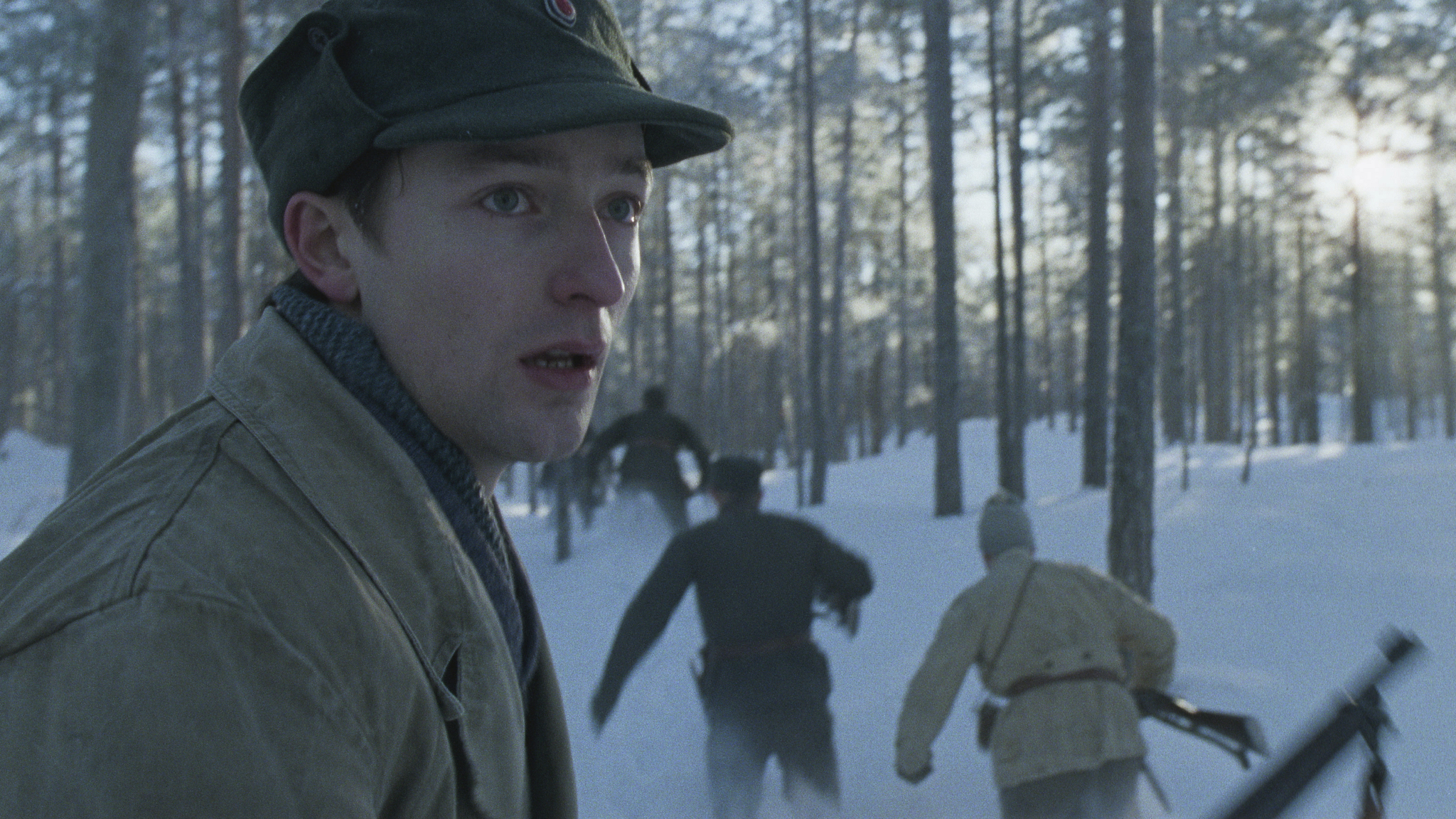
In sharp contrast, Andersen’s resistance drama Number 24 celebrates the calculated heroism of saboteur Gunnar Sønsteby, who is played by Sjur Vatne Brean. The young Sønsteby is clear-headed, cold-hearted, and ruthlessly efficient. His meticulous planning and extraordinary personal self-control make him an ideal conduit for the English to provide money, weapons, and targets to the resistance.
Andersen structures his resistance drama around an elderly Sønsteby, played by Erik Hivju, who recounts his wartime experiences to students. This framing device creates increasing tension between past heroics and present trauma, as the aging saboteur visibly struggles with what he calls “the fifth drawer in his mind,” where memories are locked away. The dynamic shifts between past and present, alternating between exciting sabotage scenes and painful current reflections on the morality of resistance violence.
Sønsteby’s strict self-control is an essential survival tactic, but even his remarkable resilience is tested when a young student confronts him about wartime executions of Norwegian collaborators. The film begins with friends skiing and debating book burning. It ends by focusing on a letter, which is now in a museum, to the German authorities by one of the friends denouncing the other. The letter leads to the writer’s execution.

It has many links to Melville’s Army of Shadows (1969), as both films strip resistance movements of Hollywood heroism, revealing the psychological toll of clandestine warfare. Melville filmed the resistance in a similar vein to gangster noir: with shadowy safe houses, trench coats, and agonizing silences. Andersen, by contrast, cuts between Sønsteby’s sabotage missions and his elderly self’s post-traumatic stress disorder. Both films explore the problematic issue of executing traitors within the resistance. In both films, executing a traitor is portrayed as a necessary action, even if the person is a friend or someone admired. Number 24 questions this approach when students challenge Sønsteby’s assassinations with alternatives such as non-violent approaches. His response was “Gandhi didn’t face the Nazis,” but the framing device makes the audience question his answer, even though the student’s question seems almost naively simple.
Both films critique national myths: Melville’s Army of Shadows is a chain of betrayals, and its “heroes” are all doomed by the war’s end. Andersen’s Sønsteby is not doomed and is celebrated as a national hero, but the film lingers on his trauma—his “fifth drawer” of memories suggesting heroism and suffering are inseparable. Quisling and Number 24 arrive in an era eager to interrogate historical narratives. Together, they prove that the truest war films aren’t about glory—they’re about what it costs to survive. Melville’s film is a eulogy for the resistance, while Andersen’s is a dialogue between past and present, but both refuse to romanticize war.
Released together at the Scandinavian Film Festival in Australia, these films offer Norwegian cinema’s most nuanced reckoning about the Second World War in years. Quisling forces viewers to sit with a collaborator’s uncomfortable humanity, while Number 24 complicates noble resistance heroism with psychological scars. Where Poppe shows evil as mundane, Andersen reveals heroism as traumatic.
As Europe faces new threats to democracy, these Norwegian films provide a crucial perspective on collaboration, resistance, and their enduring personal costs. Their contrasting approaches address current concerns about moral compromise during times of crisis. Quisling warns how easily ordinary men justify atrocity, while Number 24 questions what violence freedom requires – and who bears its enduring wounds. Both films ultimately suggest that war’s moral questions are complex, whether examining perpetrators or heroes. These films are examples of powerful historical cinema that engage viewers and challenge them to confront the complexities of the past, rather than providing simple lessons. Both these films form a compelling depiction of Norwegian wartime morality – one exploring the banality of evil through a collaborator’s final days, the other interrogating the costs of righteous violence through a freedom fighter’s memories.



 Cinema history