Coming to a head with HUAC

Dr Kevin Brianton

Senior Lecturer, La Trobe University, Melbourne, Australia
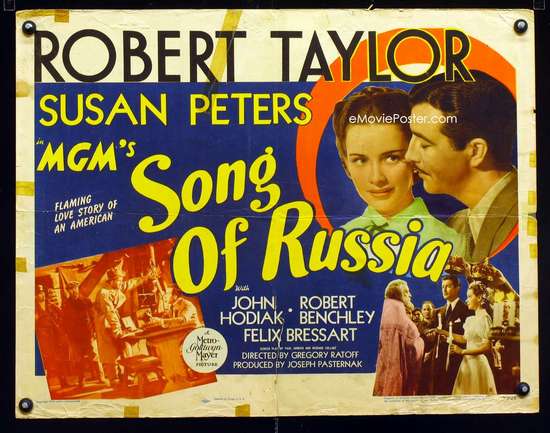
The conservative Ayn Rand viewed Song of Russia for the committee and described at length its inaccuracies, failings and lies.  Her criticism of the film clustered around the depiction of Russian peasant life.
Image courtesy of eMoviePoster.

The MPAPAI’s efforts were reinforced by the studio heads’ desire to crush the studio unions and the obtain political favour with the emerging Republican and McCarthyite forces.  The efforts of the alliance were not wasted.  The conflict between the ultra-conservatives and the radicals came to a head at the HUAC hearings into communist involvement in Hollywood on 20 October 1947.  The Washington-based committee planned to interview both communist and anti-communist witnesses for the next 10 days.

In January 1947, studio head Jack Warner had received a Medal of Merit from the Federal government for his work in government training films, yet in October his studio was being investigated for subversion.[1]  With the Republicans in control of Congress since the 1946 elections, it was clear that the political pendulum was moving toward the right and Hollywood was one of the first targets.  The committee lined up several ultra-conservative leaders in Hollywood to begin the investigation.

HUAC has also subpoenaed 19 Hollywood producers, directors and writers as unfriendly witnesses.  Eleven of these had worked for Warner Brothers, the studio which produced the most wartime propaganda and had aligned itself with the Roosevelt administration.  The studio had also been prominent for its ‘social conscience’ films of the 1930s.[2]  The HUAC investigations had a special reason for singling out the Warner Brothers studio, for its film, Mission to Moscow, as it was based on the work of Davies, a prominent member of the Roosevelt administration.  If they could establish a link between the White House and the production of the pro-Russian pictures of the Second World War, it could cause the Truman administration enormous political damage, the type that was to occur later with the Alger Hiss trial.

Studio head Jack Warner assured the committee that no subversive propaganda had ever made it to the screen, not even in Mission to Moscow.  He was initially forthright in his defence of his studio.  Warner told the committee that if making Mission to Moscow in 1942 was a subversive activity, then so too were ‘the American Liberty ships and naval conveys which carried food and guns to Russian allies’.[3]  Warner defended Mission to Moscow as being necessary because of the danger that Stalin would make a treaty with Hitler if Stalingrad fell.  Such an alliance would lead to the destruction of the world.[4]  The film was designed to cement the friendship between the USSR and the United States in a desperate time.

Following studio heads Jack Warner and Louis B. Mayer came novelist Ayn Rand, who was considered by the committee to be an expert witness on the Soviet Union.  Her expertise was derived from her Russian origins and right-wing views.  Rand viewed Song of Russia for the committee and described at length its inaccuracies, failings and lies.  Her criticism of the film clustered around the depiction of Russian peasant life. She said that at least three and a half million, possibly seven million people, had died from starvation in the drive to collectivization of farms and the film makes no mention of them.[5]  Rand said the depiction of Soviet village life was ridiculous.  Women were dressed in attractive blouses and shoes.  She said if any person had the food shown in the film in the Ukraine, they would have been murdered by starving people attempting to get food.[6]  Rand summed up her position on pro-Russia films like Song of Russia saying it was unnecessary to deceive the American people about the Soviet Union.

Say it is a dictatorship, but we want to be associated with it.  Say it is worth being associated with the devil, as Churchill said, in order to defeat another evil which is Hitler.  There may be a good argument for that.  But why pretend that Russia is not what it was.[7]

The hearings were highly unpopular at this state and the New York Times wrote in an editorial saying that the investigation was unfair and could lead to greater dangers than it was fighting.[8]  In Hollywood, the Committee for the First Amendment was formed by writer Phillip Dunne, directors John Huston and William Wyler and actor Alexander Knox to oppose censorship of films and to prevent a blacklist.[9] 

The group had a massive backing and took out huge advertisements in trade newspapers.  The Committee for the First Amendment wanted the Hollywood 19, as they were known, to take the first amendment, and do nothing else.  Instead, when the unfriendly witnesses were called they tried to answer the committee’s questions in their own way which led to shouting matches in the hearings.  The first unfriendly witness, screenwriter John Howard Lawson, attempted to yell down the committee saying it was on trial before the American people.  When he was finally dragged from the stand, he set a precedent for the remaining witnesses.  Other witnesses were simply asked if they had ever been a member of the Communist Party.  When they failed to answer, they were charged with contempt. 

On the 19 subpoenaed, ten were called before the committee and refused to testify citing constitutional rights of privacy and freedom of political thought and association.  Screenwriter and playwright Bertolt Brecht denied all knowledge of the communist party and later fled the country.  For unknown reasons, Chairman Parnell Thomas cancelled the hearings before the remaining nine were heard.

The Hollywood 10, as they became known, were sent to prison for contempt of congress and the rest were blacklisted from work in Hollywood.[10]  The group, along with most legal experts at the time, believed that their contempt charges would be overturned in the Supreme Court on the constitutional ground of the right to hold private political beliefs.[11]  Unfortunately for the Hollywood 10, two liberal judges died before their cases were heard and they were replaced by conservatives.  The deaths changed the political composition of the Supreme Court which then backed the contempt citations.  This decision by the Supreme Court opened the legal door for the McCarthyite era.  People were now in the position of taking either the fifth amendment protecting them against self incrimination and facing blacklisting and other harassment, or informing on people with communist views.


[1] New York Times, 27 January 1947.

[2] Richard Maltby, ‘Made for Each Other: The Melodrama of Hollywood and the House Committee on Un-American Activities’ in Phillip Davies and Brian Neve, (eds.). Cinema, Politics and Society in America, Manchester University Press, Manchester, 1981, p. 87.

[3] US Congress, House Committee on Un-American Activities, Hearings Regarding the Communist Infiltration of the Motion Picture Industry, 80th Congress, 1st sess., 20 October 1947, vol. 1169 (5) p.10.

[4] ibid., p. 34.

[5] HUAC Hearings, p. 85.

[6] Ibid., p.85.

[7] HUAC Hearings., p.89.

[8] New York Times, 23 October 1947.

[9] The signatories to the Committee for the First Amendment were Larry Adler, Stephen Morehouse Avery, Geraldine Brooks, Roma Burton, Lauren Bacall, Barbara Bentley, Leonardo Bercovici, Leonard Berstein, DeWitt Bodeem, Humphrey Bogart, Ann and Moe Braus, Richard Brooks, Jerome Chodorov, Cheryl Crawford, Louis Calhern, Frank Callender, Eddie Canto, McClure Capps, Warren Cowan, Richard Conte, Norman Corwin, Tom Carlyle, Agnes DeMille, Delmar Davesm Donald Davies, Spencer Davies, Donald Davis, Armand Deutsch, Walter Doniger, I.A.L. Diamond., L. Diamond, Muni Diamond, Kirk Douglas, Jay Dratler, Phillip Dunne, Howard Duff, Paul Draper, Phoebe and Harry Ephron, Julius Epstein, Phillip Epstein, Charles Einfeldm Sylvia Fine, Henry Fonda, Melvin Frank, Irwin Gelsey, Benny Goodman, Ava Gardner, Sheridan Gibney, Paulette Goddard, Michael Gordon, Jay Goldberg, Jesse J. Goldburg, Moss Hart, Rita Hayworth, David Hopkins, Katherine Hepburn, Paul Heinreid, Van Heflin, John Huston, John Houseman, Marsha Hunt, Joseph Hoffman, Uta Hagen, Robert L. Joseph, George Kaufman, Norman Krasna, Herbert Kline, Michael Kraike, Isobel Katleman, Arthur Lubin, Mary Loss, Myrna Loy, Burgess Meredith, Richard Maibaum, David Millerm Frank L. Moss, Margo, Dorothy McGuire, Ivan Moffat, Joseph Mischel, Dorothy Matthews, Lorie Niblio, N. Richard Nash, Doris Nolan, George Oppenheimer, Ernest Pascal, Vincent Price, Norman Panama, Marion Parsonnet, frank Partos, Jean Porter, John Paxton, Bob Presnell Jr., Gregory Peck, Harold Rome, Gladys Robinson, Francis Rosenwald, Irving Rubine, Irving Reis, Stanley Hubin, Slyvai Richards, Henry C. Rogers, Lyle Rooks, Norman and Betsy Rose, Robert Ryan, Irwin Shaw, Richard Sale, George Seaton, John Stone, Allan Scott, Barry Sullivan, Shepperd Sturdwick, Mrs Leo Spitz, Theodore Strauss, John and Mari Shelton, Robert Shapiro, Joseph Than, Leo Townsend, Don Victor, Bernard Vorhaus, Billy Wilder, Bill Watters, Jerry Wald and Cornel Wilde. Myron C. Fagan Documentation of Red Stars in Hollywood printed in Gerald Mast The Movies in Our Midst: Documents in the Cultural History of film in America, 2nd edn., Oxford University Press, New York, 1979, p. 549.

[10] The Hollywood Ten were screenwriters John Howard Lawson, Alvah Bessie, Dalton Trumbo, Lester Cole, Albert Maltz, Samuel Ornitz, Ring Lardner Jr; the writer-producer Herbert Biberman; the writer-producer Adrian Scott; and the director Edward Dymytryk.

[11] Hollywood on Trial, (d) David Helpern Jr, (w) Annie Resman.

For Whom the Bells Tolls (1942)

Kevin Brianton

Senior Lecturer, La Trobe University


For Whom the Bells Tolls (1942) enraged the book’s author Hemingway so much that he threatened to give a press conference to denounce the film
Image courtesy of eMoviePoster.

When the HUAC hearings began on 20 October 1947, the conservative director Sam Wood, who was president of the MPAPAI. Wood argued: “There is a constant effort to get control of the Guild. In fact, there is an effort to get control of all unions and guilds in Hollywood. I think our most serious time was when George Stevens was president; he went in the service and another gentleman took his place, who died, and it was turned over to John Cromwell. Cromwell, with the assistance of three or four others, tried hard to steer us into the Red river, but we had a little too much weight for that.” Sam Wood had a gentle-looking face that belied an almost obsessive anti-Communism: he made his children swear anti-Communist affidavits or face being disinherited. He had started his career as an assistant to Cecil B. DeMille in 1915, and these long-time colleagues were now strong anti-Communist allies. Wood had become a respected filmmaker in his own right, directing films such as A Night at the Opera (1935) and Goodbye, Mr. Chips (1939). His failure to win an Academy Award for his often highly successful films fostered enormous personal spite toward liberals whom he felt were out to discredit him. His strident anti-Communism is thought to have contributed to his death by a heart attack in 1949. Wood and other friendly witnesses had one clear message: Communists were present in Hollywood and were working day and night to wrest control of the industry. When he came to direct a film touching on communism, his political views were on display. For Whom the Bells Tolls (1942) was one film which went against the trend of flattering the communists during the Second World War.  The film was an adaption of Hemingway’s novel about an American who joined partisan fighters in the Spanish Civil War.  Conservative director Sam Wood and Paramount studios changed the word fascist to nationalist throughout the script.  Wood’s one concession to the political situation was a short speech by Gary Cooper who said that the Nazis and the Fascists were just ‘much against democracy as they are against the Communists.  The fascists were testing weapons to get a “jump on the democracies”’.[1]

The screen version enraged its author Ernest Hemingway so much that he threatened to give a press conference to denounce the film.[2]  Critic James Agee in his review of the film for The Nation said there had been denials of political interference in the film from the Franco Government, the Catholic Church and the State Department.  Agee saw the film as depicting Spain as a battleground between ‘dirty communists’ and German Nazis. The political slant of the film may have also stemmed from its original ultra-conservative director Cecil B.DeMille who was strongly considering making the film until 1942, when he handed back the rights to Paramount pictures.  He wrote in autobiography that he had screenwriter Jeanie MacPherson work on the project for six and a half months.  [3]

The Office War Information reviewer said it would hinder the war effort as it showed chinks in the alliance through its depiction of splits within the loyalist camp.[4]  The film was the first cinematic hint that the conservatives in Hollywood were not happy with the depiction of Russia in wartime cinema.

Sam Wood gave full vent to those conservative opinions through the Motion Picture Alliance for the Preservation of American Ideals (MAPAI) two years later, of which he was the founding President.  The alliance declared war against Hollywood’s radicals when it stated its principles in 1944.  The group claimed that it was in sharp revolt against the rising tide of ‘communism, fascism and kindred beliefs’.  It resented the takeover of Hollywood by ‘communists, radicals and crack-pots’.  The group demanded that communists and other extremists be removed from the film industry because they were perverting the screen with un-American ideas and beliefs.  It pledged to fight with every possible resource any attempt to ‘divert the screen from the free America which gave it birth. The MPAPAI members were Walt Disney, Cedric Gibbons, Norman Taurog, Louis D. Lighton, Clarence Brown, George Bruce, James K. McGuiness, Borden Chase, Victor Fleming, Arnold Gillespsie, Frank Gruber, Bert Kalmar, Rupert Hughes, Frank Nible Jr., Cliff Reid, Casey Robinson, Howard Emmett Rogers, Harry Ruskin, Morrie Ryskind, King Vidor, Robert Vogel and George Waggner. [5]  The alliance followed up the declaration with a lobbying campaign in Washington which rekindled Martin Dies; enthusiasm for an investigation of Hollywood for communist subversion.

The MPAPAI’s efforts were reinforced by the studio heads’ desire to crush the studio unions and the obtain political favour with the emerging Republican and McCarthyite forces.  The efforts of the alliance were not wasted.  The conflict between the ultra-conservatives and the radicals came to a head at the HUAC hearings into communist involvement in Hollywood on 20 October 1947.  The Washington-based committee planned to interview both communist and anti-communist witnesses for the next 10 days.


[1] For Whom the Bell Tolls, (d) Sam Wood, (w) Dudley Nichols, quoted by James Agee in The Nation, 24 July 1943, in James Agee, Agee on Film, Grosset & Dunlop, New York, 1969, pp. 46 – 49.

[2] Ian Hamilton, Writers in Hollywood 1915 – 1951, William Heinemann, London, 1990, p. 179.

[3] Agee, pp. 46 – 49.  See Donald Hayne (ed.) The Autobiography of Cecil B. DeMille, W.H. Allen, London, 1960, pp. 344 – 345.  The remaining synopses are in Box 1038, Folder 1, Cecil B. DeMille Archive, Brigham Young University, Provo, Utah, USA.

[4] Clayton R. Koppes and Gregory Black, Hollywood Goes to War: How Politics, Profits and Propaganda Shaped World War II Movies, Free Press, New York, 1987, p. 71.  According to Variety, 3 January 1944, it was also the most popular film of 1943.

[5] A copy of the statement of principles is printed in Nancy Lynn Schwartz, The Hollywood Writer’s Wars, Knopf, New York 1982, p. 206. 

Mission to Moscow: Hollywood goes Stalinist

Kevin Brianton

Senior Lecturer, La Trobe University


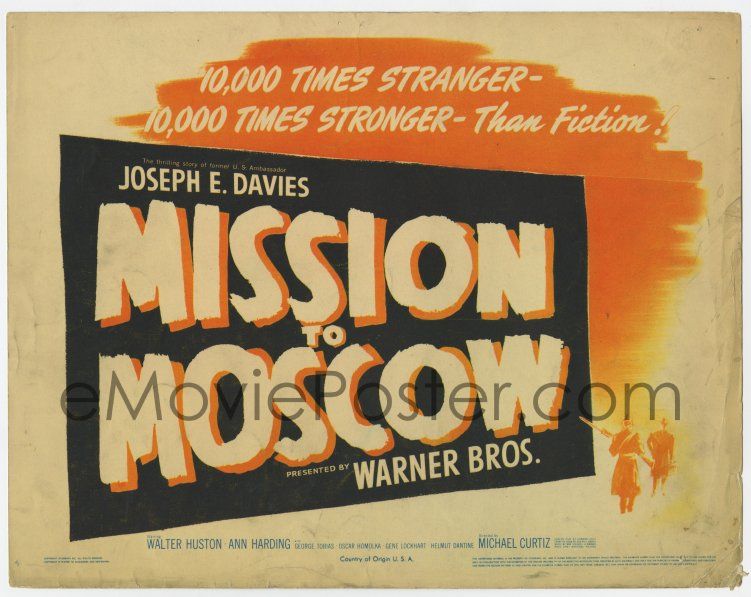
Mission to Moscow glorified Stalin at a time when the United States desperately wanted to maintain the alliance with the Soviet Union. It was despised by J. Edgar Hoover.
Image courtesy of eMoviePoster.

While popular films showed there was deeply felt anti-communism in the United States in the 1930s , there was no expressed desire to lurch to fascism.  Perhaps the sentiments of the American people were best summed up in the popular Frank Capra film You Can’t Take It With You which was released in 1938.  In the film, a fatherly figure commented on the latest developments in politics.

Communism fascism, voodooism … Everybody got isms these days… When things go badly, you go and get yourself an ism… Nowadays they say, ‘Think the way I do or I’ll bomb the hell out of you.’[1]

When the United States entered the war, Hollywood’s film output changed tack.  Many films were made which praised the effort of the Russian armies.  The scripts for these films were often written by communist or leftist writers such as John Howard Lawson, Lillian Hellman, Howard Koch or Paul Jarrico.  These films were filled with praise for the heroic efforts of the Soviet army and people.  The presence of left leaning and communist writers involved in pro-Russian footage, in American cinema was to provide the fuel for the conspiracy theorists of the right after the cold war had set in.

The most controversial of these films was Mission to Moscow (1943) which was based on the autobiography of the United States Ambassador to the Soviet Union Joseph E. Davies.  The film glorified Stalin at a time when the United States desperately wanted to maintain the alliance with the Soviet Union.[2]  The film glossed over Stalin’s disastrous collectivization of peasants and it also accepted the Stalinist line on the show trials of the 1930s.  Adjusting and simplifying history was a time-honored Hollywood tradition, but Mission presented a gross distortion.[3]  As film historian David Culbert has observed the Soviet purge trials asked people to believe that the Soviet equivalents of the American Secretary of State, the Secretary of Defense, the Chief Justice of the Supreme Court, and chairman of the Joint Chiefs of Staff had all plotted against their country.[4]  Mission to Moscow showed only one trial, that of Nikolai Bukharin, who was a strong ally of Lenin in the Russian revolution and supported Stalin against Trotsky after Lenin’s death.  He broke with Stalin after opposing the collectivization of the Kulaks and attempted to overthrow Stalin through the Central Committee of the Party.  In March 1938, Bukharin was put on trial in Moscow with other prominent Bolsheviks and subsequently shot.[5]

All of Hollywood’s skills were needed to sell the message of a benign Russia to the American public.  Warner Bothers allocated the top talents of director Michael Curtiz and screenwriter Howard Koch, who were riding high on their success of Casablanca.  In the trial scene, Nikolai Bukharin made his final speech at his trial in Mission to Moscow where he admitted collusion with the fascists:

CLOSE SHOT BUKHARIN
  As he speaks to the courtroom with deep feeling and sincerity.
BUKHARIN:  
For three months I refused to testify – then I decided to tell everything.  Why?  Because while in prison I made an entire re-evaluation of my past.  For when you ask yourself, ‘If you must die, what are you dying for?’ an absolutely black vacuity rises before you with startling vividness… My hope is that this trial may be the last severe lesion in proving to the world the growing menace of Fascist aggression and the awareness and united strength of Russia.  It is in the consciousness of this that I await the verdict.  What matters is not the personal feelings of a repentant enemy, but the welfare and progress of our country.[6]

Film producer Robert Bruker later claimed that he wanted some ambiguity in the trial scenes but Davies insisted that the accused be depicted as guilty traitors and Trotskyists.[7]  Davies’ own book contains some concerns about the trials which the film entirely lacked. 

Off the record, one is admitted, to wit: that the occasion was dramatized for propaganda purposes.  It was designed: first, as a warning to all existing and potential plotters and conspirators within the Soviet Union; second, to discredit Trotsky abroad; and third, to solidify popular national feeling in support of the government against foreign enemies Germany and Japan.  During the trial every means of propaganda was employed to carry to all parts of the country the horrors of these confessions.[8]

Davies’ more balanced assessment was disregarded during the film.  Extremely wild assertions were made about the role of Stalin’s exiled rival Leon Trotsky who was linked to both Hirohito and Hitler in their plans to invade Russia.  Immediately after the scene with Bukharin, the action crossed to the German embassy in Oslo where Leon Trotsky was plotting with German Minister of Norway.  The Nazis abandoned Trotsky because of the bungling of his plot against Russia.  The film managed to turn one of the fiercest and most persistent critics of fascism, Leon Trotsky, into a Nazi pawn.  But the scene had actually been toned down from an earlier version of the script by novelist Erskine Caldwell where after the trials of Bukharin, Hitler met with Trotsky.

HITLER:         We are not ready for this turn of affairs.  You have completely bungled the work you were supposedly directing with judicious ability.  That forces us to withdraw our hand completely for the minute.  That means Russia will be able to buildup its army and augment its supplies of war materials.  You are trying to force us to act in Russia before we are ready!

TROTSKY:      No, no, Herr Hitler.  This is all an unfortunate accident.  You know I am in perfect accord with your plans.[9]

The Office of War Information was ecstatic in its praise of the film.  They described it as a ‘magnificent contribution to the Government’s motion picture program as a means of communicating historical and political material in a dramatic way.’  It said that the presentation of the Moscow trials was a high point and:

Should bring understanding of Soviet international policy in the past years and dispel the fears which many honest persons have felt with regard to our alliance with Russia.  The clarity and conviction with which this difficult material is presented is a remarkable achievement for the screen and should do much to lay the ‘ghosts of fascist propaganda’ which still haunt us and delay the forgoing of that international unity which is essential to the winning of the war and the peace.[10]

The OWI said the film would help create a friendly relationship between the Soviet Union and the United States.  The Office gave the film immediate release for domestic and international markets.

The film was disturbing because it was not only historical drivel but contradicted Davies’ own reports form the time as well as his own book.  At the time, he described the trials with terms like ‘horror’ and ‘terror’ and it was clear that he had not been hoodwinked.[11]  Davies was not a fool and had previously had a career as a Wisconsin lawyer who had made his fortune representing Standard Oil.  Yet when he introduced the film, he must have been aware of the misrepresentations, and distortions contained within it.  Davies even had the nerve to call upon his ‘sainted mother as an ordained minister of the gospel’[12] to add weight to his claims that it was historical truth.  He also claimed that:

No leaders of a nation have been so misrepresented and misunderstood as those in the soviet government during those critical years between the two world wars.  I hope that my book will help correct that misunderstanding in presenting Russia and its people in their gallant struggle to preserve the peace until ruthless aggression made war inevitable.[13]

Davies accepted the distortions of his own book and had a fair amount of say in the production of the film.[14]  Screenwriter Howard Koch later wrote that Davies was annoyed by the fact that actor Walter Huston did not look like him.  He told this to director Michael Curtiz who replied that Roosevelt, Kalinin, Churchill and Litinov were famous men while Davies was not.  After a stony silence, Davies told Curtiz that he was well known, with thousands of friends.  To cool down the situation, Davies was permitted to personally introduce the film.[15]  The incident showed that Davies had a fair amount of his own self-image tied up in the film and wanted it to depict film as a hero mixing with the ‘Great Men’ of the day.

United States diplomats were embarrassed by the film when it was shown to Stalin and other Soviet officials on 24 May 1943.  Ambassador William Standley reported to the Secretary of State that Stalin had sat silently through its presentation and grunted once or twice.  He wrote that the glaring historical discrepancies provoked resentment from the Soviet officials and that its depiction of the 1930s trials meant that it would not be released in the USSR.  He felt that the film would not contribute to a better understanding between the countries.[16]  Davies, by contrast, thought that the picture was well received by both Stalin and Molotov.[17]

When it was released in the United States, the film was heavily criticised in many quarters.  In a massive letter, published on the editorial page of the New York Times professor John Dewey from Columbia University, who headed a commission into the Russian trials of the 1930s, wrote that Mission to Moscow was the first instance of ‘totalitarian propaganda for mass consumption’ in the United States.  Dewey described the film as propaganda which falsified history through distortion, omission or pure invention of fact.[18]  He claimed that the film falsified not only the trials, but Davies’ own reports to the State Department and his comments in letters of the time.[19]

A small group of academics and writers also condemned the picture.[20]  The group argued that the film falsified history, distorted Davies’ own book, glorified Stalin’s dictatorship and had serious implications for American democracy.  The group said that:

(Mission to Moscow) corresponds in every detail with what the Kremlin would like the American people to think about its domestic and foreign policies.  It denounces British appeasement of Hitler, but the appeasement of the Stalin-Hitler pact is glossed over as… realism!  It shows half the map of Poland in flames when Hitler attacks but the other half, invaded by the Red Army appears unaffected.  The invasion of Finland is presented as anti-fascist action.[21]

Many film critics were even less impressed.  Writing for Nation, influential critic James Agee said the film was almost ‘the first Soviet production to come from a major American studio.’  He described the film as a:

Mishmash; of Stalinism with New Dealism with Hollywoodism with journalism with opportunism with shaky experimentalism with mesmerism with onanism, all mosaicked into a remarkable portrait of what the makers of the film think the American public think the Soviet Union is like – a great glad two-million bowl of canned borscht, eminently approved by the Institute of Good Housekeeping.[22]

While the film was made to simply serve the war needs of the United States in 1943, it did raise some disturbing questions about the propaganda of the Second World War.  Many people colored their world view by what they saw on the screen and Hollywood had to at least take some critical distance.  The film recorded a modest return of $1.2 million in rentals according to Variety.  This was much lower than other pro-Russian films such as Action in the North Atlantic which made $2.6 million and North Star which made $2.8 million in the same year.[23]

The FBI director J Edgar Hoover was deeply concerned about communism, but felt constrained during the war, as the Soviet Union was an ally against Germany and later against Japan. The release of Mission to Moscow, with its pro-Stalin message,caused uproar, with the Republicans attacking the film industry for doing the bidding of the Roosevelt administration.[24] The FBI reacted to the release of the film by beginning a comprehensive surveillance of the film industry, ranging from scrutiny of industrial issues, the political activities of directors, actor and writers, through to the content of films.  At one point in 1944, Hoover demanded a report by the 15th of each month on the infiltration of Hollywood by communist agents and ideas.[25]  


[1] You Can’t Take It With You, (d) Frank Capra, (w) Robert Riskin.

[2] The publication of Mission to Moscow in 1943 became part of an internal wrangle within the State Department between those who were suspicious of Stalin’s motives and those like Davies who felt he could be negotiated with in the post war world.  See Daniel Yergin, Shattered Peace: The Origins of the Cold War and the National Security State, Houghton Mifflin Company, Boston, 1977.

[3] George MacDonald Fraser argues that, as a rule, Hollywood was very accurate in its presentation of the past.  See George MacDonald Fraser, The Hollywood History of the World, Michael Joseph, London, 1988.

[4] David Culbert, Our Awkard Ally: Mission to Moscow printed in O’Connor, John E., Jackson, Martin A. (eds) American History/American Film: Interpreting the American Image, new exp edn, Continuum, New York, 1988, p. 124.

[5] Alan Palmer (ed.), The Penguin Dictionary of Twentieth Century History 1900 – 1978, Penguin, Harmindsworth, 1962, pp. 63 – 64.

[6] David Culbert, (ed.). Mission to Moscow, Wisonsin/Warner Bros Screenplay Series, University of Wisconsin Press, Wisconsin, 1980, pp 159 – 160.

[7] Ibid., p. 253.

[8] Joseph E. Davies, Mission to Moscow, rev edn, Pocket Books, USA, February 1943, p. 37.

[9] Culbert, Mission, p. 237.

[10] Report, Hollywood Office, Bureau of Motion Pictures, Office of War Information, April 29, 1943, Box 1434, Entry 264, Record Group 208, Office of War Information Records, Archives Branch, Washington National Records Center, Suitland, Md in Culbert, Mission, p. 257.

[11] Yergin, Shattered, pp.30 – 32.

[12] Culbert, Mission, p. 225.

[13] Ibid, p. 58.

[14] Culbert, Mission, p. 253.

[15] Howard Koch, As Time Goes By, Harcourt Brace Jovanovich, New York, 1979, pp. 125 – 126.

[16] Telegram form Ambassador William Standley to Secretary of State, May 25, 1943, Box 68, President’s Secretary’s file, Franklin D. Roosevelt Library, Hyde Park, NY. In Culbert, Mission, p. 262.

[17] Letter from Joseph Davies to Harry M. Warner, May 24, 1942, box 13, Joseph E. Davies Papers, Manuscript Division, Library of congress, Washington DC in ibid p. 261.

[18] New York Times, 9 May 1943.  Letter signed by John Dewey and Suzanne La Folette.

[19] Ibid.

[20] Form letter, Dwight MacDonald et al. to ‘Dear Friend,’ May 12, 1943, NAACP MSS, Manuscript division, Library of Congress, Washington DC in Culbert, Mission pp. 257 – 259.

[21] Form letter, op cit, in Culbert, Mission, p. 259.

[22] Nation May 22, 1943 in Agee, Agee on Film, Grosset & Dunlop, New York, 1969, p. 37.

[23] Variety 4 January 1944.

[24] Hollywood Reporter, 15 April 1943. The publication of the book Mission to Moscow in 1943 had become part of an internal wrangle within the State Department between those who were suspicious of Stalin’s motives and those such as the author Soviet Ambassador Joseph E. Davies, who believed the Soviet could take its place in the world community. FBI Director J. Edgar Hoover remained on the side of those who distrusted Stalin and his motives. J Edgar Hoover to SAC Los Angeles – 21 June 1943, Volume 1, COMPIC 100 -138784. For a full account of the politics of Mission to Moscow see David Cuthbert, “Our Awkward Ally: Mission to Moscow,” 1988, printed in John E. O’Connor, and Martin A Jackson, (eds) American History/American Film: Interpreting the American Image, New expanded edition, Continuum, New York, 1988. See Daniel Yergin, Shattered Peace: The Origins of the Cold War and the National Security State, Houghton Mifflin, Boston, 1977.

[25] Variety 4 January 1944. Hollywood Reporter, 15 April 1943. The publication of the book Mission to Moscow in 1943 had become part of an internal wrangle within the State Department between those who were suspicious of Stalin’s motives and those such as the author Soviet Ambassador Joseph E. Davies, who believed the Soviet could take its place in the world community. FBI Director J. Edgar Hoover remained on the side of those who distrusted Stalin and his motives. J Edgar Hoover to SAC Los Angeles – 21 June 1943, Volume 1, COMPIC 100 -138784. For a full account of the politics of Mission to Moscow see David Cuthbert, “Our Awkward Ally: Mission to Moscow,” 1988, printed in John E. O’Connor, and Martin A Jackson, (eds) American History/American Film: Interpreting the American Image, New expanded edition, Continuum, New York, 1988. See Daniel Yergin, Shattered Peace: The Origins of the Cold War and the National Security State, Houghton Mifflin, Boston, 1977. FBI report, 29 April 1944, COMPIC – PSM.

Ninotchka – kidding the commissars

Kevin Brianton,

Senior Lecturer, La Trobe University


A small cycle of films with anti-communist themes began with the most famous and popular of these films being Ninotchka, which was made in 1939.
Image courtesy of eMoviePoster.

Against the background of the Stalinist show trials and the Nazi-Soviet pact, there were strong anti-communist and anti-Russian sympathies in the United States.  A small cycle of films with anti-communist themes began with the most famous and popular of these films being Ninotchka, which was made in 1939.  Communist emissary Ninotchka was given some vicious lines by screenwriters Charles Brackett, Billy Wilder and Walter Reisch.  She spoke of the recent show trials in Russia.  ‘The last mass trials were a great success.  There are going to be fewer but better Russians’.[1]  Played by Greta Garbo, Ninotchka was a humorless Soviet emissary sent to Paris to check up on three bungling bureaucrats who were doing little to negotiate the return of the Russian Royal jewelry.  She found the bureaucrats were enjoying the high life and she fell for the charms of the American Melvyn Douglas.  After returning to Russia, she found that her mail was censored, and she was unhappy with the communist system.  She was later sent to Constantinople where she was reunited with Douglas and true love triumphed.

The depiction of Russian life in Ninotchka was hard and bitter.  In her small room, she talked to her friend Anna:

ANNA: Are you expecting someone?
NINOTCHKA: A few friends … just a little dinner party.
ANNA: What are you serving?
NINOTCHKA: An omelet.
ANNA (puzzled): An omelet!  Aren’t you living a little above your ration?
NINOTCHKA: Well, I have saved up two eggs and each of my friends is bringing his own so we’ll manage.
ANNA: It just goes to prove the theory of our State.  If you stand alone it means a boiled egg but if you’re true to the collective spirit and stick together you’ve got an omelet.  (Devilishly) That reminds me … have you heard that latest they’re telling about the Kremlin?
  At this moment a door to one of the adjourning rooms opens and GURGANOV, a middle-aged man with sour stool pigeon expression, walks quietly through the room to another door, talking in the girls with one sly glance and giving the impression that not only his eyes but ears are open.  ANNA breaks off her remark.
ANNA (whispering): I’ll tell you later.  (after GURGANOV has disappeared into the other room she continues)  That Gurganov, you never know whether he is on his way to the washroom or the Secret Police.[2]

Ninotchka was a gentle satire on the Russians and it was clear that they were not regarded as a serious threat.The cinema of the period reflected a society which was anti-communist but did not regard communism as more than a remote foreign tyranny.  Ninotchka kicked off a minor cycle of anti-communist films which included He Stayed For Breakfast (1940), Comrade X (1940), and Public Deb Number One (1940).  In Comrade X, directed by conservative King Vidor, a communist woman was forced to flee from Russia because she was too idealistic for the Stalinist powers.  The power game within the Russian administration was one police chief knocking off another police chief.  The Russians were depicted as nothing more than bumbling fools.  When Hollywood again targeted the Russians in the late 40s, the films would tell a far different story. When Studio head Louis B. Mayer was interviewed by HUAC, he used Ninotchka as an example of the fine anti-communist cinema produced by his studio.  He claimed that the film greatly annoyed communists by kidding them.


[1] Charles Brackett, Billy Wilder and Walter Reisch, Ninotchka, The MGM Library of Film Scripts, Viking, New York, 1972, p.24.

[2] Brackett, Ninotchka, p. 98.

Sergeant York and the ire of the isolationists

Kevin Brianton

Senior Lecturer, La Trobe University


Sergeant York (1941) was the film which finally raised the ire of the isolationists in Washington.
Image courtesy of eMoviePoster.

The 1930s were not an easy time for political players in the left or right. While Roosevelt remained a popular President, the economic carnage of the depression meant that political certainties began to fade. During the 1930s, both liberal and conservative political certainties started to crumble in the face of the Great Depression and the rise of fascism. Communism seemed to offer a solution to many.The tone of films such as Gabriel Over the White House (1933) often verges on the hysterical. There was a faint desperation in the political solutions offered by both the left and the right, verging on despair. A political consensus did emerge in the United States after Pearl Harbor, when it was shaken out of its isolationist stupor and became a reluctant ally of the Soviet Union to fight Nazi Germany. While Fascism appeared rampant in Europe, American cinema was mute on the topic.

The political censorship of the production code meant for a long time almost no anti Nazi or fascist films were made in Hollywood during the 1930s. While fascism rose in Europe, isolationism was a strong and formidable force in the United States. The possibility of a war in Europe or Asia, redoubled the efforts of isolationists to stay out of the war. The isolationists were particularly strong in the Republican Party, which constantly goaded the Roosevelt administration that it was seeking an unnecessary war. The isolationists also had considerable support across the Untied States.

Sergeant York (1941) was the film which finally raised the ire of the isolationists in Washington. It was based on the life of First World War hero Alvin York and was launched with an amazing amount of fanfare, even by Hollywood standards.  The Astor theatre in New York was decorated with 15,000 flashing red, white and blue lights.  York was marched down Broadway with an escort of First World War soldiers to a premiere attended by Roosevelt, General John ‘Black Jack’ Pershing and other dignitaries.  Roosevelt enjoyed the film and welcomed Alvin York to the White House following the screening.  The army used the occasion to give out recruiting material.[1]

The film followed the transformation of a devout Christian pacifist in to a war hero.  York represented the dilemma of America in many ways.  It was a nation which clearly did not want to fight in Europe, but in the end, found it had to do so.  In a key scene, York wrestled with his conscience over the commandment “Thou shalt not kill.’  After failing to register as a conscientious objector, he went to boot camp where he was recognised as a crack shot.  After spending a day and a night debating the conflicting demands of country and God, he read the verse form the Bible about rendering unto Caesar what belongs to Caesar and decided to travel to France.[2]  The film was one of the most popular of the year.[3]

The success of this and other pro-interventionist films, finally sparked the isolationists into action.  On 1 August 1941 Senator Gerald Nye attacked Hollywood for plunging America into war fever.

When you go the movies, you go there to be entertained…And then the picture starts – goes to work on you, all done by trained actors, full of drama cunningly devised…Before you know where you are you have actually listened to a speech designed to make you believe that Hitler is going to get you.[4]

Nye reasoned that the Roosevelt administration wanted to glorify war and British actors and directors wanted to lure America into the war.  With Europe dominated by the Nazis, the major diplomatic issue of the time was whether America should intervene in the European war.  Roosevelt had committed America to the Lend Lease program and the isolationists feared that it would slowly drag the United States into the war.  Time pointed out the Senate investigative committee was ‘stuffed with die-hard isolationists.’  The committee was not even established by any Senatorial vote.[5]

If the isolationists had proven their case, it would have meant the introduction of federal legislation to control Hollywood’s film content.  The industry responded with a forthright defense headed by the former Republican party presidential aspirant Wendell Willkie who fired off a press release where he denounced Nye as un-American and questioned the legality of the hearings.  The committee demanded that Hollywood product films showing both sides of the dispute and Willkie responded:

This, I presume, means that since Chaplin made a laughable caricature of Hitler, the industry should be forced to employ Charles Laughton to do the same on Winston Churchill … the motion picture industry and its executives are opposed to the Hitler regime … we make no pretence of friendliness to Nazi Germany.[6]

Warner bothers studio head Harry Warner was even more blunt.  Sergeant York was: ‘a factual portrayal of one of the great heroes of the last war … If that is propaganda, we plead guilty.’[7]

A remarkable contrast exists between the Senate investigation of 1941 and the HUAC investigations six years later.  The Hollywood industry was vigorous in its defense.  Accusations were not taken lying down and were thrown back at the committee.  Under pressure, the committee bungled by not being thoroughly prepared for the investigation.  While facing tight questioning from Senator Ernest McFarland, Nye admitted that he had not seen some of the films.  Nye also confused the plots and titles of films and could only make weak attacks on the films he could remember.[8]  The hearings became a disaster for the isolationists who were forced to abandon the whole issue after Japan bombed Pearl Harbour on 8 December.


[1] Koppes, Hollywood, pp. 38 – 39.

[2] Ibid. p. 38.

[3] Steinberg, Reel Facts, Vintage, New York, 1982, p. 18.

[4] Gerald Nye, ‘War Propaganda’, Vital Speeches, 15 September 1941, p. 720 quoted in Koppes, p. 40.

[5] Time, 22 September 1941.

[6] Time, 22 September 1941.

[7] Koppes, Hollywood, p. 44.

[8] Koppes, Hollywood, p.45.

Before HUAC came to Hollywood

Kevin Brianton

Senior Lecturer, La Trobe University

Ever since director D. W. Griffith had created “history written with lightning” with his film The Birth of a Nation in 1915, the film industry had to deal with an anxious political leadership in Washington. The way Hollywood could present and deliver ideas was always a source of concern for the political leadership and communism was always a particular focus. According to director William DeMille, he was interviewed by federal agents as early as 1922, after he was invited to attend a lunch with communist leader William Z. Foster at the house of the actor Charles Chaplin. His brother Cecil was able to support his political innocence.

Ever since director D. W. Griffith had created “history written with lightning” with his film The Birth of a Nation in 1915, the film industry had to deal with an anxious political leadership in Washington.
Image courtesy of eMoviePoster

The House Committee on Un-American Activities[1] investigation in Hollywood in 1947 was certainly not the first time that conservative political forces had intervened in the film industry.  Hollywood had resisted many attempts from Federal and State bodies for censorship on scenes with sex and violence since the 1920s.  A HUAC investigation in 1938 was the first visible sign, however, that the conservatives wanted to influence the political content of Hollywood’s films.  Committee chairman Texan Democrat Martin Dies and his political allies were alarmed by the development of the Anti-Nazi League in Hollywood which they considered to be a communist front.[2]  Using the testimony of former communist J.B. Matthews, Dies made the ridiculous mistake of accusing child actress Shirley Temple, who was about 10 years old, and other actors’ of serving the communist cause’ because of a message in a French radical newspaper.  His opponents pounced on this and his investigation became a laughing stock.

FBI and HUAC historian Kenneth O’Reilly notes that the Dies Committee reports were only a “supplement” to the Bureau’s own operations. While the FBI did not support the Dies Committee, it had access to and used its extensive reports. FBI director J. Edgar Hoover believed that communists were prevalent throughout the film industry. A report to him said that the communist leadership had “thrown caution to the wind” in its efforts to gain control of the film industry and its intellectual leadership was now visible as a result.The release of Mission to Moscow in 1943, with its pro-Stalin message,confirmed these views and caused an uproar, with the Republicans attacking the film industry for doing the bidding of the Roosevelt administration. The FBI reacted to the release of the film by beginning a comprehensive surveillance of the film industry, ranging from scrutiny of industrial issues and the political activities of directors, actors and writers, through to the content of films. At one point in 1944, Hoover demanded a report by the fifteenth of each month on the infiltration of Hollywood by communist agents and ideas. This grew into a large body of information tracking the activity of real and suspected communists. [3]


The release of Mission to Moscow in 1943, with its pro-Stalin message, confirmed the conservative view that Hollywood – and by extension – was pro-communist and caused an uproar, with the Republicans attacking the film industry for doing the bidding of the Roosevelt administration. The publication of the book Mission to Moscow in 1943 had become part of an internal wrangle within the State Department between those who were suspicious of Stalin’s motives and those such as the author Soviet Ambassador Joseph E. Davies, who believed the Soviet Union could take its place in the world community. FBI Director J. Edgar Hoover remained on the side of those who distrusted Stalin and his motives. He regarded the film Mission to Moscow as evidence of communist infiltration of Hollywood.
Image courtesy of eMoviePoster .

After Dies’ floundering attack on Hollywood, he turned his attention to other areas.  The Federal Theatre Project has been a staging ground for many radical and liberal plays and was regarded with contempt by the conservatives.  The committee managed to get funding withdrawn.  Despite having no immediate impact, the Dies committee showed a path for the HUAC investigations of later years.  Massive publicity could be generate by an investigation of Hollywood and the committee helped originate the smear tactics that were to succeed so well after the war.[4]

The political content of films did not worry conservatives in the period leading up to 1938.  The work of the Hays Office and the Production Code Administration had ensured that Hollywood would steer clear to dealing directly with political and social issues.[5] 
The Hays Office had been set up in 1922 to self-regulate the industry and to mollify numerous state censorship boards which were slashing films across the country.  The office had initially little impact because it could only advise.  In 1930, after public criticism and threats of federal intervention, the industry introduced a production code with a detailed list of prohibited areas.  The Motion Picture Producers and Distributors of America created the Production Code Administration to enforce the regulations.  It really developed teeth in 1934 after a campaign by the Catholic Legion of Decency against immoral films.  Without a certificate of approval from the PCA, the studio could be fined $25,000 if the film was released.  The administration aimed to ensure that moral standards were maintained on the screen.  Its disapproval meant that film would be condemned by Catholic bishops and picked up by the Legion of Decency.  While primarily meant to judge films on their moral values, it would often disapprove of films because of their political or social messages. Through the efforts of these bodies and fears of losing the valuable European market, the studios managed to avoid the topic of Europe’s lurch into fascism for many years.

Hollywood gradually began to edge toward supporting a more interventionist stance in Europe from 1938 to 1941.  The first serious attempt to tackle the subject of the rise of fascism was Blockade (1938) which focused on the Spanish Civil War.  The Spanish conflict was the great divisive international issue of the 1930s.  The American left supported the Loyalist government, with 3000 people enlisting in the Abraham Lincoln brigade to fight for Republican Spain.  The right, including the Catholic Church, supported Franco and the fascists.  Germany and Italy poured huge amounts of arms and men into Spain to support Franco and were instrumental to his victory.

Because of the power of the PCA, Blockade never mentioned either Franco or the fascists.  The original publicity for the film carried the disclaimer that care had been taken to prevent any costume of the production from being accurately that of either side in the Spanish Civil War.  It said the story did not attempt to ‘favour any cause in the present conflict.’[6]  This claim was spurious as there were many references to bombers attacking cities, which was a common strategy of the fascist armies.  The disclaimer and the caution with uniforms did not stop the film from being systematically picketed by Catholic organisations throughout the United States.  These pickets wee a forerunner to the those which sprang up during the post-War era.  The film may have been watered down to gain Catholic approval, but it still contained some powerful anti-war scenes.  It focused on the cruel blockade of a Spanish province and the bombing of cities.  At end of the film, an hysterical Henry Fonda, who played a farmer turned soldier, screamed to the audience and demanded to know where was the conscience of the world.[7]  This scene and the bombing of a city and the panic it caused were particularly disturbing.  As a whole the film was more an indictment of total war than just the fascist cause, but this did not stop the protests.


The first serious attempt to tackle the subject of the rise of fascism was Blockade (1938) which focused on the Spanish Civil War.
Image courtesy of eMoviePoster .

After failing with Blockade, independent producer Walter Wagner tried to make a film based on the best selling book Personal History by Vincent Sheehan, which also focused on the rose of European fascism, but he dropped the idea for the time being after more opposition from the PCA.  Other studios picked up from there.  Warner Brother’s first major anti-Nazi film was Confessions of a Nazi Spy (1939) which was based on a trial of German agents in New York.  It was directed by anti-Nazi émigré Anatole Litvak and depicted Nazi Germany as a direct threat to America with its plans for world domination.  During the film, an FBI agent declared that Germany was at war with the United States.[8]  PCA head Breen attempted to intimidate Warner Brothers by telling them that the film would lead to foreign censorship, but the studio went ahead with it anyway.  As the film had not broken the letter of the production code, Breen could not stop it being produced.  But as Breen had predicted, it was banned across Europe, and the appeasing British demanded that several lines be deleted.[9] 


[1] William deMille, Hollywood Saga (New York: E.P. Dutton & co. Inc., 1939), 195–196. The correct acronym for the House Committee on Un-American Activities is HCUA, but it is conventional to use the acronym HUAC. Report to Director on Communist Infiltration in Motion Picture Industry, 6 September 1942, COMPIC 100–138754. (Hereafter COMPIC.) The FBI has released the COMPIC files on disc. A second set of COMPIC files, containing mostly high-level summaries, were released by BACM Research. The most comprehensive set appears to be J. Edgar Hoover and Radicalism in Hollywood, Part 1, Communist Infiltration in Motion Picture Industry, Primary Source Media, 2007, which includes a useful index. While there is some overlap between the three sets, some documents appear in one set and do not appear in others.

[2] Larry Ceplair and Ken Englund, The Inquisition in Hollywood: Politics in the Film Community 1930 – 1960, Doubleday, New York, 1980. P. 109. Hollywood Reporter, 15 April 1943. The publication of the book Mission to Moscow in 1943 had become part of an internal wrangle within the State Department between those who were suspicious of Stalin’s motives and those such as the author Soviet Ambassador Joseph E. Davies, who believed the Soviet Union could take its place in the world community. FBI Director J. Edgar Hoover remained on the side of those who distrusted Stalin and his motives. He regarded the film Mission to Moscow as evidence of communist infiltration of Hollywood. J. Edgar Hoover to SAC Los Angeles, 21 June 1943, COMPIC. For a full account of the politics of Mission to Moscow see David Cuthbert, “Our Awkward Ally: Mission to Moscow,” in John E. O’Connor, and Martin A Jackson, (eds.) American History/American Film: Interpreting the American Image, eds., New expanded edition (New York: Continuum, 1988), 121–146. For the wider debate see Daniel Yergin, Shattered Peace: The Origins of the Cold War and the National Security State (Boston: Houghton Mifflin, 1977).

[3] O’Reilly, Red Menace, 47–48. For example, FBI agent and Los Angeles Special Agent in Charge R. B. Hood used the Dies Report to conclude that the Anti-Nazi League was a “communist front of the worst type” in a report from 1941. FBI report, 1 January 1941, Anti-Nazi League FBI file, http://foia.fbi.gov/foiaindex/hollywoodleague.htm (accessed on 25 January 2009). Nancy Lynn Schwartz, The Hollywood Writer’s Wars, Knopf, New York, 1982, pp. 136 – 137.

[4] Schwartz, Writers, pp. 136 – 139.

[5] The most complete history of the Production Code Administration is Leonard J. Jeff and Jerold L. Simmons, The Dame in the Kimono: Hollywood Censorship and the Production Code from the 1920’s to the 1960’s, Weidenfeld and Nicolson, London, 1990.

[6] Halliwell, Film Guide, 5th edition, Paladin, London, 1986, p. 110.

[7] Blockade, (d) William Dietrele, (w) John Howard Lawson

[8] Clayton R. Koopes and Gregory D. Black, Hollywood Goes to War: How Politics, Profits, and Propaganda Shaped World War II Movies, Free Press, New York, 1987, p. 29.

[9] Koppes & Black, Hollywood, p.30 One year later, a full print was shown in the United Kingdom.