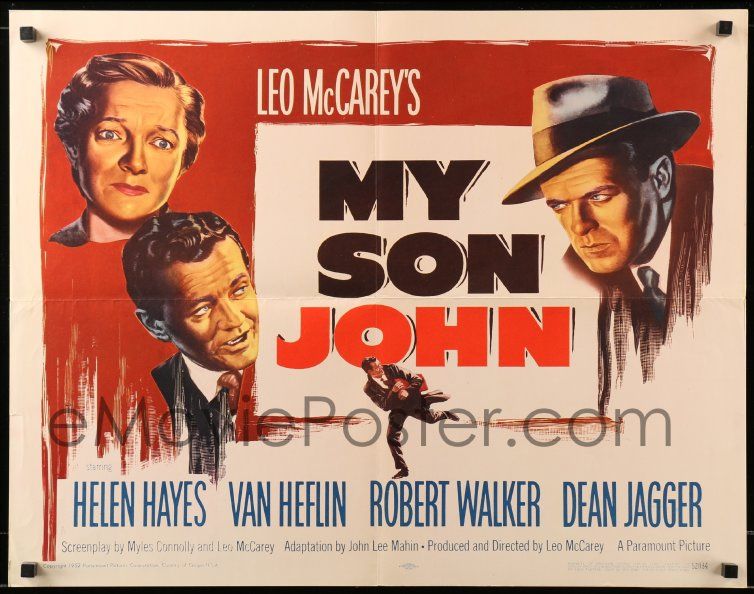
My Son John ( 1952)

My Son John was a serious attempt to alert America to, what director Leo McCarey considered, a dangerous and pressing threat.  The film seemed to have absorbed the political tensions of Hollywood during that strained time.  From its opening scenes, it was a gloomy tense depiction of strangling the American family.
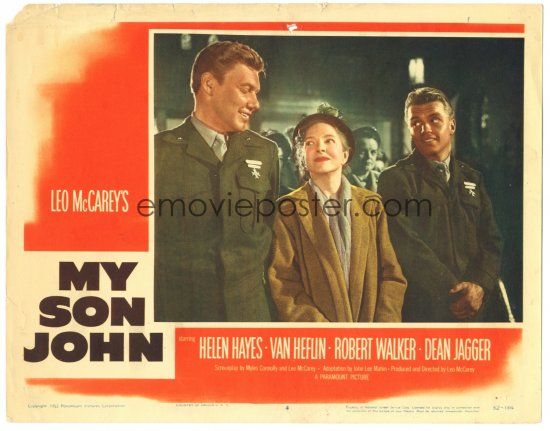
Image from eMoviePoster

Kevin Brianton

Senior Lecturer, La Trobe University

The links between sexuality and communism were seen in other films, but none more pointed than My Son John (1952) which linked political subversion to sexual activity. Producer, writer and director Leo McCarey was one of the leading anti-communist campaigners in Hollywood,[1] and his film My Son John was a serious attempt to alert America to, what he considered, a dangerous and pressing threat.  McCarey was a staunch anti-Communist and had joined Wood in testifying to HUAC in October 1947. He had directed Going My Way (1944) and The Bells of St. Marys (1945), which were very popular films with Bing Crosby as Father O’Malley. McCarey told HUAC his films were not successful in Russia because they contained God. He wanted Hollywood to produce anti-Communist films as it had done in the Second World War against fascism. In 1952, McCarey would do just that and direct one of the more feverish anti-Communist films in My Son John – the final political messages of which were fashioned by DeMille. The film seemed to have absorbed the political tensions of Hollywood during that strained time.  From its opening scenes, it was a gloomy tense depiction of strangling the American family.

The story began as Ben and Chuck Jefferson, played by James Young and Richard Jaeckel, went off to fight in the Korean War.  They were blonde clean-cut American boys who played football.
Image courtesy of eMoviePoster.

The film witnessed the return of Helen Hayes – the first lady of american Theatre – after 18 years away from the screen. The story began as Ben and Chuck Jefferson, played by James Young and Richard Jaeckel, went off to fight in the Korean War.  They were blonde clean-cut American boys who played football, while their brother John, played by Robert Walker, was dark haired and read books.  John worked at some mysterious job in Washington.  Their mother, played by Helen Hayes, was distressed that he did not return for their farewell party.  When he did return, Hayes was shocked to learn that he scoffed at his father’s membership of the American Legion.  Suspicions increased when he told his parents that he believed that Bible stories should be taken on a symbolic rather than literal level.

With the evidence mounting fast, his mother Lucille, played by Helen Hayes, made John swear on the Bible that he was not a communist.  He was quite happy to oblige because he was an atheist and was not afraid of eternal damnation by making such an oath.  The Bible was also used in a scene where John’s father Dan sang John a song he composed for his American Legion Friends.

            If you don’t like you’re Uncle Sammy;

Then go back to the your home o’er the sea;

To the land from where you came;

Whatever its’ name;

But don’t be ungrateful to me;

If you don’t like the stars in Old Glory;

If you don’t like the red, white and blue;

Then don’t act like he cur in the story;

Don’t bite the hand that’s feeding you.[2]

He then bashed John over the head with the bible when he laughed.  The scene appeared to be strongly influenced by a similar scene from Cecil B. DeMille’s 1923 version of The Ten Commandments, where a mother read the story of Exodus from the bible to her two sons.  One son also scoffed at the reading and was struck over the head by the other son with a newspaper.  In an earlier draft of the screenplay of My Son John, the father struck John when he scoffed at the commandment about honoring your parents.  The similarity was no accident as DeMille’s political speech writer Donald Hayne wrote the original drafts for the final speech by John Jefferson.[3]  To scoff at the ten commandments was the equivalent of extolling communism for DeMille who saw them as the moral basis to fight communism.[4]  Furthermore, to scoff was direct proof of communist tendencies, hence the father’s righteous and violent reaction.
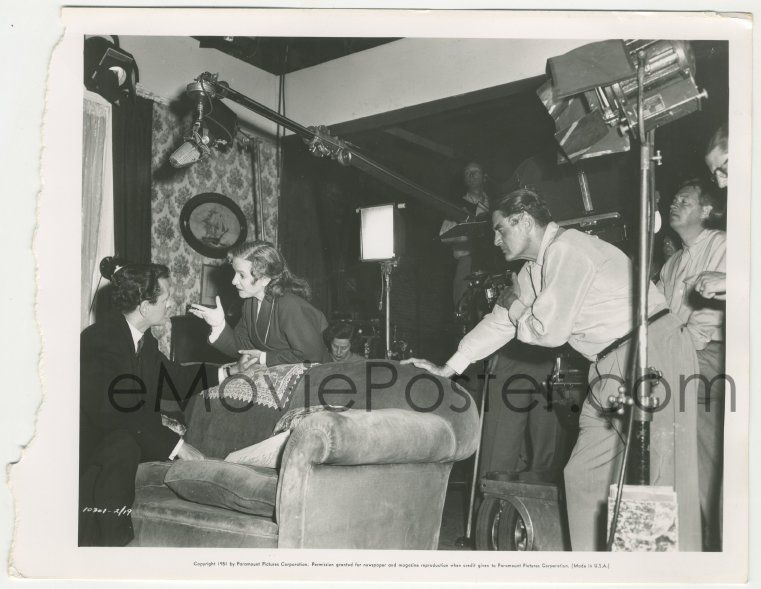
Director Leo McCarey watches Robert Walker and Helen Hayes. The relationship between Mother and Son was a bizarre subtext to this anti-Communist film.
Image courtesy of eMoviePoster

DeMille exercised absolute control over his staff and it would be impossible to believe that Hayne wrote the speech without DeMille’s direction, approval and consent.  DeMille’s writers considered themselves to be ‘trained seals’ who merely translated the director’s thoughts onto paper.[5]  Even though he has not listed in the credits, it is clear that DeMille had a great deal of power within Hollywood’s anti-communist community and that power extended to influencing the anti-communist content of films of other directors.

John’s father Dan, played by Dean Jagger, swore that if he even thought his son was a communist, he would take him into the back yard and shoot with a double-barrel shotgun.  McCarey’s depiction of the all-American father was drunk, violent, and stupid.  Throughout the film, the father was extremely hostile to John’s intellectual achievements, and yet the mother’s character was even worse.  She hovered on the edge of a nervous breakdown and there were several hints to her being menopausal.  In an earlier draft of the film, the message was clear that she was going through a ‘stage of life’ and needed to constantly take pills.[6]  When the mother heard that John was being investigated by the FBI for being communist, she regarded it as solid evidence that he was guilty. In the draft script, she actually collapsed before testifying that her son was a communist.  The audience was meant to conclude that her communist son was undermining her mental and physical health.  It would be easier to believe that these demented parents led their children into communism.

Like I Married a Communist, My Son John linked intellectual activity to communism.  John was constantly compared with his blonde brothers.  They played football and were doing their patriotic duty in Korea while John was an intellectual and a traitor.  T seemed failure to play football was one of the key elements of becoming a political subversive.  The mother recalled going to a football game to see Ben and Chuck play.  As she supported their football team, she would turn to John and barrack for him in his own personal football game.  The audience was told that John’s brothers were pulled out of school to pay for John’s education.  These ideas neatly fitted with the anti-intellectual atmosphere of the McCarthyite investigators.  It was a time when the word ‘egghead’ became a pejorative term for intellectuals.[7]  While making the film, McCarey told The New York Times:

(My Son John) is about a mother and father who struggle and slaved.  They had no education.  They put all their money into higher education for their sons.  But on of the kids gets too bright.  It poses the problem – how bright can you get?

He takes up a lot of things including atheism… The mother only knew two books – her Bible and her cookbook.  But who’s the brighter in the end – the mother or the son.[8]

But there was something more sinister than intellectual curiosity which led to communism.  In his review of the film Bosley Crowthey in the New York Times wrote that intellectuals were seen as ‘dangerous perverters of youth.’[9]  It was not only in the field of ideas that he was corrupt.  John’s twisted relationship with his mother indicated murkier reasons for the descent into the abyss.  Nora Sayre noted that John was deceitful and charming toward her and there was an undisguised hostility towards his father.  His performance was as close as Hollywood would dare come to that of a homosexual.[10]  The father looked on in disgust when he met his professor from his old University.  In the early draft of the screenplay, Dan says to his wife:  ‘Did you see that greeting?  I thought they were going to kiss each other.’[11]  John’s communism was the result of a combination of anti-athletic, intellectual and homosexual tendencies.

In the original screenplay, John’s mother was in a position to put John in prison for his communist activities.  She could not bring herself to testify against John to the FBI and collapsed and was then put into a hospital.  The draft screenplay was incomplete, but it did include notes of a speech where John renounced his communist past while making a speech to a high school.  The speech, which incriminated him, was made even though the FBI was unable to convict him.  John was arrested and taken to prison.  In the final scene, he visited his mother in hospital and told her of his return to the ‘side of the angels’.[12]

The film required a different ending as Walker died before the end of My Son John.  Some hasty rewriting was needed, and McCarey used some outtakes from Strangers On A Train given to him by director Alfred Hitchcock to spin out an ending.[13]  To complete the film.  John went through a remarkable conversion to capitalism at the end of the film and was immediately gunned down by his fellow communists beneath the Lincoln Memorial.

In the film from the 1930s through to the 1950s, the figure of Lincoln was used to bolster the political viewpoints of the filmmakers.  Abraham Lincoln was the most deified on the Presidents in the American popular imagination.  In Mr Smith Goes to Washington (1939), the dejected Smith returned to fight the corrupt politicians in the Senate after seeing a small child in front of the Lincoln Memorial.  Director John Ford repeatedly used Lincoln as an icon of fundamental American wisdom in films such as The Iron Horse (1924) and Young Mr Linclon (1939).  In Cheyenne Autumn (1964), the Secretary of State, played by Edward G. Robinson, looked at a picture of Lincoln, while pondering the fate of the Cheyenne Indians, and said ‘What would he do?’ and the problems of Cheyenne Indians were soon resolved.  Lincoln was also used to support the closing anti-communist message in I Was a Communist for the FBI and The FBI Story (1958).

Lincoln was once again the icon of traditional American values.  John’s death at the feet of the memorial showed that his political conversion and redemption was complete.  He had paid his price for becoming a communist.  In the original script he cried out:  ‘I am a native American communist spy – and may God have mercy on my soul!’[14]  The final film made John pay for his communism with his death.  At the conclusion, a tape recording of his planned speech was played to a graduating class.

I was going to help to make a better world.  I was flattered when I was immediately recognized as an intellect.  I was invited to homes where only superior minds commuted.  It excited my freshman fancy to hear daring thoughts … A bold defiance of the only authorities I’d ever known: my church and my father and my mother.  I know that many of you have experienced that stimulation.  But stimulants lead to narcotics.  As the seller of habit-forming dope gives the innocent their first inoculation, with a cunning worthy of a serpent, there are other snakes waiting lying to satisfy the desire of the young to give themselves something positive…[15]

The concluding speech described communism as an addictive drug.  This did not explain why John was able to break his addiction so easily.  During his final speech a ray of light shines down on the stage indicating God’s approval, when John asked for God’s mercy, it was surely given.

The final speech was quite different form Hayne’s original script.[16]  Hayne wanted to emphasise that the laws against communist agents were weak and the FBI could not have convicted John.  He gave up any chance of escape and confessed that he had been passing secrets to the Russians.[17]  McCarey, however wanted to drive home the inherent evil of communism.  McCarey’s draft for John’s final speech was extremely close to the final film and it seemed that Walker’s death did little to change its direction.

Once again, communism was expunged by a severe act of contrition.  Both Robert Ryan in I Married A Communist and Robert Walker in My Son John had to perform this painful act to clear themselves of communism, just as those in Hollywood had to name names before the HUAC investigations in order to clear themselves.  McCarey’s depiction of communism was the blackest of the 1950s.  It was as an addictive drug peddled by intellectuals with homosexual tendencies to young impressionable minds.  The thin academic air of college was a breeding ground for these delusions.  Young people who wanted to do something positive may fall victim to its clutches.  Yet the alternative in McCarey’s world was not much better.  Violent and threatening, verging on psychotic, fathers and neurotic mothers were the all-American couple.  These parents would sacrifice their children to the authorities through guilt by association.  He film rationalized that the techniques used throughout America and Hollywood were necessary and desirable.  It argued that being investigated was the same as being guilty; that authorities were impeccable in their research and pursuit of enemies and never made mistakes.  John’s confession at the end of the film justified the physical and mental battering he had received from his mother, his father and the authorities.  The confession was a justification of HUAC’s investigations and the stance taken by the studio heads.  When the film was released, it was not surprising that DeMille said it was a great film and showed that McCarey was a great American.[18]  The film was, however, universally condemned by film reviewers.  My Son John represented the low water mark of Hollywood’s dealing with communism and the film did not make Variety’s list for the year despite some heavy advertising.[19] Most reviewers slammed the film, aside from Bosley Crowther in The New York Times who praised some aspects of it; but even he had grave concerns about its political dogmatism.

Bernard Dick focuses on Leo McCarey’s anti-communist film My Son John (1952) in some detail in his book The Screen is Red. The film’s production fell into a shambles with the death of lead actor Robert Walker, and an ending of sorts was created – with some unheralded assistance by Cecil B. DeMille and Alfred Hitchcock. The remaining film is uncomfortable to watch; it contains one disturbing scene in which an angry father attacks his communist son for laughing at his conservative jingoism. Despite the contrived conclusion, Dick describes McCarey as a master of plot resolution. He argues that McCarey gave viewers an ending that was “dramatic and reflective,” [117] providing an accurate description of America in the early years of the Cold War. His respectful analysis is at odds with both contemporary reviewers and later critics, who see it as a mixture of hysterical anti-communism tinctured with a vague homophobia – along with some disturbing ideas about motherhood.


[1] Ceplair and Englund, Inquisition, p. 259.

[2] My Son John, (d) Leo McCarey, (w) Leo McCarey.

[3] Draft of final speech of My Son John, Cecil B. DeMille Archives, Box 439, Folder 10, Brigham Young University, Provo, Utah.

[4] A full discussion will be in the chapter on biblical epics.

[5] Quote from unnamed writer in Motion Picture Daily, 16 December 1949.  Accounts of DeMille’s legendary treatment of writers can be found in Ring Lardner Jr., ‘The Sign of the Boss’, Screenwriter, November 1945, and Phil Koury, Yes, Mr DeMille, G.P.Putnam’s Sons, New York, 1976.

[6] Undated draft script of My Son John, Box 439, Folder 10, Cecil B. DeMille Archives, Box 439, Folder 10, Brighan Young University, Provo, Utah.

[7] William Manchester, The Glory and the Dream A Narrative History of America 1932 – 1972, Bantam, New York, 1975, pp. 625 – 626.

[8] New York Times, 18 March 1952.  At the end of the original script, John asks his mother to bake cookies for him in prison.

[9] New York Times, 9 April 1952.

[10] Sayre, Running Time, p.96.  Walker’s performance is close to his acclaimed role of Bruno in Strangers On A Train where again his performance had strong homosexual overtones.  See Donald Spoto, Art Of Alfred Hitchcock, Dolphin, New York, 1976, p. 212 and for a differing view see Robin Wood, Hitchcock Film’s Revisited, Columbia University Press, New York, 1960, pp. 347 – 348.  McCarey did claim that Hitchcock was a strong influence for the film, New York Times, 9 April 1952.

[11] Draft script of My Son John, p. 11 Box 439, Folder 10, Cecil B. DeMille Archives, Box 439, Folder 10, Brigham Young University, Provo, Utah.

[12] Ibid.

[13] Walker died after being prescribed some sedatives by doctors after emotional outbursts on the set of My Son John.  He had a history of problems with alcohol and had suffered a nervous breakdown in the late 1940s.  David Thomson, A Biographical Dictionary of the Cinema, Secker and Warburg, London, 1975, p. 595.

[14] Hayne, Donald John’s Speech, 2 June 1951, Cecil B. DeMille Archives, Box 439, Folder 10, Cecil B. DeMille Archives, Brigham Young University, Provo, Utah.

[15] My Son John, (d) Leo McCarey, (w) Leo McCarey.

[16] Hayne, Donald John’s Speech, 2 June 1951, and Leo McCarey, Leo John’s Speech, 10 August 1951.  Cecil B. DeMille Archives, Box 439, Folder 10, Cecil B. DeMille Archives, Brigham Young University, Provo, Utah.

[17]Undated draft script of My Son John, Ibid.

[18] Cecil B. DeMille to Leo McCarey, 3 April 1952.  Cecil B. DeMille Archives, Box 439, Folder 10, Brigham Young University, Provo, Utah.

[19] The film’s advertising focused on a non-existent sex scene.  The film was condemned by most film reviewers at the time.  One belated defence of the film is in Leland A. Poague, The Hollywood Professionals: Wilder and McCarey, London, Tantry Press, 1980.
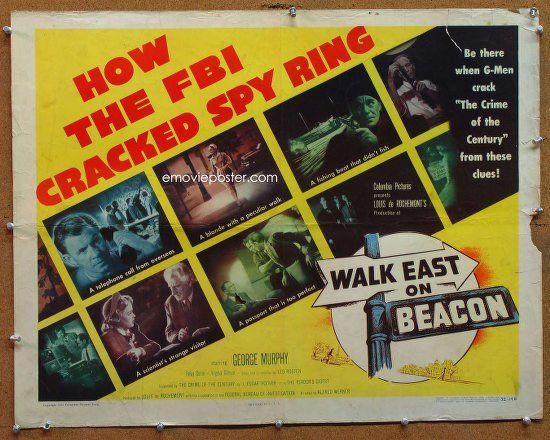
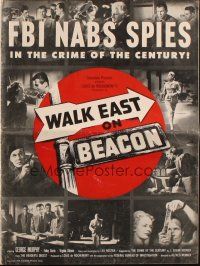
Walk East on Beacon

Walk East on Beacon was based on an article by FBI head J. Edgar Hoover called Crime of the Century which was published in Reader’s Digest in May 1951.
Image courtesy of eMoviePoster

Kevin Brianton

Senior Lecturer, La Trobe University

In 1951 FBI head J. Edgar Hoover was offered $15,000 for the rights to his article in Readers Digest which was based on the Fuchs-Gold case.  Hoover had written – or it had been ghost written – the article called Crime of the Century which was published in Reader’s Digest in May 1951. British atomic scientist Karl Fuchs and American Harry Gold gave nuclear secrets to the Russians.  Hoover refused the offer but granted the movie rights.  His biographer Curt Gentry argued that Hoover refused the money because of the links between the case and the controversial Rosenberg trial.  Gentry said that Hoover only arrested Ethel Rosenberg as a ‘lever’ to get Julius to confess.  A decision he greatly regretted.  The FBI’s anti-communist stance was shown in Walk East on Beacon .[1]  The FBI is depicted in glowing – if somewhat – ridiculous terms throughout the film. The New York Times wrote: ” Chief J. Edgar Hoover’s story, “The Crime of the Century,” is an absorbing affair, as the law, utilizing such varied aids as hidden cameras, lip readers, television equipment and the Coast Guard, efficiently tightens the net around its elusive quarry. And, in the course of the chase, it becomes increasingly obvious that the F. B. I. cooperated in the production.” Like Big Jim McLain, which praised HUAC, Walk East on Beacon praised the Bureau. It was released with publicity material which said the country was in danger and citizens should report espionage, sabotage or subversive activities, the chattering of aircraft for flights over restricted areas, suspicious individuals loitering near restricted areas, foreign submarine landings, poisoning of public water supplies, possession and distribution of foreign-inspired propaganda, unusual fires or explosions affecting vital industry, suspicious parachute landings and possession of radioactive material.[2]

HUAC had begun its investigation by interviewing selected labor and industry leaders in the film industry in March 1947. Listening to anti-communist figures in Hollywood did not provide HUAC chair J. Parnell Thomas and investigator Robert Stripling with enough evidence to proceed with a full investigation. They needed the FBI, which had been building up a massive dossier of communist involvement in Hollywood over the past three years. At first, Hoover declined to support the venture because he did not want HUAC linked to the FBI, but Thomas and Stripling promised discretion when they contacted Los Angeles FBI agent R. B. Hood for support. Under this agreement, Hoover arranged to assist the committee on the basis that the FBI remained unidentified. With this assurance, Hoover testified to it in an open session on March 26, 1947, where he declared “the aims and responsibilities” of the HUAC and the FBI were the same: “The protection of the internal security of the Nation.” Hoover used the opportunity to argue that the Communist Party was penetrating many “public opinion mediums,” particularly the film industry, and that it would achieve its goal of capturing American institutions through infiltration of the unions and creative outlets. Hoover said, “I would have no fears if more Americans possessed the zeal, the fervor, the persistence and the industry to learn about this menace of Red fascism. I do fear for the liberal and progressive who has been hoodwinked and duped into joining hands with the communists.” Hoover’s testimony to HUAC was a clear blurring of the lines between liberals and radicals. Congress further ordered that 250,000 copies of Hoover’s address were to be printed and distributed. The FBI and HUAC were now allies. The FBI would gather the evidence and the committee would disclose it. By making films about these entities were certainly trying to appease their new political masters.[3]

The plot was the unlikely plan about the blackmail and kidnapping of a scientist working on an important new computer called Falcon.  Throughout the film, the FBI was depicted as a highly efficient organisation following up hundreds of leads.  One such lead gives the name of a possible communist agent.  The suspect was followed by FBI agents to the Polish freighter where he was substituted by an agent from Moscow who was able to use his papers.  The Russian agent in turn was then followed by a series of FBI agents.  The communists were involved in a complex plot to extort important mathematical formulae from a scientist Dr Krayer.  The scientist’s son had been captured in East Germany and the communists told Krayer that he would be safe provided that the critical information he was working on was handed on to their agents. 

Communists who left the party or who pretended to leave were subject to constant recall.  One party member was threatened with blackmail after he was tracked down by his colleagues.  He said that it was impossible to leave and informing to the FBI meant death.[4]  Those who pretended to leave the party were only sleepers waiting to be activated by Moscow.  Those people lived and worked in the community and could not be detected.  Nevertheless, the FBI appeared as a ruthlessly efficient operation with thousands of agents working around the clock to stop subversion.  The audience was reminded that foreign agents in the United States were given great freedoms.  A list of agents who have been ‘sleeping’ for years before being activated was repeatedly shown.

The FBI enjoyed strong publicity from the film. The film was released with publicity material which said the country was in danger and citizens should report espionage, sabotage or subversive activities, the chattering of aircraft for flights over restricted areas, suspicious individuals loitering near restricted areas, foreign submarine landings, poisoning of public water supplies, possession and distribution of foreign-inspired propaganda, unusual fires or explosions affecting vital industry, suspicious parachute landings and possession of radioactive material. Image courtesy of eMoviePoster

Most of the film was about setting up an elaborate web to send the information to Moscow.  The web included exchanging papers in parks, taxi cabs, airport lockers and other means.  When this complex apparatus fell apart, the communists adopted the more direct route of kidnapping the scientist and smuggling him out of the country.  The film ended with the capture of all the communist agents, but with a warning that hundreds of other plots were being hatched across the United States.  The audience was told that a small group of highly trained communist agents can do the damage of millions.  Yet, as critic Nora Sayre points out, these communist agents were grossly incompetent, allowing themselves to be followed, bugged and filmed at every turn.[5]  When one communist courier was told that he was being followed by the FBI, he immediately walked over to the agent and said: ‘You’re FBI and I know you are following me.’[5]  The stupidity of the communists may be explained by the scientist who attacked the communists saying that ‘minds in chains cannot think.’[6]

The film claimed that the United States was blessed with great freedoms and this could lead to its undoing.  The message of too much freedom, and freedoms being abused, was repeated in The FBI Story (1958) which also had the backing of FBI head J. Edgar Hoover and Big Jim McLain (1951).  Despite those comments, communist agents appeared to be subject to intensive surveillance around the clock. They were filmed in parks, bugged in their houses, have their mail opened and were constantly followed.  All this was in response to a single anonymous tip that a person may be a communist.  The FBI said that hundreds of tips were received every day giving rise to an image of surveillance in the United States of Orwellian dimensions.  Walk East on Beacon was an image of society where the only way to survive was in the hands of the FBI.  Freedoms had to be given up to retain freedom.  The film was ranked 88th in the Variety rankings taking in $1.3 million.[7]


[1] See Curt Gentry, J. Edgar Hoover: The Man and His Secrets, Norton, New York, 1991 and Ronald Radosh and Joyce Milton, The Rosenberg File: A Search For Truth, Vintage, New York, 1984.

[2] Sayre, Running Time, pp. 92 – 93.

[3] Athan G. Theoharis, The FBI & American Democracy: A Brief Critical History (Lawrence: University Press of Kansas, 2004), 89. O’Reilly, Red Menace, 89–91. Ellen Schrecker, The Age of McCarthyism: A Brief History with Documents (New York: Palgrave, 2002), 154–159.

[4] Walk East on Beacon, (d) Alfred Werker, (w) Leo Rosten.

[5] Sayre, Running Time, p. 91.

[6] Walk East on Beacon, (d) Alfred Werker, (w) Leo Rosten.

[7] Ibid.

[8] Variety, 7 January 1953.

HUAC hearings and the end of liberal Hollywood

Kevin Brianton

Senior Lecturer, La Trobe University

Conservative ideologue Ayn Rand was angry about the focus of the 1947 HUAC hearings, as she had wanted to examine The Best Years of Our Lives. Committee head J. Parnell Thomas argued with her saying that if the film was attacked, there would be a furor. The fact that Rand may have been able to approach the head of the committee to complain about the way she had been interviewed strongly indicated that the friendly witnesses were stage managed.  No unfriendly witness had such an opportunity. [1]   It also demonstrated the obsession of the committee with publicity. He would later link the investigation of communism in the film industry to the leaking of atomic secrets to the Russians. Journalists were intrigued and showed up in droves to find it was a media stunt and Thomas had nothing.

The Best Years of Our Lives dominated the box office and scooped the Oscars, becoming the most successful film of the year.  After the HUAC investigations of 1947, director William Wyler claimed that he wouldn’t be allowed to make films such as The Best Years of Our Lives anymore because of HUAC.  He warned that the committee was making decent people afraid to express their political opinions by creating fear in Hollywood.  Wyler said fear would lead to self-censorship and eventually the screen would be paralysed.[2]


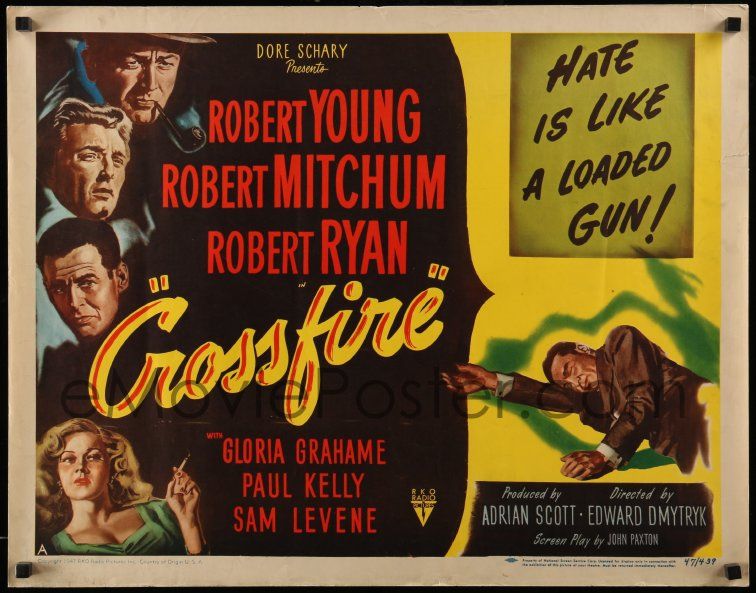
Crossfire is a 1947 film noir which deals with antisemitism.
It was part of a liberal flowering of films in post war period. Image courtesy of eMoviePoster.

Wyler’s warnings about censorship seem unjustified.  Several films were made on sensitive topics such as racial prejudice from 1947 through to 1951.  These films included Crossfire (1947), Gentleman’s Agreement (1947), Pinky (1949), Home of the Brave (1949), Intruder in the Dust (1949), No Way Out (1950), and Storm Warning (1950).  Even westerns began taking a liberal turn with films such as Broken Arrow (1950) and Devil’s Doorway (1949) depicting Indians in a positive light.  To varying degrees these films showed that Hollywood could tackle social subjects well.  Capitalism was also the subject of allegorical attack.  Abraham Polonsky made two successful radical films in his short-lived film career as screenwriter and director in the 1940s.  Both Body and Soul (1947) and Force of Evil (1948) have been read as Marxist critiques of capitalism.[3]  All My Sons (1948), based on Arthur Miller’s play, depicted an industrialist was willing to sell defective planes to the Airforce to stay in business.  But this brief flowering of liberal and radical films was cut short in 1951 at the time of the second HUAC investigation of Hollywood and the lead up to the 1952 Presidential election.

Hollywood’s political vision in the immediate post-war period was in turmoil.  The caustic anti-communism was competing with a vision of liberal tolerance.  Overall it was the liberal films which won the popularity stakes, with Pinky being the second most popular film of 1949.[4]  But their popularity did not guarantee their production.  With the second and more extensive HUAC investigation in 1951, the political pendulum had swung so far to the right that liberalism was tainted with being soft on communism.  Some people argued that the State Department and the Truman administration had lost China to the communists. This was idea so pervasive that it even strongly affected the Kennedy administration.  He was determined to be seen to be strong on communism as a Democrat President.  His determination led to events like the Bay of Pigs invasion and intervention in Vietnam.  [5]  After 1951, there was no such confusion in the political message from Hollywood.  The diet of films was straight anti-communism with no liberal trimmings.

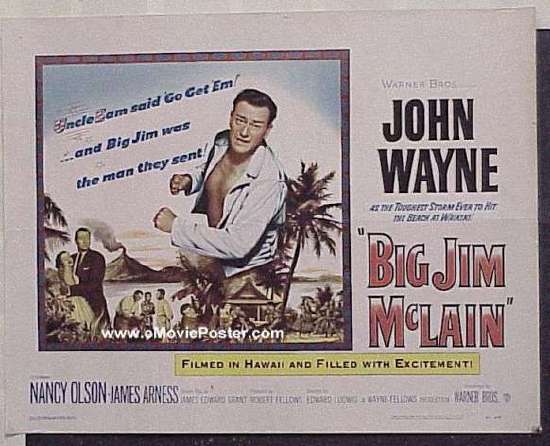
Big Jim McLain (1951), was more of a public relations exercise for the HUAC investigators, than a film.
Image courtesy of eMoviePoster.

Big Jim McLain (1951), was more of a public relations exercise for the HUAC investigators, than a film.  It was produced by the ultra-conservative actor John Wayne and was based on the experiences of HUAC investigator William Wheeler and it claimed to be made with the full co-operation of the committee with access to cases from HUAC files.  The film linked HUAC to American icons. After the opening credits, the narrator quotes from the short story “The Devil and Daniel Webster” by Stephen Vincent Benet. It then immediately praises the House Committee on Un-American Activities for its attack on communism despite “undaunted by the vicious campaign of slander launched against them.” Wayne was targeting HUAC’s opponents in Hollywood.The film began with the assumption that anybody who was a communist after 1945 was a traitor or spy or both – a few clearly stated by J. Edgar Hoover.  HUAC investigators were able to track down communist subversives but the committee could do little with them once they had took the fifth amendment.  The investigators taped several conversations about a far-fetched plot to tie up the wharfs by infecting them with some kind of bacteria.  The infestation would be the basis for long industrial dispute which would be prolonged by communist agents in management and unions.  Once again it was a waterfront union as in I Married A Communist.  This effort would be the same as putting ‘another division in the field’ in Asia. European distributors were not so impressed with the plot. According to Wikipedia, “In some European markets the film was retitled as Marijuana and dispensed with the communist angle, making the villains drug dealers instead. This was achieved entirely through script changes and dubbing. ” https://en.wikipedia.org/wiki/Big_Jim_McLain

Jim McLain, played by John Wayne, and the Hawaiian police force uncovered the plot, but only arrested those responsible for the accidental death of a communist stooge.  The audience were left wondering why the communists were not behind bars for murder of McLain’s partner.  The film’s aim, however, was to reinforce Wayne’s view that the constitution was designed to protect good citizens, not those who would tear it apart.  The communists were straight out criminals and thugs, who betrayed each other and murdered Wayne’s partner.  At one stage, McLain fought the entire gang single handedly and was so honorable that he would not punch out one communist because he was too short.  McLain said: ‘We don’t hit the little guy.  That’s the difference between us and you.’[6]  The communists take a fifth amendment and go free at the end of the film.

The real objects of Wayne’s attack, however, were those who refused to testify before HUAC, while informers on communists were greatly praised.  At one point, McLain and his partner visited an old couple who told them that their estranged son was a communist.  This evidence provided the vital clue which broke a communist cell in Hawaii.  Informing was a selfless act of patriotism, even if it meant naming your own son.  Big Jim McLain was ranked 27th by Variety making $2.6 million in rentals.[7]  It was the most successful of the anti-communist films of the early 1950s possibly because of the immense popularity of John Wayne.


According to the film’s Wikipedia entry “Nancy Olson (pictured left) hated the script but figured that six weeks in Hawaii and a chance to work with a star like John Wayne seemed a good enough reason to accept. She thought the film would flop and nobody would see it. She was right to a degree – it wasn’t one of Wayne’s more successful pictures – but she didn’t count on how often it would appear on television. She later said people stopped her all the time to mention it. Olson, a staunch liberal Democrat, said she and Wayne would often have political arguments but she would always let Wayne have the last word. ” https://en.wikipedia.org/wiki/Big_Jim_McLain
Image courtesy of eMoviePoster.

[1] Branden, p. 201. 

[2] Gordon Kahn, Hollywood on Trial, Boni and Caer, New York, 1948, p. 221.

[3] Peter Roffman and Jim Purdy, The Hollywood Social Problem Film: Madness, Despair and Politics From The Depression to the Fifties, Midland, USA, 1981, p. 278.

[4] Cobbett Steinberg, Reel Facts: The Movie Book of Records, Vintage, New York, 1982, p. 20.

[5] For a treatment of the fears of the liberals in the Kennedy administration see David Halberstam The Best and the Brightest, Fawcett crest, USA, 1973.

[6] Big Jim McLain (d) Edward Ludwig, (w) James Edward Grant.

[7] Variety, 7 January 1953.

The Fountainhead (1949)

Kevin Brianton

Senior Lecturer, La Trobe University

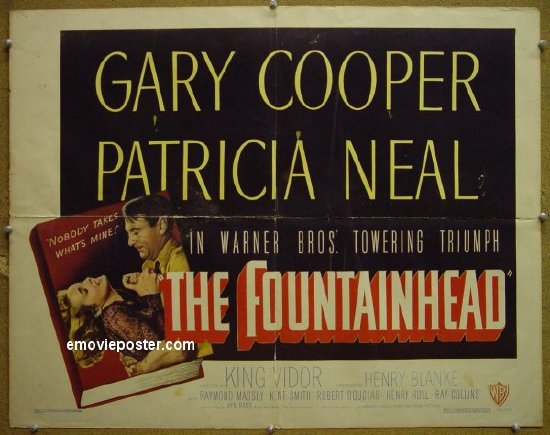
One of the oddest anti-communist films to come out of Hollywood in the period between the first and second HUAC investigations was the The Fountainhead (1949).  Based on Ayn Rand’s bestselling book, and directed by MPAPAI founding executive committee member King Vidor, the film was a defence of the creative individual against the deadening collective.  The film should be seen as Rand’s own personal vision rather than Vidor’s.  Rand had such power in Hollywood at the time that when Vidor wanted some scenes cut from the film, Rand made Warner restore them.[1]

One of the oddest anti-communist films to come out of Hollywood in the period between the first and second HUAC investigations was the The Fountainhead (1949). Image courtesy of eMoviePoster.

Gary Cooper played visionary architect Howard Roark who the public hated because of his individualism.  He was expelled from school because his ideas were too original.  His architecture was criticised by Ellsworth Touhy through his column in the populist The New York Banner, arguing that ‘artistic value is achieved collectively, by each man subordinating himself to the standards of the majority.[2]  Touhy doesn’t like genius as he believed it to be ‘dangerous’.  He explained his reasons to be compromised architect John Keating.

            KEATING: What are you after?

TOUHY: Power!  What do think is power?  Whips, guns, money.  You can’t turn men into slaves unless you break their spirit.  Kill their capacity to think and act on their own.  Tie them together.  Teach them to conform.  Untie to agree to oblige.  That makes one neck for the leash.[3]

Roark agreed to design a housing development for the poor using Keating as a front, provided his designs were exactly followed.  When they were not, Roark destroyed the building with dynamite.  Before the trial, Touhy began a storm of protest against Roark.  The owner of the New York Banner, Gail Wynand, played by Raymond Massey, wanted to support Roark and sacked Touhy.  Touhy virtually closed down the paper as the entire office walked off in support.  Touhy explained his strategy to Wynand and his assistant.

ASSISTANT:    I can’t understand how Ellsworth got so much power.  I never noticed it.  But he got his gang in little by little.  And now he owns them.

WYNAND:  And I own the Banner.

TOUHY:  (entering the room)  Do you Mr Wynand?  So you were after power, Mr Wynand and you thought you were a practical man, you left to impractical intellectuals the whole field of ideas to corrupt as we please as you were making money.  You thought money was power.  Is it Mr Wynand?  You poor amateur.[4]

Touhy represented the communist – with a liberal façade – who was destroying the system from within.  Just as Rand believed that the communists were inserting corrupt ideas into films to undermine capitalism, the character of Touhy reflected her concern.[5]  It was he, not the capitalists, who had the real power.  Eventually Touhy reasserted his control over the paper after a popular boycott.  He was quite open about his aims in a public attack on Roark.

We don’t have to wait for the trial to convict him.  Howard Roark is guilty by his very nature.  It is his work that designed Courtland.  What if he did?  Society needed a housing project.  It was his duty to sacrifice his own desires and contribute any ideas we demanded of him on any terms we chose.  Who is society? We are.  Man can only be permitted to exist in order to serve others.  He must be a tool for the satisfaction of others.  Self sacrifice is the law of our age.  The man who refuses to submit and to serve is a man who must be destroyed.[6]

At his trial, Roark argued for the role of the individual against the collective.  He made no pretense at innocence and defended his actions by conjuring up a vision of an ancient struggle between the evil collective and the vision of the individual.

Man cannot survive except through his mind.  He comes on earth unarmed.  His brain is his only weapon.  But the mind is an attribute of the individual.  There is no such thing as a collective brain.  The man who thinks must think and act on his own.  The reasoning mind cannot be subordinated to the needs, wishes or opinions of others … Look at history.  Everything we have.  Every great achievement has come from the independent work from some independent mind.  Every horror and destruction from attempts to force men into a level of brainless, soulless, robots without personality, without rights without will or hope or dignity.  It is an ancient conflict.  The individual against the collective.[7]

Despite his obvious guilt, Roark was acquitted by the jury to pursue his own career.  The decision was nonsense.  In dynamiting the building, he was guilty of a range of crimes and should have been sent to prison.  But it was a political trial and Roark was set free.  The individual had triumphed over the collective.

The Fountainhead hinted at the existence of an blacklist of anti-communists in Hollywood.  Roark could not find work while he fought with Touhy and his associates.  This suggestion was a calculated insult to those who had been blacklisted by the studios.  Rand argued that talented individuals like Roark could lose their jobs because of their beliefs.  She later told her biographer that there was a blacklist of anti-communists in force in the HUAC years.  She said almost everybody who testified for the committee who were considered dispensable, such as freelancers or writers or actors without a contract to a major studio lost their jobs.  ‘Morrie Ryskind had more work than he could handle; he never worked again in Hollywood’ while ‘Adolphe Menjou got fewer and fewer jobs’ and soon could ‘find no work at all’.[8] 

No evidence exists of a blacklist of anti-communists and Rand’s statements are not supported by an available evidence. Screenwriter Morrie Ryskind had many screen credits in the 1930s.  In the 1940s he received one for Penny Serenade in 1941, Where Do We Go From Here? In 1945 and Heartbeat in 1946.  After this his film career began to slow down.  But three credits in six years is not more work than you can handle.  It seems clear that his career was already in decline when he testified to HUAC.  When conservative critic William F. Buckley Jr. made similar claims in 1963 about Morrie Ryskind, screenwriter Phillip Dunne, one of the co-founders of the Committee for the First Amendment, told Buckley that Ryskind could have a job by turning up at 20th Century Fox Studios.  According to Dunne, Ryskind failed to show. After Hollywood, Ryskind worked as a columnist for the Hearst Press.  He also secured a position from the government in writing anti-communist films for the United States Information Agency. Menjou made three films in 1947, one in 1948, two in 1949, one in 1950, two in 1951, one in 1952 and continued to make films up to 1960.  This was about the rate before the HUAC hearings.  He also had two television series in 1951 and 1953.  See Halliwell, Leslie.  Filmgoer’s Companion seventh edition, Paladin, London, 1980, p. 546.  Kazan also claimed that Menjou was on a left wing blacklist in his autobiography and he broke the blacklist by employing Menjou for Man on a Tightrope (1952).  The facts are that Menjou enjoyed regular employment in Hollywood.    [9]

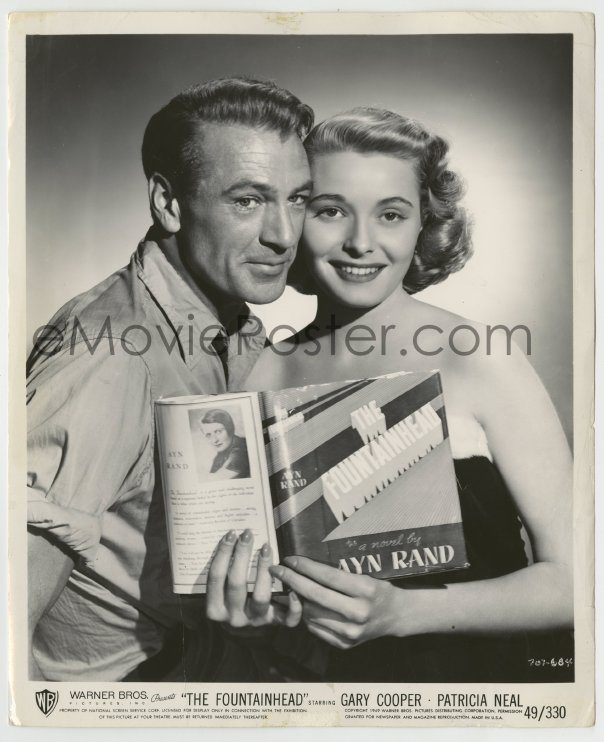
Publicity for the film was firmly based on Ayn Rand’s novel.
Image courtesy of eMoviePoster.

DeMille was clearly an influence on the production of The Fountainhead.  The closing scene of the film showed a woman rising in an open elevator and looking up at the make figure of Roark on top of the building and which then cut to look across at the city skyline.  The scene was almost identical to one in DeMille’s 1932 version of The Ten Commandments.  Vidor was either strongly influenced by the scene and incorporated it into the film or DeMille was playing a advisory role.  In either event, DeMille certainly agreed with the politics of the film.  After the launch of the film, Rand wrote to DeMille saying The Fountainhead was doing extremely well at the box office, particularly at the neighborhood houses, where ‘audiences everywhere break into applause at the end of Roark’s speech’.  Rand wrote that this made her happy, because it showed that ‘the political sympathy of the country is with us’.[10]

The reality was quite different and the film was not well received.  Bosley Crowther in the New York Times wrote:

If Miss Rand intended this drama to be a warning against the present threat of Communism muscling in on our fair democracy, then she might have shown more confidence in the good old body politic and less growing admiration for the genius who is a law unto himself… For it is out of such deadly cynicism and reckless reverence as are shown in this film that emerges a form of fanaticism which is a peril to democracy.[11]

Rand wrote back on July 24 and accused Crowther of being an Ellsworth Toohey and ignoring the real issues of the film.  She also claimed that because of her stance, approved screenplays would reach the screen unaltered at Warner Brothers.  The studio later claimed on July 31 that she had been mistaken and that actors were no longer permitted to improvise with scripts. As a novel, The Fountainhead was a bestseller, but this did not translate to the box office:  The film was ranked 38th by Variety, making $2.1 million.[12]

The initial stage of the anti-communist crusade was an attempt to exonerate the moguls for their actions in dealing with HUAC.  The political never-never land of I Married A Communist and The Fountainhead contained calculate insults aimed at Hollywood’s liberal and radical community.  The Fountainhead was perhaps the more insulting as it inverted the political order to make it appear that the communists were in control and were attempting to crush the work of talented individuals.


[1] Raymond Durgnat and Scott Simmon, King Vidor, American, Universtiy of California Press, Berkeley, 1988, p. 263.

[2]The Fountainhead, (d) King Vidor, (w) Ayn Rand

[3]Ibid.

[4] The Fountainhead op cit.

[5] Barbara Branden, The Passion of Ayn Rand, Doubleday, New York, 1986, p. 201.

[6] The Fountainhead op cit.

[7] ibid.

[8] Branden, Ayn Rand, p. 203.

[9] See Phillip Dunne, Take Two: A Life in Movies and Politics, McGraw-Hill, New York, 1980, p. 217.  as reported in Hollywood Reporter, 18 March 1954. 

See Elia Kazan, A Life, Doubleday, New York, 1988, p. 478 – 480.

No doubts exist about the effectiveness of the blacklist which ended many careers.  See John Cogley Report on Blacklisting, 2 vols, The Fund for the Republic, New York, 1956.  Rand’s claim of a blacklist for friendly witnesses are also dubious because of her own career in Hollywood began after testifying.

[10] Ayn Rand to Cecil B. DeMille, 29 April 1949, Cecil B. DeMille Archives, Box 418, Folder 3, Brigham Young University, Provo, Utah.

[11] New York Times, 17 July 1949. 

[12] Variety, 4 January 1950.

Based on original blog at https://kevinbrianton.com/the-fountainhead-1949/

Political tensions in post -war Hollywood cinema

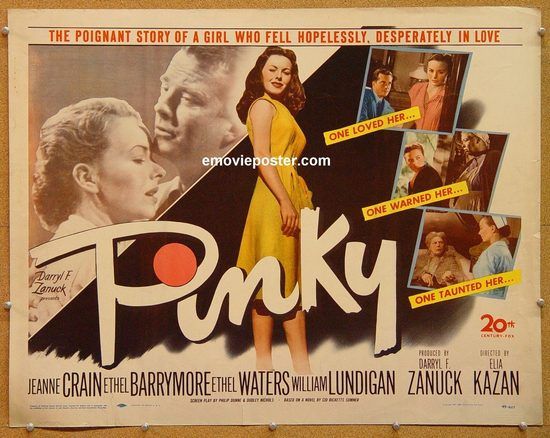
Pinky was a 1949 American drama about a light-skinned African – American woman who could pass as white.

Image courtesy of eMoviePoster.

Kevin Brianton

Senior Lecturer, La Trobe University

Liberalism and less extreme political viewpoints did not cease to exist after the Second World War. The political tensions in Hollywood remained between liberals and conservatives. Many looked to cinema as a way to project progressive idea and views, yet Hollywood’s political vision in the immediate post-war period was in turmoil.  The caustic anti-communism was competing with a vision of liberal tolerance.  Overall it was the liberal films which were winning the Box Office, with Pinky being the second most popular film of 1949.[1]  Pinky was a 1949 American drama about a light-skinned African – American woman who could pass as white.

But the popularity of these films did not guarantee their production.  With the second and more extensive HUAC investigation in 1951, the political pendulum had swung so far to the right that liberalism was tainted with being soft on communism.  Some people argued that the State Department and the Truman administration had lost China to the communists.[2] 

The Red Scare period reached its anti-communist climax in 1950. After trials lasting two years, former State Department official Alger Hiss was convicted for perjury for his alleged involvement in a Soviet spy ring on 25 January 1950. The case brought former HUAC member Richard Nixon to national prominence – and would launch his political career. On 9 February 1950, Senator Joseph McCarthy declared at a speech in Wheeling, West Virginia, that there were 205 card-carrying members of the Communist Party in the State Department. Even though the senator was a late arrival on the anti-Communist scene, the sheer viciousness and near hysteria of his anti-Communist campaign would designate the period the McCarthyite era.1

            The political temperature was certainly on the rise in Hollywood. The Waldorf Statement, and even the imprisonment of the Hollywood Ten, did not end demands for stronger anti-Communist intervention. In May 1950 John Wayne, in his role as president of the Motion Picture Alliance, called for a complete delousing of the film industry. “Let us, in Hollywood, not be afraid to use the DDT,” he told newspapers. The blacklist created by the Waldorf Statement was only part of the equation. More corrosively, people could be put on a “graylist”—a list of those who were not Communists but were believed to have Communist sympathies. These people also could not obtain work.

On June 22, 1950, the American Business Consultants published a report titled Red Channels, listing 151 names of show business figures accused of Communist ties, including many in the film industry. The editors openly stated they were not interested in whether people actually were Communists, and the evidence presented was often fragmentary or simply incorrect. Even so, those who appeared in such a publication required a political clearance in order to return to work. The clearance process was haphazard, and people with no Communist connections could lose their livelihood. The Waldorf Statement had created within the film industry a toxic work environment, in which any self-styled patriotic organization could label any producer, actor, director, or writer a Communist and jeopardize his or her career. To heighten matters, on June 25, 1950, North Korea invaded South Korea—the Cold War had become hot. his was idea so pervasive that it even strongly affected the Kennedy administration.  He was determined to be seen to be strong on communism as a Democrat President.  His determination led to events like the Bay of Pigs invasion and intervention in Vietnam.2

On June 22, 1950, the American Business Consultants published a report titled Red Channels, listing 151 names of show business figures accused of Communist ties, including many in the film industry.

While the studios were beginning to bring out anti-communist films, the right began to look for other targets.  Not content with driving communists out of Hollywood, the right turned its attention to films with liberal messages – and by implication the liberals who write and directed them.  Ayn Rand had written a Screen Guide for Americans in 1947 for the MPAPAI which said that free enterprise, industrialists, and the independent man shouldn’t be smeared; that failure and the collective shouldn’t be glorified; and that communist writers, directors and producers shouldn’t be hired.  The alliance did not see it as a ‘forced restriction’ on Motion Picture studios, rather that each man should do ‘his own thinking’ and for the guide to be adopted as a ‘voluntary action’.  Its impact has been overstated. Rand told her biographer that the guide had such a huge impact that it was printed in full on the front page of arts section of the New York Times; it was actually mentioned in summary in a column by Thomas F. Brady on page 5 of the arts section on 16 November 1947.  It was printed in full in an ultra-conservative newsletter Plain Talk in November 1947 which also featured articles on the influence of ‘communism on youth’. Rand  wrote that the guide aimed to keep the screen free from any ‘collective force or pressure.’[3]  The irony being that this was precisely what the alliance was doing.

The real point of Rand’s pamphlet was that only a conservative vision of America should be allowed on the screen.  The alliance wanted the present wave of films which attacked or criticised capitalism halted.  One of alliance’s supporters, Cecil B. DeMille was making similar speeches:

The American people know that with all its faults capitalism has given them the highest standard of living and the greatest personal freedom known in the world.  The communist cannot deny that.  But they can – and do – make a banker or a successful businessman their villain.  They can – and do – pick out the sordid and degraded parts of all America, leaving the audience – especially the foreign audience – to infer that all America is a vast Tobacco Road and successful people are all ‘little foxes’.[4]

The screenwriter of Little Foxes was Lilian Hellman who was a prominent leftist and who was called before the HUAC hearings. Tobacco Road was a film about poor white families being driven off their land in Georgia, directed by John Ford.  Little Foxes, directed William Wyler, dealt with an unscrupulous rich and powerful family, who exploited their workers, and who would stop at nothing to cheat, steal or kill each other.  DeMille’s reference to the banker was from another Wyler film Best Years of Our Lives (1946), where Fredric March played a banker who must overrule bank policy to give a returning GI a loan for a small farm.  Both Ford and Wyler would play key roles in having DeMille removed from the board of the Screen Directors Guild for his drive against liberal director Joseph Mankiewicz.[5]

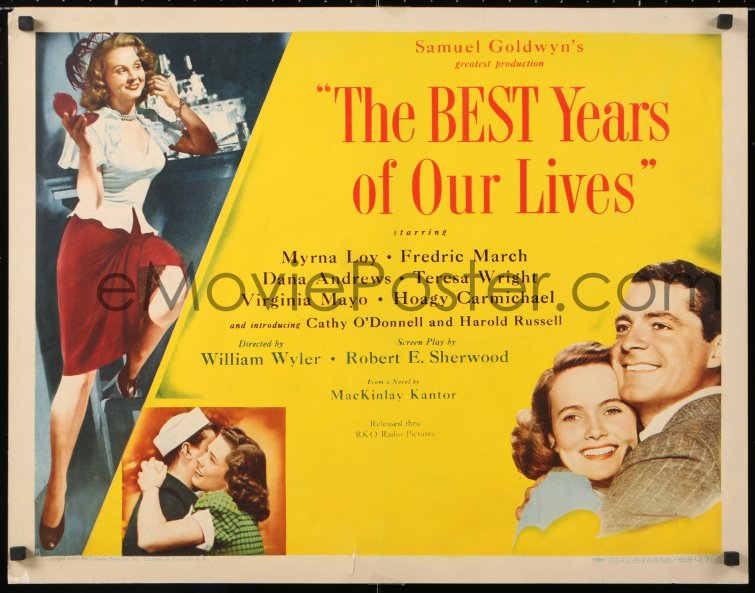
Ayn Rand had been particularly upset about the 1947 HUAC hearings because she wanted to focus on films such as Best Years of Our Lives which she considered to be communist inspired.  Rand claimed the depiction of the banker undermined capitalism and promoted communism.  She told her biographer Barbara Branden that she later spoke to HUAC chairman Parnell Thomas and complained bitterly about her treatment before the committee.  She said that Song of Russia was an ‘unimportant movie’ and it was not the worst Hollywood had done.  For Rand, it was much more important to show the ‘really serious propaganda’.[6] The fact that Rand may have been able to approach the head of the committee to complain about the way she had been interviewed strongly indicated that the friendly witnesses were stage managed.  No unfriendly witness had such an opportunity.

Ayn Rand had been particularly upset about the 1947 HUAC hearings because she wanted to focus on films such as Best Years of Our Lives which she considered to be communist inspired. 

Image courtesy of eMoviePoster.

In their survey of films about the Second World War, Koppes and Black have shown that the underlying message of films about the home front was one of promise.  Sacrifices made during the war would bring security and prosperity in the post-war world.  They concluded that Hollywood helped foster the social myth that social problems were the result of individual flaws.  Problems could be easily identified and simply resolved.[7]  The success of The Best Years of Our Lives in 1946 reflected an appetite for a more realistic approach by audiences and film makers after the Second World War to social problems.  The film contained muted, but well focused criticism, of the capitalist system and the hardships faced by returning servicemen.  Although the film was critical of American society, it was also optimistic, with all the characters adapting to their new lives.  In 1946, the film scooped the Oscars and was the most successful film of the year.  After the investigations of 1947, director William Wyler claimed that he wouldn’t be allowed to make films such as The Best Years of Our Lives anymore because of HUAC.  He warned that the committee was making decent people afraid to express their opinions by creating fear in Hollywood.  Wyler said fear would lead to self-censorship and eventually the screen would be paralysed.[8] These films were bitterly opposed by ultra-conservatives such as Ayn Rand because they criticised the aspects of the capitalist system.  According to Rand, Thomas said that because the press coverage had been so damning, that if an acclaimed film like Best Years of Our Lives was attacked, there would be a furor.[9] 

Wyler’s warnings about censorship seem unjustified.  Several films were made on sensitive topics such as racial prejudice from 1947 through to 1951.  These films included Crossfire (1947), Gentleman’s Agreement (1947), Pinky (1949), Home of the Brave (1949), Intruder in the Dust (1949), No Way Out (1950), and Storm Warning (1950).  Even westerns began taking a liberal turn with films such as Broken Arrow (1950) and Devil’s Doorway (1949) depicting Indians in a positive light.  To varying degrees these films showed that Hollywood could tackle social subjects well.  Capitalism was also the subject of allegorical attack.  Abraham Polonsky made two successful radical films in his short-lived film career as screenwriter and director in the 1940s.  Both Body and Soul (1947) and Force of Evil (1948) have been read as Marxist critiques of capitalism.[10]  All My Sons (1948), based on Arthur Miller’s play, depicted an industrialist was willing to sell defective planes to the Airforce to stay in business.  After 1951, there was no such confusion in the political message from Hollywood.  The diet of films was straight anti-communism with no liberal trimmings. This brief flowering of liberal and radical films was cut short in 1951 at the time of the second HUAC investigation of Hollywood and the lead up to the 1952 Presidential election. The blacklist was now in full force and the content of films was effectively being censored.


[1] Cobbett Steinberg, Reel Facts: The Movie Book of Records, Vintage, New York, 1982, p. 20.

[2] For a treatment of the fears of the liberals in the Kennedy administration see David Halberstam The Best and the Brightest, Fawcett crest, USA, 1973.

[3] Motion Picture Alliance For the Preservation of American Ideals, Screen Guide For Americans, 1947 p. 1. See also Branden, p.199

[4] ‘Spotlight on Hollywood’, 9 October 1947, Cecil B. DeMille Archives, Box 212, Folder 1.  Tobacco Road was directed by John Ford and Little Foxes was directed by William Wyler. 

[5] For a full account see Kevin Brianton, Hollywood Divided. Lexington: University of Kentucky Press, 2016.

[6] Branden, Ayn Rand, p. 201.

[7] Clayton R. Koppes and Gregory D. Black, Hollywood Goes To War: How Politics, Profits and Propaganda Shaped World War II Movies, Free Press, New York, 1987, pp. 143-184.

[8] Gordon Kahn, Hollywood on Trial, Boni and Caer, New York, 1948, p. 221.

[9] Ibid., p. 201. 

[10] Peter Roffman and Jim Purdy, The Hollywood Social Problem Film: Madness, Despair and Politics From The Depression to the Fifties, Midland, USA, 1981, p. 278.

Failure of early post-war anti-communist films

Dr Kevin Brianton

Senior Lecturer, La Trobe University

In Jet Pilot, John Wayne played an American pilot who takes the Russian defector on a tour of American military bases and demonstrated the United States military prowess. 
Image courtesy of eMoviePoster.

While the mood of the United States was anti-communist, cinema depicting the politics was not popular. Perhaps one of the main reasons for the failure of the anti-communist message in American cinema was the amount of studio interference in these films. There were often trivial reasons for the failure of the films.

Director Joseph Von Sternberg was listed as the director of Jet Pilot, which begun production in 1950, and was finally released in 1957, and was produced by Howard Hughes.  Von Sternberg had been Hollywood directorial royalty in the 1930s, but his fortunes had declined by the early 1950s. RKO had already flopped with I Married A Communist and The Whip Hand, and its third attempt at anti-communist propaganda almost failed to get a release.  The plot was about a Russian pilot, played by Janet Leigh, who defected to the United States.  John Wayne played an American pilot who takes the Russian defector on a tour of American military bases and demonstrated the United States military prowess.  He then faked a defection to feed false information to the Russians.  The pair fell in love and she helped him escape back to America.  Von Sternberg loathed the picture and resented the amount of studio interference. 

“I was told, step by step, day by day, movement for movement, word for word, precisely what I was to direct … My name is on the film as director, and there are other names also to which are given credit are just as shadowy, but the names of all those who had a finger in the celluloid pie are mercifully omitted.”[1] Studio interference played a key role in the poor quality of these films particularly at RKO.

The Big Lift (1950) was one of the few anti-communist films with a liberal view of the world. 

Image courtesy of eMoviePoster.

Not all anti-communist films were unbalanced in their approach.  The Big Lift (1950) was one of the few anti-communist films with a liberal view of the world.  It focused on the story of the Berlin Airlift in 1949 when the Russians blockaded the city and the western allies began supplying Berlin with all its needs from the air.  It was depicted as dangerous work and the film showed a quiet confidence in America in dealing with the communists.  The airlift was physically and mentally demanding on aircrews who were forced to work long hours to supply the city with food and coal.

One of the airmen, Danny MacCullough, played by Montgomery Clift, spent a day in Berlin and travelled through the Russian sector to see the life of ordinary Berliners.  Russian soldiers searched a railway carriage for smugglers and one man informed on a women for smuggling coffee.  The coffee was confiscated and the Russians left.  The crowd in the train was about to vent its anger on the man, when he revealed that he was a carrying a huge parcel of coffee and gave the woman, twice the amount she was smuggling.  The Russians were shown as strong but think-headed and easy to deceive.

In a separate incident another American airman Hank, played by Paul Douglas, debated the merits of the American system with a critical communist.  She said that American democracy was a farce as the results were determined by big business.  Hank argued that in the 1948 election, President Truman was written off by the newspapers and just about everyone else.  But in the end, Truman was elected by the people, despite what a big business and the papers were saying.  This was an interesting scene as it was one of the few where the merits of communism and capitalism were actually debated.  The debate was slanted against the communists, but it was clear that writer and director George Seaton was not afraid of communism and felt it could be dealt with through intelligent debate and, if necessary, through the sensible use of force.  At a later time, he spoke about his research for this film, and of being held by the Communists for 56 hours on a dirty train with his wife and daughter after attempting to enter Berlin. Seaton quoted the organizer of the airlift General Lucius D. Clay, who said that if we “resort to totalitarianism to defeat totalitarianism we have lost our democratic soul by doing it.” Seaton’s film even contains some comedy which was lacking in other anti-communist films of the period.  Seaton’s effort would be the final liberal statement from Hollywood on communism for some time.  The film was ranked at 91st by Variety for 1951.[2]

The anti- communist plots of some films were often absurd.  In Tokyo Joe (1949), a plot to return Japanese militarists was described as ‘communist inspired and communist directed’.  This ludicrous idea was either a last minute rewrite of the script or a dubbing of the original soundtrack.  From internal evidence I the film, it appeared as though the words were dubbed at some late stage.  The voice of the General talking to Humphrey Bogart goes oddly deep while this was being said.  The words were also spoken when the camera was focused on Bogart.  This suggests dubbing as it would be difficult to synchronise the General’s mouth movements with his speech.  In either event, the communist element plays no logical part in the film at all.  Communism was not mentioned again.


[1] Joseph von Sternberg, Fun In A Chinese Laundry, Secker & Warburg, London, 1965, p. 282.

[2] Variety, 3 January 1951.  A film called Destination Moscow is listed at 88th.  The film is not listed in Halliwell’s Film Guide, 5th edn, Paladin, London, 1986, but it would be reasonable to conclude that it was an anti-communist film.

The Red Menace (1949)

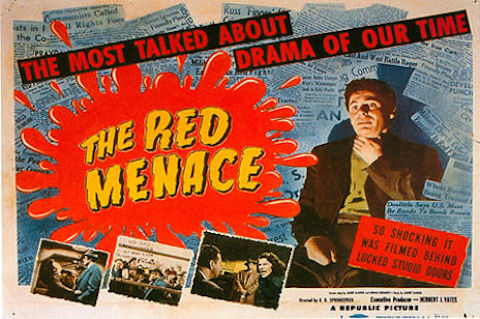
The Red Menace looked at the links between illicit sex and communism.

Kevin Brianton

Senior Lecturer, La Trobe University

The apparent links between illicit sex and political subversion were a central theme of many anti-communist films. In The Red Menace (1949) directed by R.G. Stringsteen, an ‘impressionable young man’ called Bill Jones was seduced and indoctrinated by a communist agent.  He was angry about being cheated in a land deal.  He was then taken to a demonstration against a local real estate agent which was orchestrated by communist agitators to become violent.  As the crowd attacked the real estate office, the violent demonstration was broken up by the police.  The narrator said:

The introduction of Bill Jones to communist strategy; a misguided young man fallen under the spell of Marxian hatred and revenge.  Unaware of that he is only the tool of men who would destroy his country.  The signs [of the demonstrators] don’t tell of a whole wide Marist racket intent on spreading dissension and treason.[1]

Two days later, Bill Jones was taken along with other recruits to introductory classes at workers school where he was taught Marxist principles, strategy and tactics.  The narrator said the classes explain the basis of communism.

It teaches that man is the product of natural forces which are constantly changing.  There are no positive values, no external principles of right and wrong.  Actually it is the old doctrine of atheism sugar-coated with highbrow terms.  It says that men cannot be responsible to anyone except the totalitarian socialist state and yet the American communist party claim that they do not wasn’t to overthrow the government by force.[2]

Towards the end of the film, Bill Jones comes to his senses and decides to quit the party, but his communist girlfriend Anna Petrovka cannot because she had signed in her immigration papers that she was not a communist. The Party need only send her card to the immigration department and she would be deported back to Eastern Europe.  The studios were once again sending out the message that those who are involved in the communist party could never leave.

Yet the irony was that the communist party in Red Menace seemed to be more interested in stomping on any deviation than in subverting the United States.  One member was murdered after leaving the party, another committed suicide when forced to recant that Marxism was based on Hegel’s writing, and another broke down and confessed to murder after almost three minutes of mild questioning by immigration officials about illegally entering the country.  One member refused to attack an ex-member in their newspaper and then left the party.  Another was influenced by the speech of her priest and returned to her family.  The two remaining communists that we see were about to be arrested by the police.  The communist party appeared to be absolutely useless.

Despite these major organisational flaws, social problems were worsened by the communists.  The audience was told that the greedy real estate agent would be dealt with, but that it ‘takes time’.  The communists promised a speedier solution, but it was merely a trap to recruit people to the party.  They also claimed to be against racism, but call Italians “Mussolini spawned dago’s’ and Blacks ‘African Ingrates’.  The communists admitted that they were merely using people’s suffering to further their own cause.

The only real solution to the communist threat was religion, as one priest in the film said:

God isn’t very popular in some countries, just as he wasn’t in a lot of countries which are now dead.  The atheistic systems are always based on hatred.  Race hatred when they are Nazi, class hatred when they are communist.[3]

According to the priest, ‘the best way to defeat communism is to live Christianity and American democracy everyday.’[4]  These ideas woudl re-emerge with the biblical epics, whihc wer far more popualr than the overt anti-communist films..


[1] The Red Menace, (d) R.G. Springsteen, (w) Albert LeMond, Gerald Gerharty.

[2] Ibid.

[3] Red Menace op cit.

[4] ibid.

I Married a Communist or Woman on Pier 13 (1949)

Dr Kevin Brianton

Senior Lecturer, Strategic Communication, La Trobe University


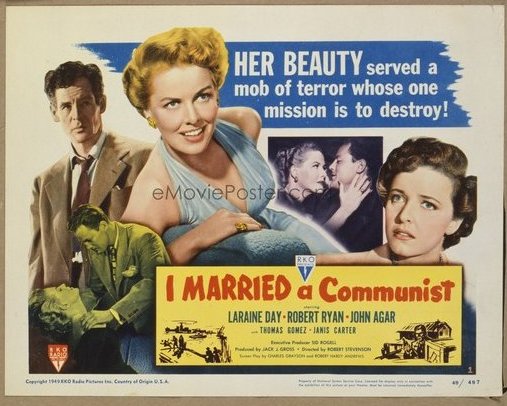
I Married a Communist was one of the most distinctive of the early anti-communist films.
Image courtesy of eMoviePoster.

The initial failure of anti-communist films deterred some filmmakers.  A Hollywood producer John Sutherland scrapped plans for anti-communist film Confessions of an American Communist after he found that exhibitors were ‘indisposed towards films touched with propaganda’.[1]  But the major studios were not deterred and a series of anti-communist films followed in 1949 including The Red Menace, The Red Danube and I Married a Communist.

I Married a Communist or Woman on Pier 13 (1949) was one of the most distinctive of the early anti-communist films.  It was the second of Howard Hughes’ attempts at an anti-communist film,[2] and was an important film for RKO, as the New York Times noted, because it signaled the switch at the studio from its traditional liberal views Hughes’ ultra-conservative values.[3]  The film was beset with production problems, the screenwriters had to ensure its attacks on communist unions were not seen as attacks on all unions.  Making the distinction was proving difficult.  The writers had to create a story about industrial unrest on dockyards without ever mentioning the word ‘strike’.  Instead they had to contend with ‘walk-out’, or ‘work stoppage’ or ‘tie-up’.  Actors Merle Oberon and Paul Heinreid were pressed into appearing in the film and then walked out.[4]

The film was also used as a political barometer for RKO directors.  Joseph Losey along with 13 other directors were offered the job before it was picked up by Rovert Stevenson.  Losey told that the film was the ‘touchstone for establishing who was a “red”’.  Directors were offered I Married a Communist and if they turned it down, they were blacklisted.  Nicholas Ray was also one of the directors offered the film.  He began working on sets and on the script thinking that the film was so idiotic that it would never be made.  When he realized that it was going to be produced, he walked off the set.[5]  Ray later claimed that he told Hughes that the film was a ‘loser’ and wanted nothing to do with it.[6]

After its first disappointing commercial screenings, the film was retitled The Woman on Pier 13, in the hope that a hint of sex and mystery on the waterfront would attract the crowds.[7]  Despite the screenwriting problems about unions, the film was, in large measure, a smear campaign against the head of the West Coast Longshoreman’s and Warehousemen’s Union Harry Bridges.  The union leader was born in Australia and FBI head J. Edgar Hoover tried hard and failed to have him deported.[8]  The choice of Bridges as a target by the studio may also have been made because of the links between the ILWU and the Hollywood’s 10’s Dalton Trumbo who had been a noted supporter of the union leader for many years.[9]  In return, the ILWU had also been a strong promoter of the Hollywood 10.[10]  The ultra-conservative director Cecil B. DeMille had said that Harry Bridges should be in jail and wanted laws to stop him from having a ‘stranglehold on a critical American industry’.[11]

The film focused on Brad Collins, played by Robert Ryan, who played a reformed communist.  He was blackmailed by his former colleagues who threatened to tell his wife and employer of his communist and criminal past.  Ryan, who worked for the waterfront management, was forced to prolong a litter union dispute on the waterfront.  His brother-in-law Don Lowry was indoctrinated by the communists to lead the waterfront union towards confrontation.  The communists acted by manipulating key agents in sensitive positions.  With agents in management and in the union, the communists inflamed and prolonged an industrial dispute which caused economic damage to the United States.  They did this because Moscow had ordered that the docks had to be ‘tied up for 60 days’.[12]  Eventually Lowry became aware of he communist plans and was killed by them.  Angered by Lowry’s murder, Ryan fought and exposed the communist ring, but while regaining his honour, he lost his life.

Throughout the film, the structure of the Communist Party was not made clear; the leader Thomas Gomez took his orders from a shadowy figure on a telephone.  The appearance of this shadowy figure who directed operations from behind the scenes, and who was never caught, was one of the consistent images in anti-communist films.  The figure appeared to be rich and wealthy; a member of the establishment.  The film implied that communists were present throughout society and their senior officials occupied high levels of power.  This hinted that the officials were connected with the Democrat administration.

Former communist membership could be an instrument of blackmail.  If Ryan’s communist past – which included murder – were discovered, he was told he would lose both his wife’s love and his career at the shipyards.  This was a clear attack on those Hollywood radicals who defended their party membership on the grounds of a youthful indiscretion.  Party membership was a lifetime commitment, regardless of the intentions of the individual.  Once a member of the party, it took an extreme act of contrition to remove the taint.  I Married a Communist can be read as Hollywood’s version of its own internal politics.  The hysterical tone of the films and the slimy depiction of communists was a reflection of how the moguls saw the communist threat.  In one scene, an FBI informer was killed by the communists and this was a calculated insult to those who refused to testify.  Informing on communists was depicted as an act of bravery.  Those who attempted to purge themselves of their past were the only ones who could be free from the taint of communism, just as those who did not recant before the various committees could ever again be trusted.

Exploration of the reasons for becoming a communist were confined to those weak-minded young men who were seduced – both literally and metaphorically – by communists.  The script of I Married A Communist claimed that one party member can indoctrinate a thousand Americans.[13]  The means of indoctrination looks to be sexual in nature.  Critic Nora Sayre has noted that there was a common figure running through the anti-communist films called ‘the Bad Blonde’.  The role of the blonde was to seduce ‘impressionable’ young men into joining the Party.[14]  Certainly as the communist agents Nixon[15] and Christine discussed indoctrination of Lowry in I Married A Communist, they equated it with seduction.

            INTERIOR DARKROOM-NIGHT

We begin on Christine’s hands rinsing a short piece of Leia film in tray-pull back as she hands the film to Nixon, who slips it in viewer and studies it closely.

CHRISTINE:   (in moment) Important?

NIXON: (continues studying film) Very.  As a matter of fact, it’s what I’ve waited for – for he last eight months.  (still studies film while questioning) How close is young Lowry to his brother-in-law?

CHRISTINE: Very close.  Why?

NIXON: (still studies film)  In that case – I’ve changed my mind about him.  Continue with his indoctrination.  I’ll inform headquarters you personally guarantee he’ll be delivered for use when and if he’s needed. 

Christine takes this with mingled reaction: pleasure about Don, puzzlement about Nixon’s new purpose.  She smiles answering:

CHRISTINE: (with slight mockery) Why – that will be a very interesting assignment- that I will enjoy very much.

He gives her an unreadable side-look – hands strip of film to her.

NIXON: Destroy it.

She drops film I tray – takes bottle of chemical from shelf.  Nixon exists.  Christine pours acid on film.  Fumes and vapor rise.  She still smiles – about herself and Don.[16]

Anti-intellectualism was another theme of I Married a Communist.  In one scene, communist agent Nixon reminded Brad Collins of his communist past.

            Nixon sits – opens briefcase – rummages through folders.

NIXON: (during this action) I’m a student of contracts.  They’re what makes this country of ours fabulous to the rest of the world. (finds what he seeks) On one hand, we have Bradley Collins – the great success story.  On the other – here I have the record of a very unsuccessful young man named Frank Johnson.

                        Brad shows no visible reaction – asks:

BRAD: Who’s he?

NIXON: He was typical of the lost generation – produced by the 30’s.  He left school – ambitious, strong, intelligent – hunting a job, to make his start up ladder.  Unfortunately – there were no jobs.

BRAD: (calmly) Why tell me about him?

NIXON: I’m coming to that – Mr. Collins. (consults documents) Embittered – and violent by nature – Frank Johnson joined the Young Communist League – then became a full fledged member of the Party… (seem to skip through document – hitting only the salient details).. Party card listed Frank J… Agit-prop activities, strikes in New Jersey … Very prominent in strong-arm work .. Then suddenly – broke all connections with the Party and disappeared … Reason unknown.

He stops – puts folder down – removes spectacles in a gesture we’ll learn is characteristic.  With spectacles off, Nixon is a changed man: cold, hard, the complete “intellectual”

NIXON: (continued) … Or was unknown until now…[17]

For these screenwriters being an intellectual was to be suspect, and being ‘the complete “intellectual” was to be a communist.


[1] New York Times, 4 August 1948.

[2] The first was a film called The Whiphand (1951) which was originally on Nazis but had the focus changed to communists because of Hughes’ ownership of RKO.

[3] New York Times, 5 December 1948.

[4] New York Times, 5 June 1949.

[5] Tom Milne (ed.).  Losey on Losey, Secker & Warburg, London, 1968, pp. 73 – 76.

[6] Michael Goodwin and Naomi Wise, No. 6. ‘Nicholas Ray: Rebel!’ Take One, 5 January p. 11.

[7] Andrew Velez (ed.).  Robert Stevenson’s The Woman on Pier 13, RKO Classic Screenplays, Frederick Ungar, New York, 1976.  From introduction by Andrew Velez.  No page Number.

[8] Harry Bridges was the president of the International Longshormen’s and Warehousemen’s Union.  He is remembered for leading a strike in 1934 on the West Coast which eventually became a general strike.  The Congress of Industrial Organizations expelled the ILWU on the grounds of communist domination.  Bridges never denied his sympathy for communist and radical causes, but always denied being a party member.  Curt Gentry, J. Edgar Hoover: The Man and His Secrets, Norton, New York, 1991, pp. 245 – 264.

[9] Bernard F. Dick, Radical Innocence: A Critical Study of the Hollywood Ten, Universtiy Of Kentucky Press, Lexington, 1989, p. 219.

[10] Dalton Trumbo to

[11] Keep Faith, a speech before the American Legion Convention, Dinner Kay Auditorium, Miami, Florida, 15 October 1951, Box 212, Folder 1, Cecil B. DeMille Archives, Brigham Young University, Utah, USA.

[12] Velez, Woman on Pier 13, p. 31.

[13] Velez, Woman on Pier 13, p. 31.

[14] Nora Sayre, Running Time: Films of the Cold War, Dial, New York, 1982, p. 81.

[15] The script refers to the communist leader as being Nixon, but the final cast list gives the name as Vanning.  It may have been changed to avoid confusion with HUAC member, later US President, Richard Nixon.  As the screenplay refers to him as Nixon, this name will be used.

[16] Velez, Woman on Pier 13, p. 33.

[17] Velez, Woman on Pier 13, p. 13.

The cinematic anti-communist crusade

Dr Kevin Brianton

Senior Lecturer, La Trobe University, Melbourne, Australia

The anti-communist crusade of the movie moguls began when they signed the Waldorf Declaration on 24 November 1947 which was the same day that Congress met to approve the HUAC contempt citations. 

The anti-communist crusade of the movie moguls began when they signed the Waldorf Declaration on 24 November 1947 which was the same day that Congress met to approve the HUAC contempt citations.  The declaration was supported by the Motion Picture Association of America, the Association of Motion Picture Producers – the studio heads – and was signed at the Waldorf-Astoria Hotel in Manhattan.[1]  They voted to sack any employee who would not say under oath that he or she was not a communist.  This meant that the Hollywood 10 were sacked without compensation.  The studio heads also voted to refuse to employ any person with communist beliefs.[2]

The Waldorf declaration was the action of men who were quite prepared to sacrifice their political independence of financial gain.  Attacking the communists did not appear to be a high price to pay; after all it was only a small group of writers who were being sacked.  Moverover, the spirited resistance against the HUAC-style investigation in 1941 was done at a time when Roosevelt was firmly entrenched in power.  The political pendulum had swung to the right and the studios were attempting to appease their new political masters.

The Hollywood 10 soon lost most of its support when many in the Committee for the First Amendment dropped their backing for the group.  Some believed that they also could also lose their jobs and others thought the Hollywood’s 10’s behavior before the committee as unforgivable, and support for the group began to fade quickly in the film industry.[3]  In subsequent HUAC investigations, there was little or no effective organised opposition.

The HUAC investigations were, in part, a reaction to the Roosevelt years and the close relationship of the film industry with its administration.  But there were other links between the HUAC investigators and Hollywood.  The film industry had encouraged the myth that America was the unblemished ‘good guy’ of world politics, it now had to reap some of the bitter fruits of that wartime propaganda.  The myth helped give Americans a feeling of infallibility which assisted in their massive war effort.  In fostering the belief that to fight America was to do wrong, the films of the Second World War helped create the mental framework for the cold war.  The adjustment from Nazi Germany to communist Russia as the Untied States central enemy was surprisingly swift.[4]  But it did raise some nagging problems.  If America was always right, and Russia was wrong, why was the United States allied to the country in the first place?

The answer for the American right – and in particular the HUAC investigators – was a vast conspiracy stretching from Russia, to the White House, onto communist screenwriters in Hollywood.  Historian Richard Hofstadter has written about the attractiveness of the conspiracy theory to Americans and its frequent explosions in American life.[5]  A common theme of these theorists was that small groups with outside backing were seeking to control the United States by nefarious means.  Conspiracy theories were a well established part of American political culture and they flourished during the uncertain post-war period.  According to the conspiracy theorists, the Roosevelt administration had a long term plan to undermine capitalism in order to bring the economy under the control of the Federal Government and to pave the way for socialism or communism.  HUAC Investigator Robert E. Stripling believed that Hollywood was in danger of falling under the control of communists, just as other industries had already done.[6]

The scapegoats for the conspiracy theorists were the communist and left-wing writers who worked on the ‘praise Russia’ films of the Second World War.  Screenwriter Howard Koch had been ordered by Warner to make Mission to Moscow and is efforts had been praised by Warner.[7]  Koch was subpoenaed but did not testify, he placed full page ads in the Hollywood trade papers saying that he was not and had never been a communist, but reserved the right not to say it to HUAC.[8]  Koch’s strong liberalism had shown out in films such as In This Our Life (1942) and his talent in Sergeant York (1941) Casablanca (1943), and Letter From an Unknown Woman (1947).  His efforts counted for nothing and his refusal to answer HUAC’s questions, on the principle of his constitutional rights meant that he did not work in Hollywood for another 12 years.  The studio heads were not interested in Justice, they were interested in scapegoats and Koch was one of those blacklisted as a result.

For other members of the Hollywood 10, there were more sinister motives for their blacklisting.  Action in the North Atlantic screenwriter John Howard Lawson was a central figure in the formation of the Screenwriters Guild.  Eradicating him would also relieve the studio heads of a radical and determined union leader.  Ring Lardner Jr had always been a thorn in the side of the ultra-conservative Hollywood leaders.  In November 1945, Lardner wrote a long, highly critical and funny article for Screenwriter on the ultra-conservative Cecil B. DeMille where he relentlessly attacked and satirized the director and his politics.  He focused sharply on the Cecil B. DeMille Foundation for Political Freedom writing:

All policy and action are determined by the self perpetuating board of directors, yet every rank and file member is assured his political freedom to read and listen to whatever pronouncement Mr DeMille is moved to make.[9]

He described the foundation as essentially a right-wing organisation which had attacked the rights of unionists to make a united stand.  The editor of Screenwriter was Dalton Trumbo and the managing editor was Gordon Kahn.  All three became member of the Hollywood 19.  The article was specially transcribed the DeMille and left in his papers in a file on background information on communists for his autobiography.[10]  DeMille was often accused by his political opponents of providing names to HUAC and it seems clear that the selection of Lardner, Trumbo and Kahn was no accident: Hollywood’s right-wing was exacting revenge.

Many have argued that it was the economic decline of Hollywood which forced the studio heads to retreat so vigorously.[11]  However, he moguls had opposed intervention strongly before the war.  It was not economic pressures which drove them to make the Waldorf declaration.  The year 1947 was the second most successful year for the cinema in its history.[12]  There was a slight dip from the figures for 1946 which had been a record year for the industry, but they were not under savage pressure.  Anti-trust legislation and television were on the horizon, but in general the motion picture industry was sound.  The Waldorf declaration and the consequent blacklisting was a personal failure of nerve by the studio heads to fight the HUAC investigations.

The studio heads did not realize that the declaration opened the way for constant sackings and suspicion.  In trying to get a quick fix to a complex problem, the studios had allowed themselves to be held hostage by any patriotic organisation which called any actor, director or writer a communist and promised to picket a film carrying their name.  These organisations were extremely demanding.  When a person was named as a communist by a patriotic organisation of some description, the studio heads either had to get the person concerned cleared through certain channels or have them blacklisted.  Red Channels was one example of the publications circulating at the time which itemized the various offences of actors and writers supposedly in communist from organisations.  The evidence was often wafer thin, but as the introduction to Red Channels showed the editors were not interested in subtleties.

The information set forth in the following report is taken for records available to the public.  The purpose of this complications is threefold.  One, to show how communists have been able to carry out their plan of infiltration of the radio and television industry.  Two to indicate the extent to which many prominent actors and artists have been inveigled to lend their names,  according to these public records, to organisations espousing Communist causes.  This, regardless of whether they actually believe in, sympathize with, or even encourage actors or artists from naively lending their names to Communist organizations or causes in the future.[13]

The Waldorf Declaration and the acquiescence of the studio heads to the HUAC investigators opened the way for chaos in the filmmaking industry.  Blacklisting could occur for being a member of a political group, attending a meeting or signing a petition.  The Blacklisting of an actor was not a one way street.  His or her name could be cleared by approaches to the various agencies concerned.  Certain shadowy figures during the blacklist era made a living attempting to clear people so that they could return to work.  Indeed some groups would cast aspersions on a person’s character and then offer to redress the balance.  This led to a continuing round of clearances of actors and writers through various organisations.  Blacklisted writers could also still write for the studios using fronts to submit their scripts.  People were told to avoid blacklisted people or at least not to meet them in public.[14]

The third phase of the crusade against communism was the release of a series of anti-communist films.  Actor Adolphe Menjou, one of the friendly witnesses before the HUAC hearings, demanded that the studios produce anti-communist films.

I believe it would be an incredible success… I think it would be a very wonderful thing to see one made.  I would like to see a picture of the Bulgarian situation; … I would like that shown to the American public to see communism as it actually is.  I would like to see the brutal beatings, the stabbings and killings that go on through Europe… We showed many anti-Nazi pictures.  I see no reason why we do not show anti-communist pictures.[15]

The studios responded quickly to Menjou’s call.  The first anti-communist film to roll out of the studios was Ninotchka which was re-released by MGM in November 1947.  Earlier the State Department had been so impressed with the film’s anti-communist message that it helped release it in Italy to help undermine the Italian communists in 1946 elections.[16]

Ninotchka was quickly followed by The Iron Curtain which was released by RKO in May 1948.[17]  The title of the film was the image for Churchill’s famous speech of an iron curtain descending across Europe which he made on 5 March 1946.[18]  This film was similar in style to the successful Confessions of a Nazi Spy released before the war, and it also shared the same writer in Martin Krims.  The film concentrated on the defection of a Russian clerk Igor Gouzenko, played by Dana Andrews, who defected in Canada.  Even with its novelty value, and the huge publicity of the HUAC hearings, the film was ranked 64th in the year’s rentals.[19]


[1] Otto Friedrich, City of Nets, Headline, London, 1986, p. 332.

[2] Phillip French, The Movie Moguls, Penguin, Harmonsworth, 1969, p. 154.  Producers Sam Goldwyn, Walter Wagner and liberal Dore Schary opposed the declaration.

[3] Barry Norman, Talking Pictures: The Story of Hollywood, Hooder and Stoughton, London, 1987, p. 205.

[4] Les K. Alder and Thomas G. Paterson, ‘Red Fasciasm: The Merger of Nazi Germany and Soviet Russia in the American Image of Totalitarianism, 1930s-1950s, ‘American Historical Journal, vol. 75, no. 4, April 1970, pp. 1059 – 1061. Alder and Paterson discuss how easily the substitution from Germany to Russia occurred as a totalitarian enemy.

[5] Richard Hofstadter The Paranoid Style In American Politics and Other Essays, Jonathan Cape, London, 1966, pp. 3 – 40.

[6] Robert E. Stripling, The Red Plot Against America, Bell, Pennsylvania, 1949.

[7] Jack Warner to Howard Koch, November 24, 1942, Howard Koch Collection, Wisconsin Center for Film and Theatre Research in David Culbert (ed.). Mission to Moscow, Wisconsin Warner Bros Screenplay Series, University of Wisconsin Press, Wisconsin, 1980, pp. 264 – 265.

[8] Norman, Talking, p. 205

[9] Ring Lardner Jr., ‘The Sign of the Boss’, The Screen Writer, November 1945, pp. 1 – 12.  Transcript in Box 29, Folder 7, Cecil B. DeMille Archives, Brigham Young University, Provo, Utah, USA.  The Cecil B. DeMille Foundation for Political Freedom was formed to campaign for right-to-work laws and against communist infiltration.  DeMille set up the foundation when he refused to pay one dollar to the American Federation of Radio Artists to fight right-to-work legislation on the California state ballot in 1944.  The foundation was closed soon after his death in 1959.

[10] Other names in the files include writers Albert Maltz, Sidney Buchman, and John Howard Lawson who were all blacklisted.  Edward G. Robinson and Elmer Bernstein were described as not communist.  Actor Howard Da Silva was also described a ‘commie’ out to get DeMille.  All appeared before HUAC. Box 29, Folder 7, Cecil B. DeMille Archives.

[11] French, Moguls, p. 153.

[12] Garth Jowett, Film: The Democratic Art, Little Brown, Boston, 1976, p. 473.

[13] American Business Consultants, Red Channels: The Report of Communist Influence in Radio and Television, New York, 1950, p. 9.

[14] Larry Ceplair and Ken Englund, I, Doubleday, New York, 1980, pp. 386 – 397.

[15] HUAC Hearings, p. 106.

[16] Dorothy Jones, ‘Communism and the Movies’ in John Cogley, Report on Blacklisting, The Fund For The Republic, New York, 1956, p. 300.

[17] For a complete discussion of the film see Daniel J Leab, ‘The Iron Curtain (1948): Hollywood’s First Cold War Movie’, Historical Journal of Film, Radio and Television, Vol 8, No. 2, 1988, pp. 153 – 188.

[18] Rhode, Robert James (ed.), Winston S. Churchill: His Complete Speeches 1879 – 1963, Chelsea, London, 1974, p. 7285.

[19] Variety, 5 January 1950 estimated that the film made $2 million in rentals.  No other 1949 anti-communist made the lists.

HUAC hearings begin

Dr Kevin Brianton

Senior Lecturer, La Trobe University, Melbourne, Australia

Ayn Rand wrote The Screen Guide for Americans for the Motion Picture Alliance of American Ideals

The MPAPAI’s efforts were reinforced by the studio heads’ desire to crush the studio unions and the obtain political favour with the emerging Republican and McCarthyite forces.  The efforts of the alliance were not wasted.  The conflict between the ultra-conservatives and the radicals came to a head at the HUAC hearings into communist involvement in Hollywood on 20 October 1947.  The Washington-based committee planned to interview both communist and anti-communist witnesses for the next 10 days.

In January 1947, studio head Jack Warner had received a Medal of Merit from the Federal government for his work in government training films, yet in October his studio was being investigated for subversion.[1]  With the Republicans in control of Congress since the 1946 elections, it was clear that the political pendulum was moving toward the right and Hollywood was one of the first targets.  The committee lined up several ultra-conservative leaders in Hollywood to begin the investigation.

HUAC has also subpoenaed 19 Hollywood producers, directors and writers as unfriendly witnesses.  Eleven of these had worked for Warner Brothers, the studio which produced the most wartime propaganda and had aligned itself with the Roosevelt administration.  The studio had also been prominent for its ‘social conscience’ films of the 1930s.[2]  The HUAC investigations had a special reason for singling out the Warner Brothers studio, for its film, Mission to Moscow, as it was based on the work of Davies, a prominent member of the Roosevelt administration.  If they could establish a link between the White House and the production of the pro-Russian pictures of the Second World War, it could cause the Truman administration enormous political damage, the type that was to occur later with the Alger Hiss trial.

Studio head Jack Warner assured the committee that no subversive propaganda had ever made it to the screen, not even in Mission to Moscow.  He was initially forthright in his defence of his studio.  Warner told the committee that if making Mission to Moscow in 1942 was a subversive activity, then so too were ‘the American Liberty ships and naval conveys which carried food and guns to Russian allies’.[3]  Warner defended Mission to Moscow as being necessary because of the danger that Stalin would make a treaty with Hitler if Stalingrad fell.  Such an alliance would lead to the destruction of the world.[4]  The film was designed to cement the friendship between the USSR and the United States in a desperate time.

Following studio heads Jack Warner and Louis B. Mayer came novelist Ayn Rand, who was considered by the committee to be an expert witness on the Soviet Union.  Her expertise was derived from her Russian origins and right-wing views.  Rand viewed Song of Russia for the committee and described at length its inaccuracies, failings and lies.  Her criticism of the film clustered around the depiction of Russian peasant life.. She said that at least three and a half million, possibly seven million people, had died from starvation in the drive to collectivization of farms and the film makes no mention of them.[5]  Rand said the depiction of Soviet village life was ridiculous.  Women were dressed in attractive blouses and shoes.  She said if any person had the food shown in the film in the Ukraine, they would have been murdered by starving people attempting to get food.[6]  Rand summed up her position on pro-Russia films like Song of Russia saying it was unnecessary to deceive the American people about the Soviet Union.

Say it is a dictatorship, but we want to be associated with it.  Say it is worth being associated with the devil, as Churchill said, in order to defeat another evil which is Hitler.  There may be a good argument for that.  But why pretend that Russia is not what it was.[7]

The hearings were highly unpopular at this state and the New York Times wrote in an editorial saying that the investigation was unfair and could lead to greater dangers than it was fighting.[8]  In Hollywood, the Committee for the First Amendment was formed by writer Phillip Dunne, directors John Huston and William Wyler and actor Alexander Knox to oppose censorship of films and to prevent a blacklist.[9] 

The group had a massive backing and took out huge advertisements in trade newspapers.  The Committee for the First Amendment wanted the Hollywood 19, as they were known, to take the first amendment, and do nothing else.  Instead, when the unfriendly witnesses were called they tried to answer the committee’s questions in their own way which led to shouting matches in the hearings.  The first unfriendly witness, screenwriter John Howard Lawson, attempted to yell down the committee saying it was on trial before the American people.  When he was finally dragged from the stand, he set a precedent for the remaining witnesses.  Other witnesses were simply asked if they had ever been a member of the Communist Party.  When they failed to answer, they were charged with contempt. 

On the 19 subpoenaed, ten were called before the committee and refused to testify citing constitutional rights of privacy and freedom of political thought and association.  Screenwriter and playwright Bertolt Brecht denied all knowledge of the communist party and later fled the country.  For unknown reasons, Chairman Parnell Thomas cancelled the hearings before the remaining nine were heard.

The Hollywood 10, as they became known, were sent to prison for contempt of congress and the rest were blacklisted from work in Hollywood.[10]  The group, along with most legal experts at the time, believed that their contempt charges would be overturned in the Supreme Court on the constitutional ground of the right to hold private political beliefs.[11]  Unfortunately for the Hollywood 10, two liberal judges died before their cases were heard and they were replaced by conservatives.  The deaths changed the political composition of the Supreme Court which then backed the contempt citations.  This decision by the Supreme Court opened the legal door for the McCarthyite era.  People were now in the position of taking either the fifth amendment protecting them against self incrimination and facing blacklisting and other harassment, or informing on people with communist views.


[1] New York Times, 27 January 1947.

[2] Richard Maltby, ‘Made for Each Other: The Melodrama of Hollywood and the House Committee on Un-American Activities’ in Phillip Davies and Brian Neve, (eds.). Cinema, Politics and Society in America, Manchester University Press, Manchester, 1981, p. 87.

[3] US Congress, House Committee on Un-American Activities, Hearings Regarding the Communist Infiltration of the Motion Picture Industry, 80th Congress, 1st sess., 20 October 1947, vol. 1169 (5) p.10.

[4] ibid., p. 34.

[5] HUAC Hearings, p. 85.

[6] Ibid., p.85.

[7] HUAC Hearings., p.89.

[8] New York Times, 23 October 1947.

[9] The signatories to the Committee for the First Amendment were Larry Adler, Stephen Morehouse Avery, Geraldine Brooks, Roma Burton, Lauren Bacall, Barbara Bentley, Leonardo Bercovici, Leonard Berstein, DeWitt Bodeem, Humphrey Bogart, Ann and Moe Braus, Richard Brooks, Jerome Chodorov, Cheryl Crawford, Louis Calhern, Frank Callender, Eddie Canto, McClure Capps, Warren Cowan, Richard Conte, Norman Corwin, Tom Carlyle, Agnes DeMille, Delmar Davesm Donald Davies, Spencer Davies, Donald Davis, Armand Deutsch, Walter Doniger, I.A.L. Diamond., L. Diamond, Muni Diamond, Kirk Douglas, Jay Dratler, Phillip Dunne, Howard Duff, Paul Draper, Phoebe and Harry Ephron, Julius Epstein, Phillip Epstein, Charles Einfeldm Sylvia Fine, Henry Fonda, Melvin Frank, Irwin Gelsey, Benny Goodman, Ava Gardner, Sheridan Gibney, Paulette Goddard, Michael Gordon, Jay Goldberg, Jesse J. Goldburg, Moss Hart, Rita Hayworth, David Hopkins, Katherine Hepburn, Paul Heinreid, Van Heflin, John Huston, John Houseman, Marsha Hunt, Joseph Hoffman, Uta Hagen, Robert L. Joseph, George Kaufman, Norman Krasna, Herbert Kline, Michael Kraike, Isobel Katleman, Arthur Lubin, Mary Loss, Myrna Loy, Burgess Meredith, Richard Maibaum, David Millerm Frank L. Moss, Margo, Dorothy McGuire, Ivan Moffat, Joseph Mischel, Dorothy Matthews, Lorie Niblio, N. Richard Nash, Doris Nolan, George Oppenheimer, Ernest Pascal, Vincent Price, Norman Panama, Marion Parsonnet, frank Partos, Jean Porter, John Paxton, Bob Presnell Jr., Gregory Peck, Harold Rome, Gladys Robinson, Francis Rosenwald, Irving Rubine, Irving Reis, Stanley Hubin, Slyvai Richards, Henry C. Rogers, Lyle Rooks, Norman and Betsy Rose, Robert Ryan, Irwin Shaw, Richard Sale, George Seaton, John Stone, Allan Scott, Barry Sullivan, Shepperd Sturdwick, Mrs Leo Spitz, Theodore Strauss, John and Mari Shelton, Robert Shapiro, Joseph Than, Leo Townsend, Don Victor, Bernard Vorhaus, Billy Wilder, Bill Watters, Jerry Wald and Cornel Wilde. Myron C. Fagan Documentation of Red Stars in Hollywood printed in Gerald Mast The Movies in Our Midst: Documents in the Cultural History of film in America, 2nd edn., Oxford University Press, New York, 1979, p. 549.

[10] The Hollywood Ten were screenwriters John Howard Lawson, Alvah Bessie, Dalton Trumbo, Lester Cole, Albert Maltz, Samuel Ornitz, Ring Lardner Jr; the writer-producer Herbert Biberman; the writer-producer Adrian Scott; and the director Edward Dymytryk.

[11] Hollywood on Trial, (d) David Helpern Jr, (w) Annie Resman.