Kevin Brianton, Senior Adjunct Research Fellow, La Trobe University
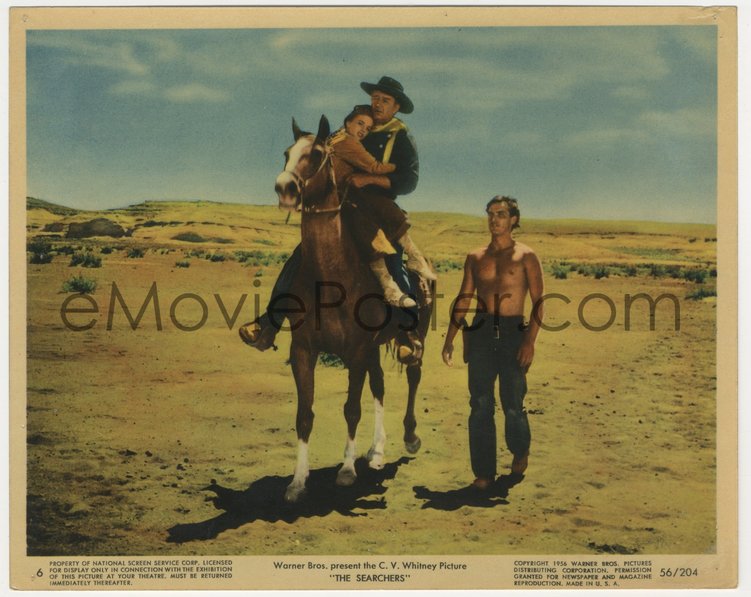
Vulture film critic Bilge Ebiri wrote that, in the latest cinematic version of “Wuthering Heights” (2025), when Jacob Elordi plays Heathcliff and rides a horse against a red sky, it looks like a scene out of The Searchers.[1] The film is based on the novel Wuthering Heights (1847), which is a novel about passionate, destructive love, and The Searchers (1956) is a Western about obsessive, racist hatred. They may seem worlds apart, but their central plots share a profound and compelling structural similarity.
Both narratives are driven by a central male figure whose obsession defines the plot and whose morality is deeply ambiguous. Heathcliff is an outsider – a foundling of unknown origins – who is consumed by his love for Catherine Earnshaw. When she chooses to marry the genteel Edgar Linton, his obsession turns into a decades-long, meticulously planned campaign of revenge against both families. He is brutal, manipulative, and vindictive.
Ethan Edwards in The Searchers is a Civil War veteran and outsider who returns to his family’s farm on the frontier. When his niece, Debbie, is abducted by Comanches – who also murder the rest of his family – he embarks on a long quest to find her. His motivation is a complex and dark mix of familial duty and a racist desire to “kill” or “save” her from being assimilated into the culture he hates. Both are brooding, violent, and morally compromised men driven by a singular, all-consuming obsession that isolates them from society and spans many years.
Both are Herculean characters capable of great feats of strength, but also destructive to their families. The core conflict in both stories revolves around a woman who is ‘lost” to the male protagonist, not just physically but culturally, as Heathcliff perceives Catherine Earnshaw as ‘stolen’ from him by Edgar Linton and the trappings of civilized society represented by Thrushcross Grange. Her choice is framed as a betrayal of their shared, wild nature. In a sense, she is assimilated into a world that is the opposite of who they are as a couple.
In The Searchers, the central question for Ethan—and the film—is whether Debbie Edwards can be ‘saved’ after being absorbed into Native American life. She is, to Ethan, stolen by a culture he despises. Both narratives feature a woman taken from the male protagonist by an ‘other.’ In Heathcliff’s case, it is civilized society; in Ethan’s, it is a Native American tribe. The story revolves around the male protagonist’s tortured response to this loss.
Apart from the two worlds, both stories use the passage of significant time as a key structural element, showing the protagonist’s obsession hardening over the years. In Wuthering Heights, the plot unfolds over the course of decades. After Catherine’s death, Heathcliff’s quest for revenge continues for nearly 20 years, as he systematically destroys the next generation to consolidate his power. In The Searchers, the quest is explicitly a seven-year journey. The film is structured around the changing seasons and the return of Ethan and his nephew, Martin, to the Edwards homestead at intervals, their mission perpetually unfulfilled. Both narratives reject a quick resolution, instead showing the corrosive, long-term effects of obsession as the protagonist’s singular goal stretches across years.
A key part of both stories hinges on a moment where the protagonist finally confronts the woman. Catherine and Heathcliff have their final, devastating confrontation shortly before her death. He doesn’t get her back in a traditional or romantic sense, but their reunion is a moment of raw, destructive passion that defines their bond. The ambiguity lies in whether this is a triumph or a final, mutual act of destruction. In contrast, after seven years, Ethan finally finds Debbie. In one of the most famous shots of the film, he chases her and, in a moment of extreme tension, lifts her in his arms and says, ‘Let’s go home, Debbie.’ In the original script of the film, Edwards says: “You sure take after your mother.’ It is faintly suggested that Debbie’s mother and Edwards had an affair, and Debbie may well even be his daughter. Heathcliff also sees something of Catherine in hr daughter Cathy: “…perhaps you have never remarked that their eyes are precisely similar, and they are those of Catherine Earnshaw.” Heathcliff only reveals this to another person rather than to the young woman herself. He can no longer execute his final revenge.
Heathcliff in Emily Brontë’s Wuthering Heights was always meant to be a “Herculean” figure, not in the sense of a virtuous hero, but a Byronic hero or anti-hero possessing superhuman willpower, immense physical presence, and the ability to both endure and inflict extreme suffering. He exclaims, “It is a poor conclusion, is it not?.. An absurd termination to my violent exertions? I get levers and mattocks to demolish the two houses and train myself to be capable of working like Hercules, and when everything is ready and in my power, I find the will to lift a slate off either roof has vanished!” Hercules was capable of great feats but also caused great suffering. After seeing Cathy’s eyes, Heathcliff loses the will to live and dies a broken man, his obsessive project complete but ultimately hollow. He is buried next to Catherine, “where they have unquiet slumbers for the sleepers in that quiet earth.” They are also separated from the peaceful union of the next generation with Cathy and Hareton,
This structural similarity is not a coincidence. The Searchers is a foundational work of the Western genre, which has frequently adapted and repurposed archetypal stories. The film’s screenwriter, Frank S. Nugent, and its director, John Ford, were deeply literate men. While there is no direct evidence, they consciously used Wuthering Heights as a blueprint; the novel’s powerful template of an obsessive outsider driven by a consuming loss is a classic literary structure that has influenced countless stories across genres. At the end of The Searchers, after bringing Debbie home, the other characters enter the homestead. Ethan is left standing outside. In the final, iconic shot, he turns and walks away into the wilderness, framed in the doorway as the door closes on him. He cannot enter the home; he is forever the wanderer, an outsider. Both end with the protagonist being symbolically and physically excluded from the domestic sphere, forever set apart by the very obsession that drove the narrative. Both characters end their journeys alone, unable to integrate or return to the domestic, civilized world.
[1] Bilge Ebiri, Sorry, But These Wuthering Heights Trailers Rule, https://www.vulture.com/article/sorry-but-these-wuthering-heights-trailers-rule.html

 Cinema history