Kevin Brianton, Adjunct Senior Research Fellow, La Trobe University, Melbourne, Australia

It is a simple plotline where a traveller appears on the horizon and arrives at a remote town. The wanderer may be returning to the town or arriving for the first time. At the end of the film, the traveller leaves the town having faced the past or resolved present tensions or both. The image appears again and again in films up to the present day. It is a standard way to start many films – particularly in westerns. While the start may be similar, the scene opens up a wealth of stories. After their work, they cannot stay and must move on. In each of these films, the central figure leaves a town that is changed by their presence. The highly regarded Australian film, The Dry (2020), is the most recent example, but it is mainly seen in American westerns.
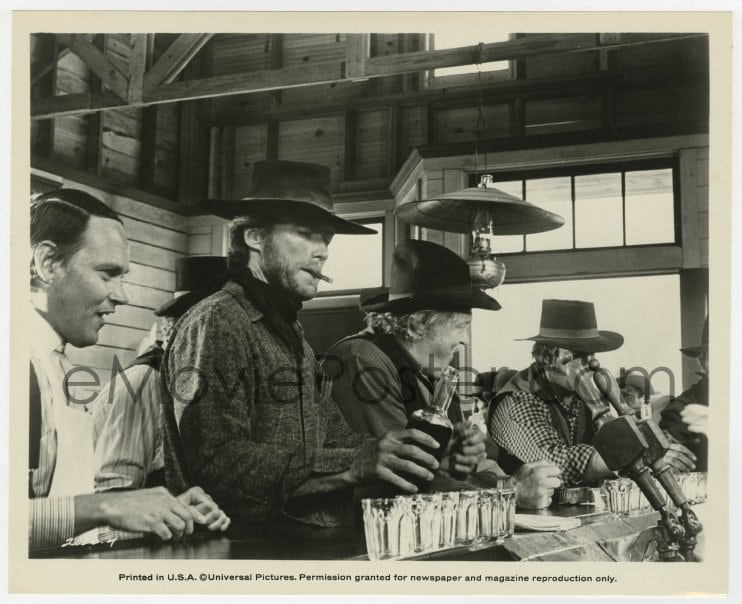
A central example is Shane (1953), where a drifting gunfighter arrives at the homestead and tries to settle down. Giving up his shady past, Shane works hard for a family establishing a farm. Hoping to leave a lifetime of violence, Shane must deal with his demons while protecting a town and the family from its violent enemies. While Shane begins to fit into the community, he soon realises that he cannot stay if he is to defend the community. Once Shane has defeated the town’s enemies, he must leave as the gunfighter cannot silence his torments. He leaves, saying to a young boy that idolises him: ‘Joey, there’s no living with… with a killing. There’s no going back from one. Right or wrong, it’s a brand. A brand sticks. There’s no going back. Now you run on home to your mother, and tell her… tell her everything’s all right. And there aren’t any more guns in the valley.’[1] Shane was a highly popular and influential film, and it was itself derivative of any number of westerns, which told the story in different ways. The ideas run through many of Clint Eastwood’s westerns in High Plains Drifter (1973), where the gunfighter was pure vengeance, and of course, Pale Rider (1985), which was essentially an update of Shane.
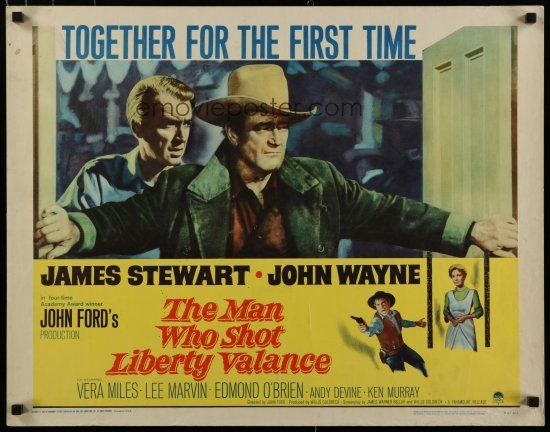
John Ford provided a variation on the theme in The Man Shot Liberty Valance (1962), where Senator Ranson Stoddard returns to Shinbone after a long absence. Stoddard comes back to honor the memory of Tom Doniphon, who died a drunken and broken man. His return sparks the local newspaper editor’s interest, who does not accept his initial stories about the reasons for returning. After a while, Stoddard reluctantly reveals the real story behind the shooting of the loathsome Liberty Valance. The killing of the despised outlaw in self defence propelled him on to a great political career, but it was based on a lie. In telling the story, Stoddard returns some dignity to the figure of Tom Doniphon, who was a far more heroic figure than the town drunk. Stoddard has finally told the truth, perhaps looking for some dignity for his former friend and a release from the burden of living a lie. In Ford’s western universe, even when the truth is told, it is better to ‘print the legend.’
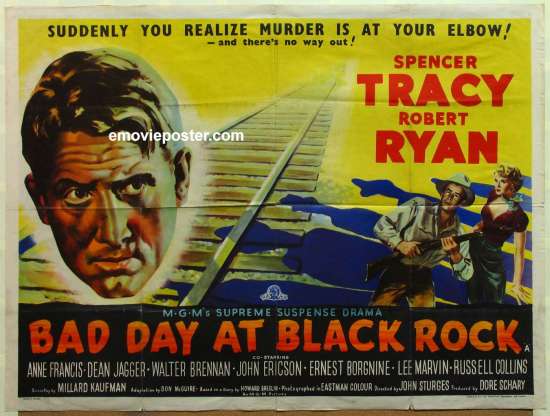
The scene is not confined to westerns, and the films often had political and social messages. Bad Day at Black Rock (1954) was one of the most clear-cut attacks on the McCarthyite era’s politics. John J. Macreedy, played by Spencer Tracy, is a one-armed stranger who stopped at an isolated desert town in California. He aimed to give a Japanese farmer a Congressional Medal of Honor, won by his son, who served with Macreedy during the war and saved his life. It was the first time the train had stopped in four years, and the townspeople were uneasy with his presence. Macreedy stumbled across the fact that the town’s leader Reno, played by Robert Ryan, killed the Japanese farmer at the outbreak of the Second World War. He described the town as being taken over by the ‘guerillas.’
The town was aware of the crime but afraid to fight Reno, a power-crazed racist and considered the lynching of the Japanese farmer a patriotic act. One of his henchmen Pete Wirth, played by John Ericson, said: ‘We were drunk, patriotic drunk,’ to explain the lynching.[2] The film has strong political undertones. Reno was the closest Hollywood got to a portrayal of Joseph McCarthy until the depiction of the crazed Senator in The Manchurian Candidate (1962). Eventually, Macreedy defeats Reno, uncovering the truth of the past. The medal is given to the town to begin its healing after the ravages of Reno. Bad Day at Black Rock was directed by John Sturges, one of the petitioners for Joseph L. Mankiewicz and produced by Dore Schary, who protested against the Waldorf Declaration.[3] The declaration signalled an anti-communist crusade of the movie moguls on 24 November 1947. The declaration was supported by the Motion Picture Association of America, the Association of Motion Picture Producers – the studio heads – and was signed at the Waldorf-Astoria Hotel in Manhattan.[4] They voted to sack any employee who would not say under oath that they were not a communist. This declaration meant that the Hollywood 10 were sacked without compensation. The studio heads also voted to refuse to employ any person with communist beliefs. Schary would work on the film during the day and watch the Army-McCarthy hearings at night.[5] It was clear that these events impacted the filmmakers as the film was a concerted liberal attack on the McCarthyite era.
It seems to be a world away from the Hollywood Westerns. Yet The Dry belongs to this group of films, which have essentially the same basic plot. The individual has some tortured relationship with the town and left for various reasons – good or bad. In The Dry, Aaron Falk is a Federal Police Officer who returns to his hometown in rural Australia, suffering from a year-long drought. Falk is to attend his childhood friend Luke’s funeral. Luke is thought to have killed his wife and son and then committed suicide. Played by Eric Bana, Falk does not want to return to the town, as he left under a cloud, suspected of killing his teenage sweetheart Ellie Deacon. Even though he wants to stay only a day, Falk immediately suspects that something has been missed in the investigation. Linking with the local police, Falk tries to prove that Luke was innocent and deal with the past accusations.
This investigation is conducted against the backdrop of the town’s pent-up rage spurred by the ongoing drought. Despite these obstacles, by the end of the film, Falk has resolved the town’s problems – aside from the drought – and is ready to move away. In an almost classic sequence at the end of The Dry, Falk walks away from the camera towards the horizon. Falk is almost riding off into the sunset like Shane or Clint Eastwood in Pale Rider. In Bay Day at Black Rock, Macreedy takes the train, as does Ranson Stoddard in The Man Who Shot Liberty Valance. Stoddard says to his wife that he would like to return to the town in their retirement – his wife agrees wholeheartedly but realises it is a pipe dream when the conductor says: “Nothing is too good for the man who shot Liberty Valance.” They realise the western myth will not leave them alone. Like the others, these figures have resolved the tensions of the town and need to move on.
[1] Shane Listing on IMDB, accessed at https://www.imdb.com/title/tt0046303/quotes/?tab=qt&ref_=tt_trv_qu, accessed on 15 April 2021.
[2] Bad Day at Black Rock,  John Sturges, Milliard Kaufman.
[3] Phillip French, The Movie Moguls, Penguin, Harmonsworth, 1969, p. 154. Alogn with Schary, producers Sam Goldwyn, Walter Wagner opposed the declaration.
[4] Otto Friedrich, City of Nets, Headline, London, 1986, p. 332.
[5] Dore Schary, Heyday: An Autobiography of Dore Schary, Berkley Books, Boston, 1969, p. 273. The Army-McCarthy hearings proved to be the end of the political career of McCarthy. He charged the army with tolerating communist subversion. Televised hearings were held before the Senate Armed Forces Committee which left McCarthy thoroughly discredited. For an account see William Manchester, The Glory and The Dream, Bantam, New York, 1975, 700-716.
 Cinema history