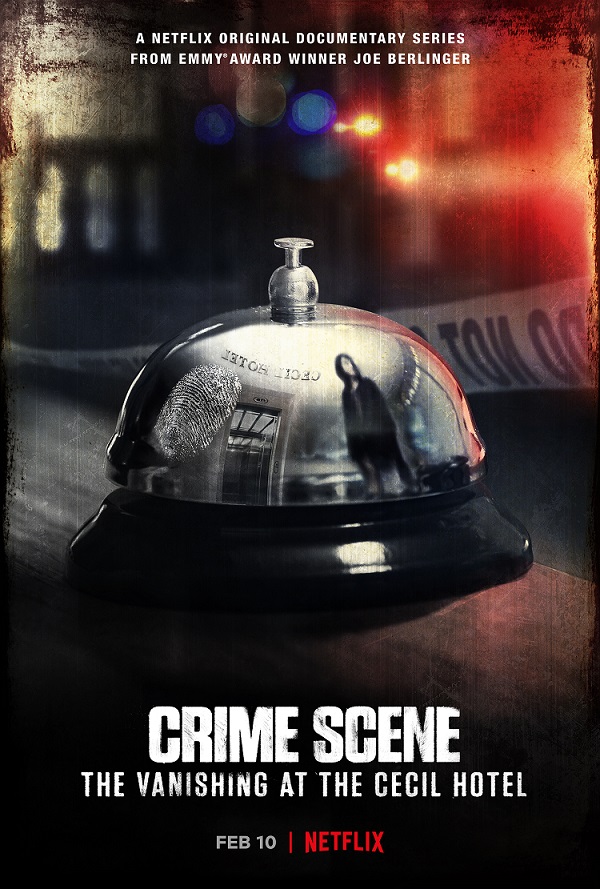
On the ease of conspiracy theories: Crime Scene: The Vanishing at the Cecil Hotel

A new series of Netflix conveys the power of conspiracy theories.

Kevin Brianton, Senior Adjunct Research Fellow

La Trobe University, Melbourne, Australia

The recent Netflix series Crime Scene: The Vanishing at the Cecil Hotel is an interesting but overlong and repetitive true crime investigation about Elisa Lam’s disappearance at the infamous Cecil Hotel in Los Angeles.

The investigation is the starting point of a look at the Hotel Cecil, which despite its impressive façade and foyer, is the hotel of choice for those who want cheap accommodation and are not overly concerned about hygiene or the safety of life and limb.

It was a cheap hotel in the middle of one of the poorest zones in Los Angeles. Such a setting makes Lam’s disappearance all the more intriguing. We understand from interviews that the place is the site of deaths and suicides and drug deals. Elisa Lam booked a stay at the hotel and then disappeared. She did not leave the building, and no body was found.

During the investigation, a fascinating video sequence was found of the poor woman terrified out of her mind in an elevator. The footage, coupled with her disappearance, makes for the spine of the documentary. The disappearance reminded me of one of those closed room killings favoured by the crime novelist John Dickson Carr and his impossibly clever mysteries.[1]

The investigators of disappearance work along traditional lines looking for evidence of how she would go missing. Their investigation is logical and thorough, but it takes time to discover the truth.

In today’s era, where there is a mystery, there must be social media, and then there must be conspiracy theories. Without giving away too much, Elisa Lam’s disappearance is explained clearly by the end of the show. The conspiracy theories are shown to be nothing much more than wild speculation.

Perhaps the most farfetched is that Elisa Lam was an agent spreading TB – a type of biological warfare. After all, there was a TB break out at the time, and the test for TB was called the LAM-ELISA.[2] It is an astonishing coincidence, but that is all it is. The conspiracy theory’s remarkable nature is that they take a coincidence and then build their case. It has an internal logic, but nothing more. The cases bounce off each other, and they present an erratic and enticing sequence of events.

How social media users made a relatively simple set of circumstances into something tangible that many people still believe is remarkable. [3] In this case, a whole body of conspiracy theories was uncovered. One unfortunate soul, who had been at the hotel a year before, was named the killer and subjected a vicious social media hazing.

At almost every level in society, facts have become irrelevant as people seek the most convenient version of the truth. The United States is presently working through the fallout of an insurrection against the Senate. Those participating were pushed along by a stream of unfounded complaints against the election’s conduct on social media. The simple fact was that the courts rejected the claims for lack of evidence. Yet, the conspiracy theorists continue to spread their savage distortions, and a fair proportion of the population took it up. Crime Scene: The Vanishing at the Cecil Hotel shows the dynamics of how all this works.

Before the social media barrage of conspiracy theories, films such as The Parallax View (1974) and Executive Action (1973) offered their take on political assassinations, arguing that a large corporate body was behind the political violence in the United States. [4] One the Hollywood 10, Dalton Trumbo wrote the script for Executive Action, which proposed that a group of right-wing politicians, businessmen, assassins and intelligence agents developed a plan to assassinate President John F. Kennedy.

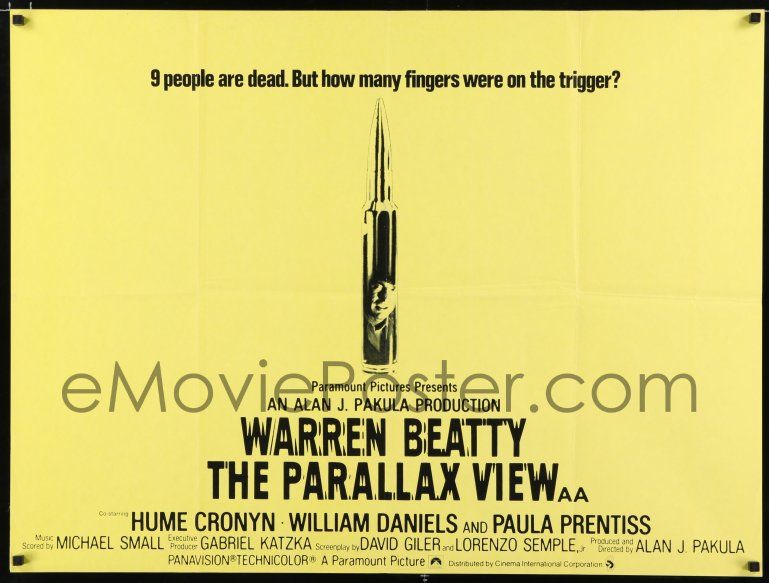
In the 1970s, Executive Action, and The Parallax View harnessed some of the conspiracy theories. Images courtesy of eMoviePoster.

These films fed into the widely held view that a sole deranged assassin in Lee Harvey Oswald did not murder President Kennedy, and there was a broader conspiracy. These conspiracy theories do not stand scrutiny, but are widely held.[5] The theories were later reinforced by films such as JFK (1991) which a complex web of conspiracy theories weaved together. These films are joined by Flashpoint (1984), Ruby (1992), and Interview with the Assassin (2002).

Conspiracy theories centre on great stories, which is always a sound base for some fine films. What is alarming is how easy it is to create a plausible – albeit evidence-free – conspiracy theory. While not the greatest of documentaries, the TV show has shown how simple it is to construct a conspiracy theory based on little or no evidence or simple speculation. What was once laughable has now entered the political and cultural mainstream.

The political implications are serious. It shows the astonishing ease that complete and utter nonsense can be translated into a creditable belief. The commentators had no special ability in research, aside from a fascination with the subject of Elisa Lam’s disappearance. This disappearance was tragic, but the detectives reveal a perfectly logical sequence of events. Even the social media theorists admitted that their conspiracy theories were unfounded. However, there appears to be no concession to reality for those in the crowd who stormed the Capitol building.


[1] https://en.wikipedia.org/wiki/John_Dickson_Carr.

[2] The test for the tuberculosis was her name in reverse order: LAM-ELISA, which stood for Lipoarabinomannan (LAM) Enzyme-Linked Immunosorbent Assay (ELISA). 

[3] Lucy Devine, “People Are Still Convinced Elisa Lam’s Death Was Connected To TB Outbreak,” Tyla, accessed at:

https://www.tyla.com/news/tv-and-film-what-is-the-elisa-lam-cecil-hotel-tb-outbreak-theory-skid-row-death-20210216 on 19 February 2021

[4] Art Simon, In The Parallax View, Conspiracy Goes All the Way to the Top—and Beyond, Slate, 21 July 2021, accessed at https://slate.com/culture/2017/07/the-parallax-view-is-a-70s-paranoid-classic-about-evil-corporations-and-political-assassinations.html on 22 February 2021.

[5] Gerald L. Posner, Case Closed: Lee Harvey Oswald and the Assassination of JFK. 1st Anchor Books ed. New York: Doubleday, 1994, provides an overview of the weaknesses of all the major conspiracy theories.

Your Honor and the legacy of noir

Kevin Brianton

Adjunct Senior Research Fellow, La Trobe University, Melbourne Australia

Your Honor has a great debt to film noir.

In the recent TV series Your Honor, (Stan in Australia) a respected and fair judge descends down a moral abyss to protect his son. Desiato is depicted as a liberal judge handing out fair sentences in the hopelessly corrupt city of New Orleans, and he appears to have a strict moral code. When his son Adam is involved in a hit and run, Desiato does not cover up but takes Adam down to the police station to report the crime, only when he discovers that his son has killed the son of a violent crime family head – that he begins a cover-up. Judge Michael Desiato breaks every rule to protect his son from the wrath of a vicious organised crime family.

The TV series was adapted from the Israeli TV series Kvovo, which has a similar premise. This series is set in New Orleans, and it contains the basic stories in film noir: individual moral decline and a doomed attempt to beat the system.

The TV series has many of the elements of film noir. Underpinned by the production code, film noir in the 1940s and 19050s contained the idea that anyone committing a crime must pay the penalty. Without giving away the ending, Your Honor keeps to the formula. The moral fabric of the universe, or the gods that run it, will not allow an individual to break the rules and get away with it.

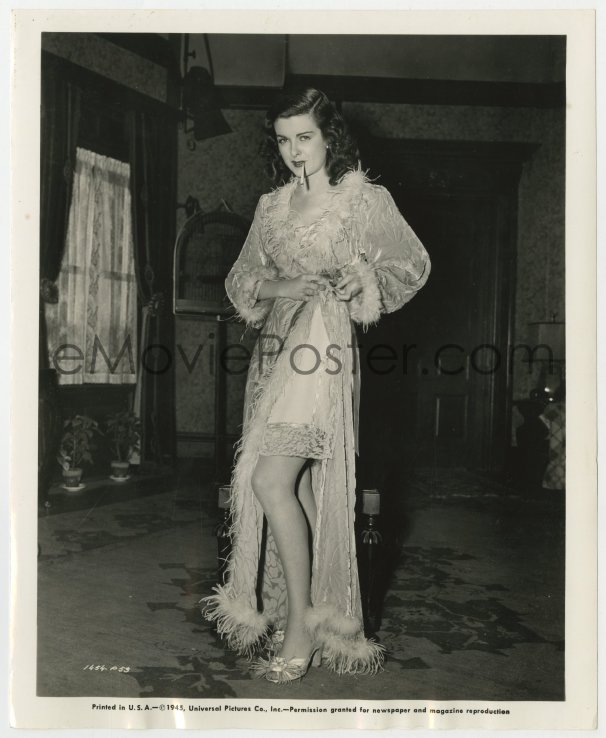
The plot has many elements of Scarlet Street (1945), directed by Fritz Lang. In Scarlet Street, an honest man, a painter called Christopher Cross, played by Edward G. Robinson, is in a loveless marriage and a hopeless job. His meeting with Kitty March, played by Joan Bennett, paves the way for personal destruction. Cross makes some decision to embezzle funds from his employer to pay for Kitty.

The key difference in Your Honor to film noir is that there is no femme fatale to lead Desiato to the brink. Joan Bennett provides the lure for Edward G. Robinson in Scarlet Street. Image courtesy of eMoviePoster.

When betrayed, Cross commits murder and implicates the wrong man, who goes to the gallows. Christopher fails at suicide, becoming homeless and needy, and he cannot even claim credit for his paintings, one of which has now been sold for a small fortune. He wanders New York, constantly hearing his victim’s voices in his mind.[1]

In film noir, stepping off the moral path destroys the individual. Like Cross, Desiato’s action starts a chain reaction where people are killed, and the innocent are found guilty of crimes they did not commit. Every action Desiato takes to defend his son results in more mayhem and death. It is a dance with the devil, spiraling down to hell.

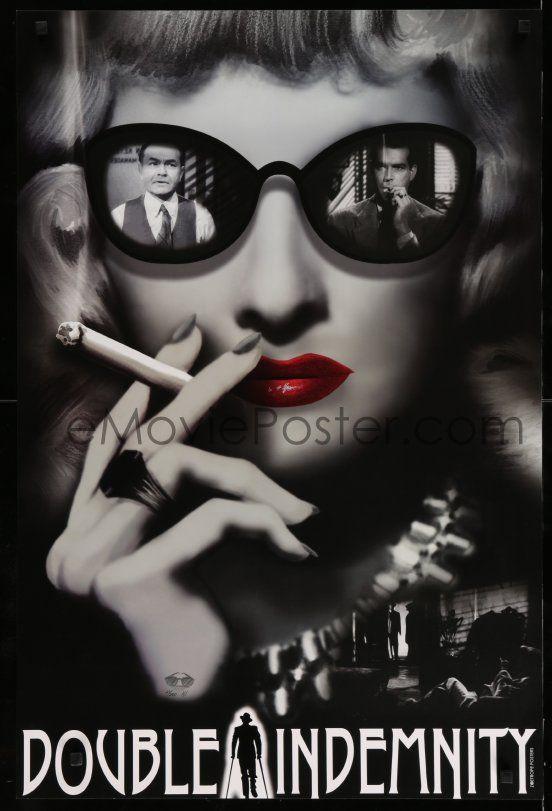
. In Double Indemnity (1944), the central character is an insurance salesman who tries to beat the system by murdering a client to run off with his wife. Image courtesy of eMoviePoster.

Desiato promises his son that he can fix this problem as he understands the system. In Double Indemnity (1944), the central character is an insurance salesman who tries to beat the system by murdering a client to run off with his wife. Neff says, “You’re like the guy behind the roulette wheel, watching the customers to make sure they don’t crook the house. And then one night, you get to thinking how you could crook the house yourself. And do it smart. Because you’ve got that wheel right under your hands.” The salesman, Walter Neff, wants to receive double the payout from a life insurance policy. Every element of the murder is successful, and it appears certain that he and Phyllis Dietrichson, played by Barara Stanwyck, will triumph.[2] However, film noir’s rules demand that their murder is exposed, and both must suffer for their crimes. They must take the “ride to the end of the line, ” which in their cases is death. Desiato also takes the same ride.

In a comment on the theme, Woody Allen wrote and directed Crimes and Misdemeanors (1989), where there is no punishment for the guilty. The originator of the film’s murder, Judah Rosenthal, says: “And after the awful deed is done, he finds that he’s plagued by deep-rooted guilt. Little sparks of his religious background, which he’d rejected, are suddenly stirred up… Suddenly, it’s not an empty universe at all, but a just and moral one, and he’s violated it. Now, he’s panic-stricken. He’s on the verge of a mental collapse-an inch away from confessing the whole thing to the police. And then, one morning, he awakens. The sun is shining, his family is around him, and mysteriously, the crisis has lifted. He takes his family on a vacation to Europe, and as the months pass, he finds he’s not punished. In fact, he prospers. The killing gets attributed to another person-a drifter who has a number of other murders to his credit, so I mean, what the hell? One more doesn’t even matter. Now he’s scott-free. His life is completely back to normal. Back to his protected world of wealth and privilege.”

Rosenthal is challenged, but he responds that his accuser has, “seen too many movies. I’m talking about reality. I mean, if you want a happy ending, you should go see a Hollywood movie..” [3]

The key difference in Your Honor to the film noir of the 1940s is that there is no femme fatale to lead Desiato to the brink. The women in Your Honor are strong and ethical. Desiato’s decision to fix the system is his own. The decision is based on reasonable fears that Adam will be murdered in prison by the criminal gangs. Whatever the reasons, having moved off the moral path, Desiato finds that his decision leads to even worse outcomes. People – innocent or otherwise – are killed or have their lives destroyed. The themes of film noir resonate today, but in today’s world, it should be noted that the murderer of an innocent man – the son of a gangster – gets off scott free. Those with values or principles appear to be trampled.


[1] Alan Silver and Elizabeth Ward (ed.), Film Noir, London: Secker Warburg, 1980, p. 248.

[2] Alan Silver and Elizabeth Ward (ed.), Film Noir, London: Secker Warburg, 1980, pp. 93-94.

[3] Woody Allen Crimes and Mideamnours, 1989, in https://www.imdb.com/title/tt0097123/quotes/?tab=qt&ref_=tt_trv_qu

The impact of Victorian Theatre on the film industry

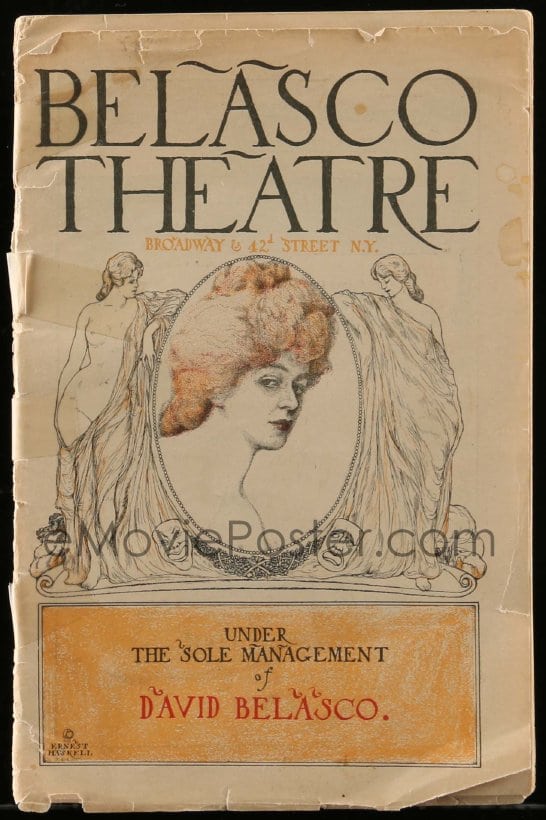
Most people going to see plays at the Belasco Theatre in New York would probably not recognise the origin of the theatre’s name.

Kevin Brianton, Adjunct Senior Research Fellow

La Trobe University, Melbourne, Australia

Most people going to see plays at the Belasco Theatre in New York would probably not know the origin of the theatre’s name. David Belasco was an inspiring figure who was a leading figure in American theatre from 1895 to 1915. His theatre was flamboyant, extravagant and spectacular, and he dominated Broadway for decades.[1] Belasco certainly had an impact on Hollywood. He helped launch the careers of James O’Neill, Mary Pickford, Lenore Ulric and Barbara Stanwyck, who became major Hollywood stars. He also had a major influence on Hollywood directors such as Cecil B. DeMille and his influence continues to the present day.

In turn, Belasco had been building on the work of Imre Kiralfy and his spectacular circuses of the 1880s and 1890s. Kiralfy’s Nero or the Fall of Rome – The Greatest Spectacular Production of Modern Times was performed at St. George, Staten Island, New York, in 1888. These shows were part circus and co-produced with P. T. Barnum, the founder of Ringling Brothers and Barnum and Bailey. [2]  The New York Times observed that Kiralfy was: …never satisfied with doing things on a large scale, and in his latest spectacular production, he is fully satisfied in his own mind that he has the biggest thing of its kind on earth. As far as magnitude is concerned, his production of “Nero: or the fall of Rome” is on a colossal scale, and Mr Kiralfy takes pride in the fact that on the biggest stage now built, he places 2,000 people and uses up 20,840 feet of scenery and has a ballet of 500 girls.[3]

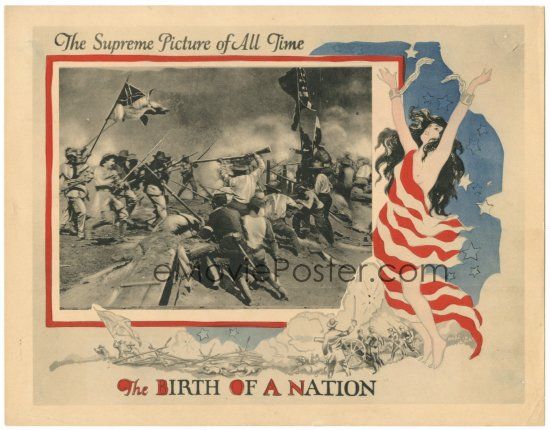
Birth of A Nation employed Victorian publicity tehcniques. Image courtesy of eMoviePoster.

Cinema was only in its infancy during this time, but such shows’ visual display would have impacted those growing up in this environment.  The first major Hollywood director D.W. Griffith had a strong background in Victorian theatre, and he employed a similar technique to Kiralfy when promoting Birth of a Nation in 1915. For example, this ad was printed in The Atlanta Constitution, 12 December 1915: D.W. GRIFFITH’S GIGANTIC SPECTACLE, THE BIRTH OF A NATION, YOU WILL SEE

18,000 People – 3,000 Horses – 5,000 Scenes

  • Petersburg at the height of battle.
  • Lee and Grant at Appomattox.
  • The shot that killed Abraham Lincoln.
  • The pillaging of Atlanta by Sherman’s invaders. [4]

Future directors such as Cecil B.DeMille was only a child at this time. His father Henry worked with Belasco for many years before his early death. With his family’s deep involvement in the theatre, he would almost certainly have attended performances of this or similar events. Such productions made an impact on his cinema. Posters for the Karifly production called it “The Greatest Show on Earth” – a title DeMille would eventually use for his film in the 1950s. Indeed, Nero would feature in The Sign of the Cross (1932), which was based on Wilson Barrett’s religious play of 1895.

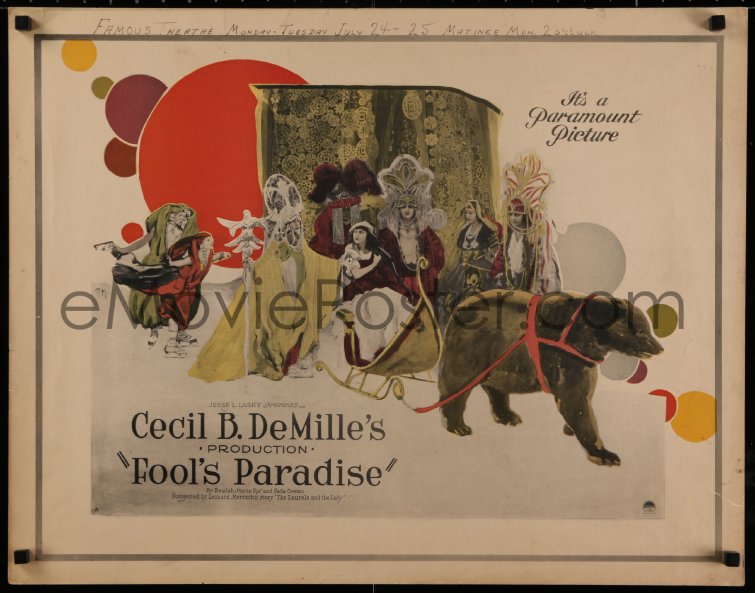
Flyers supporting the film Fool’s Paradise (1921) showed an approach to promoting films from the period he would use for his entire cinematic career. Image courtesy of eMoviePoster.

DeMille’s debt to Victorian Theatre is obvious in both the films and in the publicity he employed. He would convert a stream of Belasco plays to cinema in his early years as a director. Flyers supporting the film Fool’s Paradise (1921) showed an approach to promoting films from the period he would use for his entire cinematic career. It involves highlighting the film’s most sensational aspect and constant repetition of the word “see”.

  • See the wonderful ice-ballet and the flight of the magic carpet.
  • See the marvelous growth of a Mexican oil town.
  • See the great thrill of sacred reptiles and the flight for life against man-eating reptiles.
  • See the spectacular Siam Soo dances by natives and the attempt at a living sacrifice.
  • See the great theatre scenes, the cigar explosion, the knife-throwing villain, the sacrifice of a woman’s soul for the man she loves and a thousand other elements of a marvellous story. [5]
Victorian publicity techniques are in place throughout DeMille’s careers. Image courtesy of eMoviePoster.

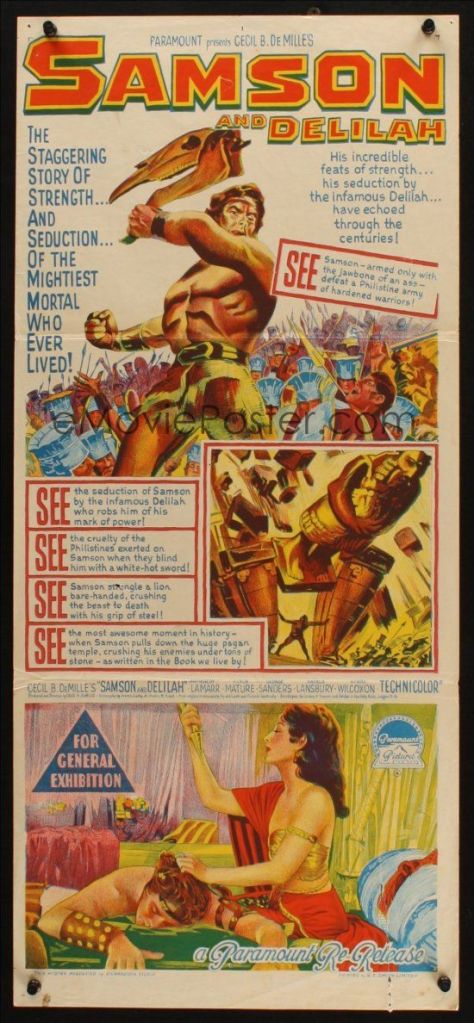
DeMille used this strategy, a direct lift from Victorian theatre, of describing in sensationalist terms some of the key scenes from the film. As late as his third last film Samson and Delilah (1949), he would continue the motif of: “See the seduction of Samson by the infamous Delilah who robs him of his mark of power! See Samson strangle a lion bare-handed, crushing the breast to death with his grip of steel”.[6] The presentation of DeMille’s films never lost a sense of Victorian spectacle.

“See the great thrill of sacred reptiles and the flight for life against man-eating reptiles.” Jurassic Park continues the tradition of Vicotrian Theatre on Hollywood. Image courtesy of eMoviePoster.

DeMille and Griffith could trace their origins back to Victorian Theatre, but they had a great deal of influence on future generations. Directors such as Stephen Spielberg would acknowledge their debt to DeMille. The same sense of spectacle can be seen in films such as Jurassic Park (1993). It has the same basic idea of the story: a family staying together in the face of enormous challenges – and you get to see some great dinosaurs. You could almost use the line that DeMille employed in Fool’s Paradise in 1921. “See the great thrill of sacred reptiles and the flight for life against man-eating reptiles.” The same basic motif can be seen in thousands of films. Victorian Theatre is still very much with us.


[1] William Winter, and William Jefferson Winter, The Life of David Belasco.(New York: Moffat, Yard and Company, 1918).

[2] Robert Sugarman, The Many Worlds of the Circus. (Newcastle: Cambridge Scholars Publishing, 2007).

[3] KIRALFY’S BIG SPECTACLE.: DRESS REHEARSAL OF “NERO” AT ST. GEORGE, STATEN ISLAND, The New York Times, 24 June 1888.

[4] The Atlanta Constitution, 12 December 1915: D.W. GRIFFITH’S GIGANTIC SPECTACLE, THE BIRTH OF A NATION, YOU WILL SEE

[5] Fool’s Paradise Flyer, Paramount 1921.

[6] Samson and Delilah, daybill from author’s collection.

Rediscovering Box office failures

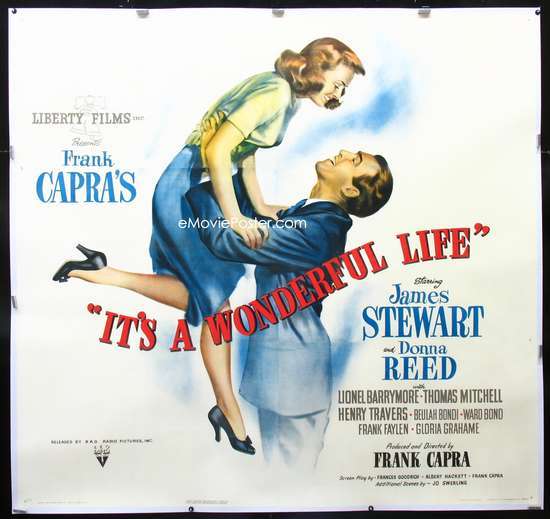
It’s A Wonderful Life is now a cherished film, but it did not recover its costs on release. Image courtesy of eMoviePoster.

Kevin Brianton, Adjunct Senior Research Fellow

La Trobe University, Melbourne, Australia

Looking back on some films, it seems absurd that they were not popular on their release. Yet too many good films have failed for this to be the case.  A standout case is It’s A Wonderful Life. The film is now a classic shown almost every Christmas, and it is considered one of the popular films in American cinema. Capra considered it to be his finest film – indeed, he thought it was the greatest film of all. Yet, the film did not do well and failed to recover costs. What elements contributed to its failure? In 1946, the United States had been through a long and difficult war. It’s A Wonderful Life would have fitted in with a cycle of films about the afterlife and the importance of each life. But perhaps in the aftermath of the war, people did not want messages about death and life’s meaning. It may have made uncomfortable viewing. After all, it was about a man contemplating suicide for leading a wasted life. As Andrew Sarris noted, it was: “one of the most profoundly pessimistic tales of human existence ever to achieve a lasting popularity.”[1] In later times, Capra’s message of realising the richness of ordinary life appears to have resonated with the American public.

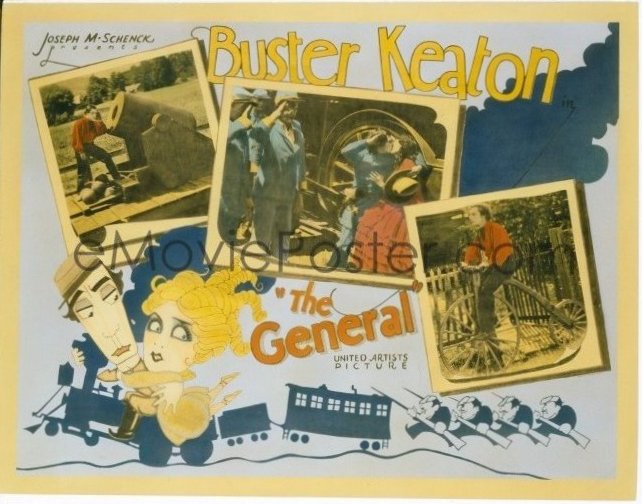
Other examples are easy to find. One of the Chaplin’s main rivals was Buster Keaton.  Keaton had made a string of successful short and feature films.  When Buster Keaton released The General in 1927, he considered it to be his masterpiece.  Film scholars have echoed that opinion for more than 60 years.  Yet when it was released, it did not prove to be a box office success, and after its screening, his film career disintegrated.[2] 

Audiences were left cold by the inventiveness of The General and it was one of Keaton’s great commerical failures. Image courtesy of eMoviePoster.

Looking back at the film, it is almost inexplicable why the film would be a financial failure. Keaton plays a train driver who loves his engine called The General. When the civil war breaks out, the Union forces steal his beloved engine. Despite its undeniable quality, the audience of 1927 simply did not respond to Keaton’s battling little character.  Keaton had enjoyed great success until this point, and his films are now regarded as works of genius. It could be that his benign depiction of the American South did not resonate with the audience. It could be that audiences had simply grown tired of his battling little character who overcame every obstacle. The reasons for the failure of a film are difficult to pin down. Nonetheless, to click with an audience of the time, a film must fulfill a need more complex than straight entertainment.  Keaton’s little character has lost favor with the public, and his decline had begun. 

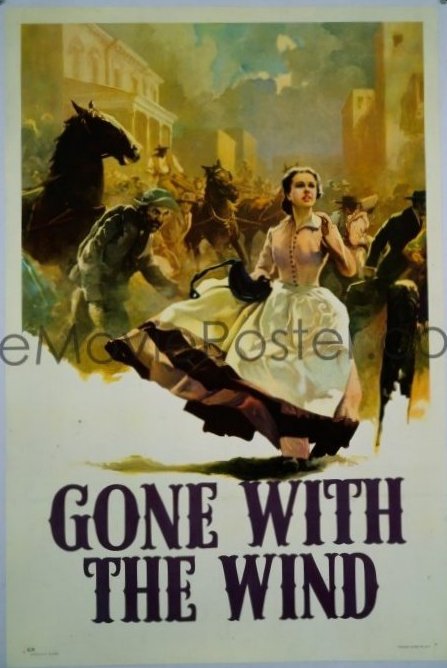
While Keaton’s vision of the South did not resonate, a film made 13 years later certainly did. Gone with the Wind (1939) was a massively successful film, and it remains an extremely popular to this day.  It has been re-released several times and has made handsome profits on each occasion. More than eighty years after its release, the film now has Blu Ray sets, special editions, and it remains one of the most popular films on cable television.  The perennial nature of its popularity could indicate that good films will be successful whenever they are released.  The argument is flawed.  Gone with the Wind was a bestselling novel published in the 1930s, and it was because of that popularity that producer David O. Selznick picked it up.  So even before the film was made, there was strong popular support for it.  Many people who attended the film went to see it simply because of the wonderful spectacle.  But once again, the film provided more than simple entertainment.  It dealt with a society about to be torn apart by war – as America was – and the sacrifices that men and women would have to make in that war.  These themes were also present in a large group of films that enjoyed popularity at the time.[3]  Films such as Drums Along the Mohawk (1939), Young Mr. Lincoln (1939) and Union Pacific (1939) reassured America about its great past, and the ability to face challenges was in heavy demand.  With fascism on the march in Europe, that reassurance was needed.

Gone with the Wind continues to entertain 8o years after its release. Image courtesy of eMoviePoster.

The reasons for its perennial popularity have more to do with the quality of its artistry. Films must operate at two levels to be successful. One, they have to contain elements of good writing, direction and production or a well executed or clever idea. But on another level, they are products of their time and need to talk to the audience of the period in which they were created. To succeed at the box office, a film needs to have more than a high standard of artistic and technical ability, it requires to have a level of audience involvement.  At some level, a popular film must discuss issues and dilemmas affecting the contemporary audience.


[1] Andrew Sarris, You Ain’t Heard Nothin’ Yet: The American Talking Film History & Memory, 1927-1949, 356.

[2] Tom Dardis, Keaton: The Man Who Wouldn’t Lie Down, Penguin, Harmonsworth, 1979, p.114.

[3] For a full discussion read John E. O’Connor, ‘A Reaffirmation of American Ideals’ in O’Connor, John E., and Jackson, Martin A. (eds.). American Film/American History: Interpreting the Hollywood Image, Continuum, New York, 1988, 97 – 120.