The cold war of Leo McCarey

Kevin Brianton, Adjunct Senior Research Fellow

La Trobe University, Melbourne, Australia

In 1944, Leo McCarey directed Going My Way, concerning Father Chuck O’Malley. A film showing the positive influence of religion on american life. Image courtesy of eMoviePoster.

During the Second World War, religious films were in vogue.  The Song of Bernadette (1943) was a popular film, based on the bestselling novel of 1941. In 1944, Leo McCarey directed Going My Way, concerning Father Chuck O’Malley, who guided young people an it proved to be one of the most successful films of the year. This benign vision of religion reverberated with the American public, who probably needed reassurance of religious guidance. The Bells of St. Mary’s (1945), was its follow up and was also successful.

Leo McCarey was a devout Catholic and his Catholicism helped spawn a strong anti-Communism. McCarey testified before HUAC in 1947 and in 1948, Leo McCarey, wrote an article for The New York Times on the need for films with religious themes. McCarey wrote that the film industry had a tremendous opportunity for ‘education, enlightenment, and influence’.  He claimed there was a growing plea for motion pictures with a religious influence.  McCarey called for religious pictures that entertained.

Religion and its principles can be absorbingly and tellingly presented within the basic screen itself.  After all, the cinema would soon lose its influence, if it lost the primary function of entertainment.  As an example, the unentertaining, heavy handed pounding of a theme is one of the mistakes which the Communists repeatedly make in the filming of their Soviet propaganda.  Pictures which are so colossally dull that their points, if any, are already lost. [1]

McCarey argued for the tactful and tasteful use of religious stories to show the ‘goodness of good as against the banality and wastefulness of those living without beliefs.[2]  By contrasting religious films with Soviet propaganda, it is clear that McCarey, like many others, saw religion as an effective antidote to communism. [3]  McCarey wanted religious films to be more effective propaganda than the Soviet efforts and he wanted Hollywood to contribute to ensuring a deeper belief in religion throughout the world.  He looked forward to the production of The Robe to demonstrate the strength of his arguments.

McCarey would also be a key ally for DeMille when conservatives moved against Mankiewicz in 1950, but his anti-communist activity did not end there. In 1950, he made a film You Can Change the World was a short film for the Christopher movement who were members of Catholic church aiming to reinvigorate the United States with strong religious values. It features Bing Crosby, Jack Benny, Bob Hope, Irene Dunne, Rochester, William Holden, Loretta Young, and Ann Blyth. The film hoped to energise people to do more good work in the community, as antidote for those who were taking control – read communists. Despite the clear talent, it is like a poor lecture on the Declaration of Independence and the need for religion or religious values. The participants, aside from Benny, Rochester, and Hope, are lifeless. The film gives the distinct impression of being an exercise to prove anti-communist credentials, and the actors appear to be disinterested in the whole lecture – which includes slabs of the Declaration of Independence. It is not a Catholic film as the participants covered a wide range of religious views. Ann Blyth was a devout Catholic and Jack Benny was Jewish.

Despite its noble grandstanding, the film has a barely concealed racism. Rochester, as an African-American, is not invited to hear the father speak, even though he is just as famous as the rest of the guests. He was a valet, and his rejection is either based on class or race or both. Race is also mentioned when the priest tells the story of a young man who may lose his job at a service station because he is African-American. After a community boycott, one person finds the service station 25 new customers and he is allowed to keep his job. The film does not question the right of the customers to discriminate or the service station owner’s ability to sack his employee, because of his customer’s reaction to race. The implicit assumption in the film, “You Can Change the World,” is that the “you” is limited to white people. They can help African Americans, but it is one-way street.

Despite the honour roll of talent, the film is a rather dull lecture. Image courtesy of eMovieposter.

McCarey would again tackle communism in his feature films. In My Son John (1952), his message was clear: communism was a cancer in American society which had to be ripped out. The film was a strange mixture of political intolerance, homosexual repression and anti-intellectualism.  The film was not well received, and it is now regarded as one of the more feverish of the anti-communist films. (See: https://cinemahistoryonline.com/2019/08/23/my-son-john-1952/ for a fuller discussion.) A decade later, he would try again with Satan Never Sleeps and it was also a dismal failure. The actors appeared to be going through the motions, and the Chinese Communists were moronic thugs. If My Son John is feverish, Satan Never Sleeps is just dreary. Leo McCarey and fellow writer Claude Binyon were accomplished comedic writers and drama appeared to elude them. It represented a sad end for McCarey, who was one of Hollywood’s greatest directors, but simply did not know his limitations. McCarey had made some highly effective and notable religious films during the Second World war, but something seemed to be missing when he made religious or political films in the immediate period following the cold war.

The advertising for Satan Never Sleeps, gives it a message of unresolved sexual tension between the two leads., which is simply not present in the film. Image courtesy of eMoviePoster.

[1] New York Times 12 December 1948. 

[2] Ibid.

[3] Ceplair and Englund, Inquisition, p. 259.

Tenet and MAD superpower conflict in the 1960s: the end of moral superiority

Kevin Brianton, Adjunct Senior Research Fellow, La Trobe University, Melbourne, Australia

The recent film Tenet looked at the possibility of worldwide destruction, where civilsation is eliminated.
Image courtesy of eMovie Poster.

The recent film Tenet (2020) looked at the possibility of worldwide destruction, where everything is destroyed, in order to satisfy the crazed needs of a suitably deranged villian. The film is the latest of a long line of films, where the world faces destruction through nuclear annnihilation that stretches back to the 1960s, when fears about nuclear weapons began to be discussed more openly. In the 1950s, science fiction films, often had themes of nuclear armageddon, but this was usually disguised as aliens or monsters being unleashed in Them or Earth versus Flying Sources. Direct discussion of this issue was clearly too painful during this decade, because it simply did not happen.

While nuclear fears were discussed in these films in allegorical terms, the biblical epics of the 1950s created a cultural mythology that assured the eventual destruction of the communist empires.  As communists gained power in China and Russia became a nuclear power, the American people needed reassurance that this rising threat of a Sino-Soviet bloc with more soldiers and nuclear weapons would inevitably fail.  At the time, communism appeared to be on the march, with the Korean war beginning and McCarthy’s allegations of communist conspiracy within the United States Government.  The biblical epics provided another depiction which showed the communists empires vulnerable to resistance based on spiritual values.  The rhetoric of historian Arnold Toynbee, evangelist Billy Graham and State Department head John Foster Dulles linked religious conviction with national strength.  It was this message which was eagerly taken up by the American people.

Cold war messages were contained in all these films, but they received their most reverent and inspired treatment in DeMille’s The Ten Commandments.  The biblical epics created the cultural myth for Americans that society needed a firm moral basis to succeed and flourish.  Communism lacked this moral basis and may flourish for a while, but they would wither in time because of this absence.  The image of doomed or damned communism was highly reassuring to audiences.  The domestic and international political strengths contained within the United States would eventually lead to the destruction of communism and the re-birth of freedom. The Ten Commandments (1956) painted a picture of the irresistible conflict between the superpowers. The spiritual strength was the only permanent bulwark against the rise of the Soviet Union.

Almost exactly one year to the day after the release of The Ten Commandments, the satellite Sputnik was launched by the Soviet Union on 4 October 1957, destroying American certainties of technological superiority.[1] Previously, the Communsit powers had gained advances by duplcity. Now, the Soviet Union was a step ahead. These fears would crystallise in 1962, when the Cuban Missile Crisis led to the two superpowers coming perilously close to nuclear conflict. As the real impact of a possible conflict between the superpowers began to sink in, these ideas of moral superiority began to lose their hold, and with the change, cinema began to shift directions. Superpower conflict was not going to be an event with moral strength prevailing – everyone was going to die and civilisation was going to end. The term ‘mutually assured destruction’ had its origins in this period, and it began to be seared into the American political consciousness.[2] No one was going to win the nuclear war.

The Manchurian Candidate was a black political satire which said the political extremes had joined forces against the United States. (Image courtesy of eMoviePoster.)

The Manchurian Candidate (1962) was the first film to cast doubt on the idea of a Manichean conflict between the Soviet Union and the United States. The book and film feature a McCarthyite figure in the United States who is an unwitting dupe of the communists. The film had a short run, and some have suggested it was removed from public view considering sensitivities regarding the Kennedy Assassination in 1963. Kennedy’s assassin, Lee Harvey Oswald, had spent some time in the USSR, and one theory argued that he was brainwashed there to shoot the president. Whatever the reasons for its short run, the film had a massive impact, and the film’s title entered popular language. It was remade in 2004, with a different political setting in the Iraq war. Most recently, President Donald Trump has been called: “A Manchurian Candidate,” for his foreign policy positions – particularly with Russia.[3] The film is notable in that it began to blur the lines between the super patriots and the communist threats – both were dangerous to the political system.

The United States President, played by Henry Fonda, must release a nucelar weapon over New York, after US fail safes are broken and Moscow is destroyed. (Image courtesy of eMoviePoster.)

While The Manchurian Candidate was a black political satire, other films delved into the impact of the Cold War. The first cinematic response to the possibility of mutually assured destruction was Fail Safe (1964), directed by Sidney Lumet, was based on the 1962 novel of the same name by Eugene Burdick and Harvey Wheeler. The film was released in early 1964 and it portrayed an accident leading to nuclear war, with destruction for Moscow and New York. While the film enjoyed critical success, it was not popular at the box office. It is an overwelmingly bleak assessment of the chances of nuclear war.

Dr Strangelove, played with impeccable comic style by Peter Sellers, depicted the moral morass that the United States found itself in deploying nuclear weapons.
(Image courtesy of eMoviePoster.)

The bleak vision of nuclear conflict was followed by Dr. Strangelove’s black satire, directed by Stanley Kubrick, which was also released in 1962. With the comedic genius Peter Sellars playing three roles, including the crazed scientist Dr. Strangelove, the film argued that the whole system was a mess, and a madman could release the nuclear holocaust. Based on the Democrat presidential candidate Adlai Stevenson, Peter Sellers also played a US President fighting being the greatest mass murderer in world history. He also played the unforgettable Dr Strangelove, a clearly insane scientist, who has taken the world to a nuclear abyss. In most films, a James Bond hero manages to meet all the challenges, but the worse does happen in this film, and the world is destroyed. Even satire provided no escape from nuclear terrors.

A further film, The Bedford Incident (1965), showed a clash between a US destroyer and a Soviet submarine that leads to the destruction of both in an exchange of nuclear weapons. The depicted clash that occurred before or during the Cuban Missile Crisis – accounts differ. In October 1962, a Soviet submarine was pursued by the US Navy. When the nuclear-armed Soviet vessel failed to surface, the destroyers began dropping training non-lethal depth charges. The officers on the submarine argued over deploying the weapon, believing that World War Three had begun. Senior officer Vasili Arkhipov prevented any escalation by refusing to launch the weapon. After an argument, it was agreed that the submarine would surface and await orders from Moscow.[4]

This small group of films was criticised for being alarmist about the possibility of an accident or a madman leading to a nuclear war. In time, it would be demonstrated that the film’s writers and the directors were close to the truth. The United States and the Soviet Union could have easily gone to war, as the security around nuclear weapons were poor, and systems were haphazard. Both The Bedford Incident and Fail-Safe had an underlying message that nuclear weapons were too dangerous and would inevitably lead to destruction. The safeguards were not in place. In sharp contrast, The Manchurian Candidate and Dr. Strangelove depicted the whole government apparatus as insane. The political certainties of the Eisenhower period were being eroded. [5] Its political system looked rickety, its religious shield was ineffectual, and its technological lead looked shaky. The moral certainity of the Ten Commandments (1956) had all but disappeared.


[1] The Ten Commandments was released on 5 October 1956.

[2] The term “mutual assured destruction” was coined by Donald Brennan, a strategist working in Herman Kahn’s Hudson Institute in 1962. Daniel Deudney, Whole Earth Security: A Geopolitics of Peace, Washington: Worldwatch Institute, July 1983, 32-33, accessed at https://eric.ed.gov/?id=ED233950 on 18 November 2020.

[3] Travis M. Andrews, “Some call Trump a ‘Manchurian Candidate.’ Here’s where the phrase originated,” Washington Post, 13 January 2017.

[4] Nickola Davis, “Soviet submarine officer who averted nuclear war honoured with prize, The Guardian, ,” 27 October 2017.

[5] Eric Schlosser, “Almost Everyhting in “Dr. Strangelove” was True,” 17 January 2014.

The sad predictions of The Last Hurrah (1958)

Kevin Brianton, Adjunct Senior Research Fellow, La Trobe University, Melbourne, Australia.

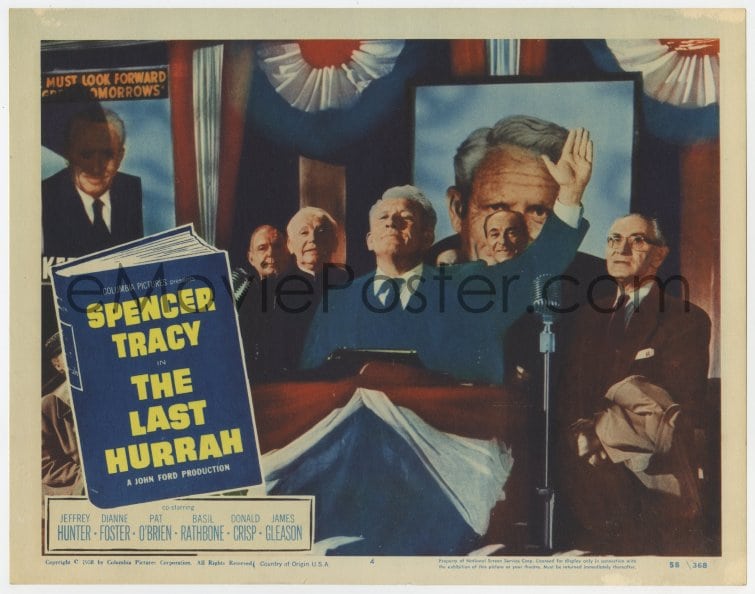
Skeffington begins his last campaign in John Ford’s The Last Hurrah.
Image courtesy of eMoviePoster.

The recent United States election has certainly been a memorable one. As the dust settles, it is an absolute certainty that films and TV shows will be produced on the Presidency of Donald Trump – if they are not already in production. Whatever people think of Trump, it is undeniable that he generates interest in whatever he does – and will continue to do so for many years. The TV network Showtime has already shown The Comey Rule depicting the relationship between Trump and FBI director Comey. Based on Comey’s book A Higher Loyalty: Truth, Lies, and Leadership, it focusses on their relationship, leading to his sacking by Trump. The political drama stars Jeff Daniels as Comey and Brendan Gleeson as President Donald Trump. Trump has such an over-the-top persona that actors will undoubtedly be queuing to do their interpretation of him. Brendan Gleeson has had the first serious crack, but the mini-series highlighted that political drama done well could be engaging and popular. [1]

In the TV series, the FBI is depicted as an organisation that has to constantly balance out political pressure, while investigating crimes. Founding FBI director J. Edgar Hoover would barely recognise what his successors at the FBI were even doing. Hoover highlighted the Bureau’s role in catching gangsters or identifying communists. The focus was on crime and treason. In the social media age, the FBI director’s working life seems consumed with emails from politicians’ computers, along with the antics of Russian social media trolls. As well as dealing with tweets from the President, the media dominates all communication, and Comey is even advised that he had been sacked by television.

The days of the FBI hunting criminals such as Dillinger are clearly over in The Comey Rule.
Image courtesy of eMoviePoster.

While not predicting the future of media and politics, one film that certainly made some prescient observations about American politics was The Last Hurrah (1958). The film was adapted from the 1956 novel of the same name by Edwin O’Connor. The prestigious director John Ford and the actor Spencer Tracy joined forces to depict a long-term Irish-American mayor preparing for a final election campaign. Mayor Frank Skeffington and his campaign are followed by his nephew and journalist, Adam Caulfield, who covers American politics at close range.

Skeffington – a mayor of a New England city which appears to be Boston – delivers one of the novel’s finest political speeches when talking to his nephew about politics, saying it is the greatest spectator sport in the United States. Everyone knows ‘who is up and who is down’, according to Skeffington. He wants to run one more campaign the old-fashioned way, knowing his time is up, as Skeffington realises that radio and television were becoming the dominant force, reducing politics to a televised sport.[2]

The election contains a scathing vision of American politics with a dolt of a candidate opposing Skeffington. Bosley Crowther in The New York Times would call him “a farcical nitwit.” [3] Backed by the town’s moneyed interests, the only advantage he seems to have over Skeffington is the use of new technology, which in 1958 was television. The book was written after Democratic Presidential nominee Adlai Stevenson’s disastrous drive to solicit votes through speeches, where the more media-savvy President Dwight Eisenhower used advertising and television to promote his political profile.  Eisenhower slaughtered Stevenson in both the 1952 and 1956 campaigns. The Democrats would take note of the lessons of campaigning against Eisenhower, and use them to full effect when they worked for the future President John F. Kennedy in the 1960 election campaign.

While a supporter of Kennedy, John Ford was not a fan of television politics at which JFK would prove to be a superb practitioner. Ford was concerned with the rise of media politicians, and he could see that the days of Skeffington were numbered with their low-level corruption, but with a focus on distributing goods to their lower-income neighborhoods. The new politicians had a commitment to nothing. The film highlights the impact that television would make on American politics for the next 60 years. In more recent times, television has been supplanted largely by social media, of which US President Donald Trump has shown some mastery. In the 1950s, Adlai Stevenson could still attempt to campaign with beautifully written speeches.[4] Ford would never have imagined that a reality TV star could use the medium for a political base. It is inconceivable that Ford could not even envisage reality TV, but he understood that image was now as important as substance in the 1950s.

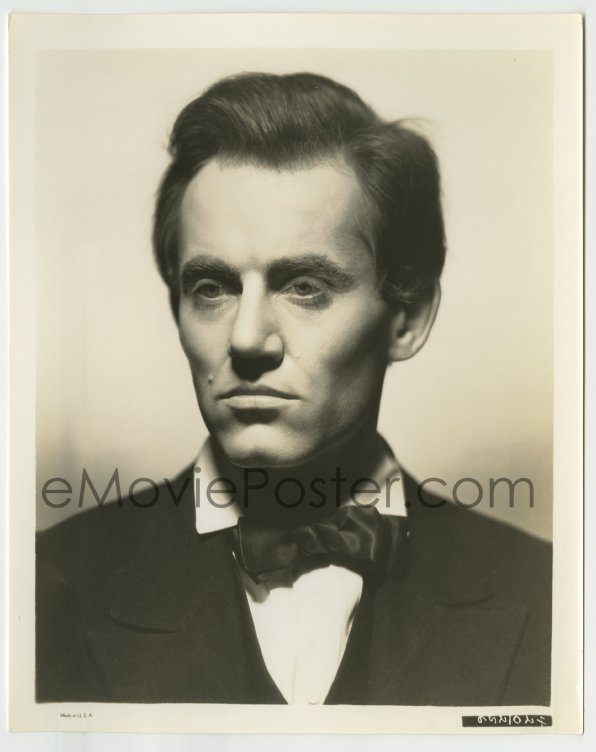
Ford’s film is lamenting for a political past where politicians were elected on character and policies. The warnings from 1958 in O’Connor’s novel and Ford’s film are clear for all to see. Ford seemed more comfortable with the political speeches of Abraham Lincoln, as shown by his sentimental depiction of his political campaigns in Young Mr Lincoln (1939). Lincoln commands through the use of language, logic, and force of personality. In Lincoln’s time, two hour speeches were recorded in full in newspapers and people rode or walked miles to hear them. Lincoln would later develop the precursor to the grab with the Gettysburg address, which was a ridiculously short speech by the standards of the time. Today, neither side would even bother with a speech of any length in the age of Twitter. Our society has election campaigns with all image and no substance, having reached the bottom of the slippery slide identified by O’Connor in 1956.

Ford seemed more comfortable with the political speeches of Abraham Lincoln, as shown by his sentimental depiction in Young Mr Lincoln, who commands through simple persuasion, logic, and force of personality – and the occasional use of his fists.
Image courtesy of eMoviePoster.

The film also has one remote link back to Trump. At the end of the film and the book, Skeffington lies dying, having lost the campaign, and one of his detractors says if he were alive, he would regret what he did in his political life. The comatose figure comes back to life and says: “Like hell, I would.” I cannot imagine Donald Trump saying anything else much different in similar circumstances. Despite the massive impact of television and social media, over the preceding seven decades, it seems politicians do not change all that much.


[1] Rick Porter, ‘The Comey Rule’ Draws Solid Initial Ratings for Showtime,’ Hollywood Reporter, 30 September 2020.

[2] The clip from The Last Hurrah (1958) can be seen at:

https://www.tcm.com/video/480786/last-hurrah-the-1958-spectator-sport

[3] Bosley Crowther, “Spencer Tracy in “The Last Hurrah;” Portrays Skeffington, John Ford directs,” The New York Times, 24 October 1958, accessed at https://www.nytimes.com/1958/10/24/archives/spencer-tracy-in-the-last-hurrah-portrays-skeffington-john-ford.html on 12 November 2020.

[4] Jill Lepore,  If Then: How One Data Company Invented the Future, London: John Murray, 2020 has an excellent discussion of the election and the links between advertising and politics.

Horatio Alger and The Queen’s Gambit

This image has an empty alt attribute; its file name is queens_gambit_ver6.jpg
The Netflix’s series The Queen’s Gambit is based on Walter Tevis novel. which is part of a long tradition of Horatio Alger characters.

Kevin Brianton, Adjunct Senior Research Fellow

La Trobe University, Melbourne, Australia

The Queen’s Gambit released by Netflix looks to be an ultra-modern series with state of the art set design and touching on a whole set of current issues – such as drug addiction and feminism. Yet the story is a particularly old fashioned Horatio Alger style tale, which is almost the quintessential American myth. Alger was a Nineteenth-Century writer whose central characters rise through meticulousness and industry to become a respected society member.[1] In many ways, the central character Beth Harmon, played with style by Anya Taylor-Joy, represents the traditional Alger protagonist. A creature of the 19th century, Horatio Alger’s characters were invariably young men. Despite the difference in gender, Harmon resembles one of his characters perfectly. Beth comes from the humblest of origins. Harmon worked hard at her craft – which in this case is chess. She succeeds through a combination of hard work and the astonishing mental gifts bestowed on her. Her gender is a barrier, and she still has to break into the chess world, but the doors were open to her through the vastly superior American system.

Alger’s central characters are usually young, white men living in big cities with low-paying jobs. Published in 1868, Alger’s first major work Ragged Dick followed the story of a young boy working as a shoeshine on New York streets. Dick befriends a customer who gives him five dollars for a service. The protagonist then uses that small sum to create a small fortune through being frugal and mostly through hard work. In The Queen’s Gambit, Beth is also given five dollars to play in a state chess tournament by a kindly janitor who taught her how to play chess. She wins the tournament and moves onto becoming US champion, before taking on the world.

In contrast, the Soviet system is no place for genius, but it allows a player such as her rival Bogrov to succeed. He is a machine, who shows no flashes of brilliance, but can crush any opponent in the end game. In the Soviet system, players with ability are hand picked by the Soviet bureaucracy, and drilled to play at their best. The state provides every assistance, and the players are a team who help each other, planning how to beat their foreign opponents.

The show depicts Harmon’s friends rallying to her assistance to meet the Soviet team on equal terms. They eventually adopt the Soviet collegiate system, where players support each other, which is a departure from the Alger myth. Beth Harmon is based on Bobby Fischer, an United States chess genius who broke the Soviet Union’s stranglehold in a cold war showdown in 1972.[2] The show does not mention that the Soviet Union dominated chess from 1948 until Fischer loosened their grip in 1972. While one of the greatest players in chess history, Fischer was only a blip to Soviet domination. It is rarely mentioned that the Soviets retook and retained command of the sport until 1990 when the Soviet Union fell apart. Russia retained its grip for a while, and it still has two players in the top ten.

Fischer and Harmon have similar traits, such as learning Russian, and both are outsiders who are obsessed with chess. In the 21st century version of the Alger myth, the protagonist must fight both external forces and internal demons. Beth Harmon must deal with her parent’s separation, her mother’s death, being an unwanted orphan in a dreadful school, a remote stepfather, a loving but crushed stepmother coupled with a drug and alcohol problem. Beth is also compared to Paul Morphy of the 19th century, one of the finest players of the era, who dazzled the world with his brilliant attacking play, then went mad after being compelled to stop. 

This image has an empty alt attribute; its file name is lc_safety_last_a_BM12775_B.jpg
A distant ancestor of Beth Harmon is Harold Lloyd, who triumphs against adversity. While Harmon had to conquer a Russian giant in chess, Lloyd had to conquer a building in Safety Last. Image courtesy of eMoviePoster.

Horatio Alger provided the basis for many cinematic heroes. In the silent period, Harold Lloyd was the personification of the Horatio Alger myth. With his get up and go, the Lloyd character conquered massive obstacles to his ambition, of which the climb up the side of the multi-storey building in Safety Last was the most famous. Despite his glasses, his tenacity would win over the biggest obstacle and strongest opponent.

This image has an empty alt attribute; its file name is program_book_rocky_iv_a_dupe1_WC11506_T.jpg
Horatio Alger in boxing: Rocky Balboa triumphed in boxing against the USSR in Rocky IV. Beth Harmon’s triumph is far more dignified. Image courtesy of eMoviePoster.

In more recent times, the boxer depicted in Rocky is a prime example. A loser Rocky Balboa is given one chance to fight the world champion. He trains hard and then comes close to beating Apollo Creed. In later sequels, like The Queen’s Gambit, it developed a cold war edge with Rocky going up against an inhuman Soviet Goliath and triumphing. In contrast, Beth Harmon goes up against Russians who are ruthlessly competitive, but also courteous and dignified. This a post-Cold War series and we are allowed to see the Russians as human. While Bogrov can destroy any opponent, he is polite, respectful in defeat and triumph, and appears to be a dedicated family man. He even seems genuinely happy at Harmon’s triumph.

At the time of writing, The Queen’s Gambit, is the most popular TV show on Netflix. The success of TV series shows how underlying Horatio Alger myths retain a stranglehold on the American imagination. The story may shift from a young man to a woman. It may shift from commerce to boxing to chess, but the myth remains in firmly in place.


[1] For a discussion  on  Horatio Alger see Weiss, Richard. The American Myth of Success : From Horatio Alger to Norman Vincent Peale. New York: Basic Books, 1969.

[2] Edmonds, David & John Eidinow. Bobby Fischer Goes to War: How the Soviets Lost the Most Extraordinary Chess Match of All Time  provides an excellent account of the 1972 world championship.