High Noon and its successors

Riding Shotgun also had anti-McCarthyism themes. Image courtesy of eMovieposter.

Kevin Brianton

Strategic Communication Senior Lecturer, Melbourne: Australia.

High Noon had many successors which took up the various themes about McCarthyism in differing ways.  Riding Shotgun (1954) again looked at the political situation in allegorical terms, but with disdain for the hysteria created by McCarthy.  A respected guard on the stage coach Larry Delon, played by Randolph Scott, attempted to warn the town of an impending raid on the town’s ‘Bank Club’ by a gang of criminals.  Delon was almost lynched by the townspeople who believed that he was responsible for the shooting of a stagecoach.  A posse was formed to chase the outlaws who were actually planning to rob the undefended town.  Delon was bailed up in a building throughout the film while the town attempted to lynch him.  Eventually the outlaws raided and Delon foiled the robbery and regained the town’s respect.  The film was not as sharp in its criticism of the worn as in High Noon, but there were some strong scenes where Scott walked through the town with every eye on him, thinking; ‘The city had already tried and found me guilty.[1]  The film was not critical of the law enforcement agencies as the deputy Sheriff was depicted as a sensible man desperately trying to see that no one gets hurt in the town’s desire to lynch Scott.

Unlike High Noon, the film showed that the town was willing to fight, but needed firm leadership.  Without that leadership, the town could turn into a lynch-mob and attack the innocent.  Riding Shotgun was a conservative film that asked for respect for the traditional law enforcement, rather than the hysteria of the mob.

Although not strictly a western, as it was set in contemporary America, Bad Day at Black Rock (1954) was one of the most clear cut attacks on the McCarthyite era within the genre.  Bad Day at Black Rock was directed by John Sturges, who was one of the petitioners for Jospeh L. Mankiewicz, and produced by Dore Schary who protested against the Waldorf Declaration.  Schary would work on the film during the day and watch the Army-McCarthy hearings at night.[2]  It was clear that these events had an impact of the filmmakers as the film was a concerted liberal attack on the McCarthyite era.

John J. Macreedy, played by Spencer Tracy, was a one-armed stranger who stopped at an isolated desert town in California.  His aim was to give to a Japanese farmer a Congressional Medal of Honor, won by his son, who served with Macreedy during the war and saved his life.  It was the first time the train had stopped in four years and the townspeople were clearly threatened by his presence.  Macreedy stumbled across the fact that the town’s leader Reno, played by Robert Ryan, killed the Japanese farmer at the outbreak of the Second World War.  He described the town as being taken over by the ‘guerillas.’  The town was aware of the crime but afraid to fight Reno who was a power-crazed racist and considered the lynching of the Japanese farmer to be a patriotic act.  One of his henchmen Pete Wirth, played by John Ericson, said ‘We were drunk, patriotic drunk,’ to explain the lynching.[3]

Reno was the closest Hollywood got to a portrayal of Joseph McCarthy until the depiction of the crazed Senator in The Manchurian Candidate (1962).  He manipulated and terrified the people of the town with the crime.  He described Macreedy as a ‘virus’ which had given the town a fever and had to be destroyed.  Very similar to the way, McCarthy depicted communists as an infection of the American political system.  The Sheriff, played by Dean Jagger, was ineffectual and complaint to Reno’s orders, just as McCarthy blustered his way over the legal system.  Others simply tried to ignore the crime and remained in apathetic fear.  When Macreedy faced and defeated Reno, the town was forced to face the collective guilt of their silence.  The conclusion of the film was optimistic as it showed the town could prosper again with the departure of Reno, just as the American community had to realize the enormity of the damage inflicted by the McCarthyite era before it could begin to move forward again.

The Fastest Gun Alive continued the themes of High Noon. Image courtesy of eMovieposter.

Other films carried similar messages to High Noon throughout the 1950s.  In At Gunpoint (1955) a shopkeeper played by Fred MacMurray killed a bank robber with a lucky shot.  He was called a hero, but his fellow townspeople deserted him when the robbers plotted reprisals.  MacMurray eventually convinced the town to fight and they defeated the outlaws when they return.  In The Fastest Gun Alive (1956), the townspeople cower in a church while a gunslinger threatened to burn down the town unless their reluctant local hero cam out for a showdown.  They eventually forced him out to face the villain.

In The Tin Star (1957), a sheriff had to stand up to a town turned into a lynch mob to re-establish the authority of law and order.  The prisoners inside his jail were clearly guilty and it was certain they would be hanged or jailed.  The film argued that the lynch mob was not the answer.  Only when the leader of the lynchers was stared down, humiliated and then destroyed did peace come to the town.  If the mob was equated with McCarthyism, the legal approach of the sheriff was the best way for American society to go.  The central figure was a man similar to High Noon’s Will Kane who was bitter and resentful about society but at the end of the film, he picked up ‘the tin star’ to renew the fight against criminals.[4]  Law and order depended on the professional pride and determination of law enforcement officers.  Without them, the weak townspeople would be at the mercy of the bandits and agitators.  The central theme of these films was that the town by its inaction or corruption could collapse into lawlessness.

As the 1950s drew to a close, director Jack Arnold made an interesting western called No Name on the Bullet (1959) which can be read as an anti-McCarthyite tract. Image courtesy of eMoviePoster.

As the 1950s drew to a close, director Jack Arnold made an interesting western called No Name on the Bullet (1959) which can be read as an anti-McCarthyite tract.  A stranger played by Audie Murphy rode into town and registered at a hotel.  He was John Gant who made his living goading people into a fight and then killing them in self defence.  His appearance caused a slow breakdown of the town as prominent citizens remembered guilty secrets of the past and were afraid that he has been sent to kill them.  Old antagonisms began to rise an people committed suicide or left town or tried to bribe Gant. The films focused on what fear can do to people.  If you were Gant’s target then you were already dead.  The most effective scenes were when a banker with a guilty secret in his past attempted to buy Gant off the trail.  But Gant would not leave the town until his intended victim was dead.  The law enforcement officers can’t stop him as he was too deadly with the gun, and even managed to stare down the entire town when they tried to drive him out.  The atmosphere of paranoia and fear which pervaded the film with Gant’s arrival and Murphy’s edgy performance as Gant make it one of the most effective successors to High Noon.  At the end of the film, Gant ensured that his target was dead, but he was wounded and rode away.  He could certainly return and wreck havoc again.


[1] Riding Shotgun Warner, (d) Andre De Toth, (w) Tom Blackburn.

[2] Dore Schary, Heyday: An Autobiography of Dore Schary, Berkley Books, Boston, 1969, p. 273.  The Army-McCarthy hearings proved to be the end of the political career of McCarthy.  He charged the army with tolerating communist subversion.  Televised hearings were held before the Senate Armed Forces Committee which left McCarthy thoroughly discredited.  For an account see William Manchester, The Glory and The Dream, Bantam, New York, 1975, pp. 700-716.

[3] Bad Day at Black Rock, (w) John Sturges, (w) Milliard Kaufman

[4] One of the sources for High Noon was a story called The Tin Star by John Cunningham which appeared in Colliers on 6 December 1947.  Behlmer, p. 270.

Johnny Guitar (1954)

Johnny Guitar (1954) was also directed against HUAC in a different way to High Noon.
Image courtesy of eMoviePoster.

Kevin Brianton

Senior Lecturer Strategic Communication, La Trobe University, Melbourne, Australia

Johnny Guitar (1954) was also directed against HUAC in a different way to High Noon.  In the film, Johnny Guitar, played by Sterling Hayden, returned to this estranged lover Vienna, played by Joan Crawford, who owned a disreputable bar.  A stage robbery occurred in town, and a banker was killed.  The dead man’s sister Emma Small, played by Mercedes McCambridge, convinced a wealthy rancher John McIvers, played by Ward Bond, that the crime had been committed by the Dancin’ Kid, Corey ad Young Turkey, when they were innocent.  Small was jealous of the Dancin’ Kid’s attraction to Vienna.  The accused trio decided to rob a bank since they were being forced to flee the area anyway.  Small made the bank teller swear that Vienna was involved in the robbery.  In response, a posse rode to Vienna’s bar and burned it down.  The posse hanged the injured Turkey who was hiding there.  Eventually, the posse learned the truth about Emma and stood back while Emma and Vienna shoot it out.  Vienna killed Emma and rode off with Johnny.

The plot had all the elements of a standard western plot, even a final shootout, yet it can be read as a political film.  The outlaws can be seen as communists who were blamed for every wrongdoing in town.  Critic Michael Wilmington argued that former gun-man Johnny, represented an ex-Communist called before the HUAC.  Wilmington saw Vienna as a fellow traveller and Emma as a vindictive witness or a politician who used the investigations to destroy the careers of rivals.  McIvers represented big business or law enforcement authorities which, while basically good, had succumbed to the pressure of McCarthy’s tirades.  The townspeople were the American middle class.[1]

Lynching was a key theme in Johnny guitar. Image courtesy of eMoviePoster.

Wilmington’s argument can be taken further, Turkey was promised that he could be saved when he was caught by the posse if he would point an accusatory figure at Vienna.  For Ray and writer Yordan, this was the dilemma of the witnesses before the HUAC investigators.  The fact that he was hung was a reminder that informing did not guarantee survival.  Critic Danny Peary contended that Emma’s attack on Vienna was similar to the techniques used by McCarthyite investigators who assumed that social deviance of any kind was an indication of communism.[2]

The personal political viewpoints of the actors were also interesting. Ward Bond, who was one of the leaders of the lynching party, was President for the Motion Picture Alliance for the Preservation of American Ideals, which helped HUAC weed out communists in Hollywood.  Sterling Hayden, who played Johnny Guitar, testified before the committee and regretted it all of his life.  Hayden wrote in his autobiography about his testimony that: ‘Not often does a man find himself eulogized for having behaved in a manner that he despises.  I subscribed to a press clipping service.  They sent me two thousand clips from papers, east and west, large and small, and from dozens of magazines.  Most had nothing but praise for my on-shot stoolie.  Only a handful – led by the New York Times – denounced this abrogation of constitutional freedom.’[3]  This casting may have been deliberate or accidental.  Yet the end result was to have actual participants acting out their roles in a political allegory.

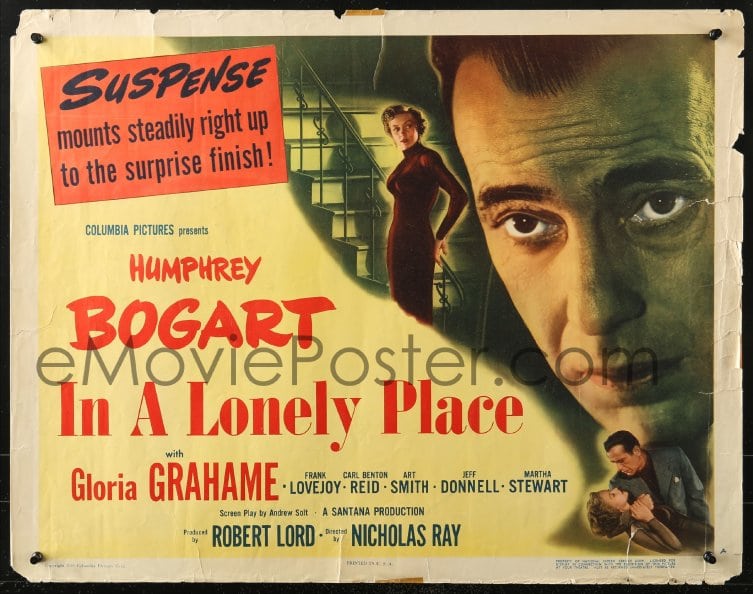
Ina Lonely Place, also directed by Ray, did not discuss the political situation in Hollywood, but it was a commentary on the HUAC-inspired witch hunt, the blacklisting and the paranoia that affected the film industry.
Image courtesy of eMoviePoster.

Apart from Johnny Guitar, Ray had already attacked the investigations in In A Lonely Place (1950).  James W. Palmer, writes about in  ‘In a Lonely Place: Paranoia in the Dream Factory’, Literature/Film Quarterly, vol. 12, 1985, No. 3, pp. 202 – 210.  The film did not discuss the political situation in Hollywood, but it was a commentary on the HUAC-inspired witch hunt, the blacklisting and the paranoia that affected the film industry.  The film focused on a writer Dixon Steele, played by Humphrey Bogart, who had been rejected by the Hollywood community.  Since returning from the war, he had been unable to write and his drinking and aggressive behavior had led to him become an isolated figure in the Hollywood community.  At the beginning of the film, he invited a hatcheck girl back to his apartment for her to tell him the story of a book which he might turn into a movie.  Dixon sent the woman home and the next morning, her body was found brutally murdered.  Steele was considered to be a prime suspect by the police.  After being questioned and then released by the police, Steele was further isolated by the Hollywood community who saw him as guilty.  Bu the end of the film, Steele, who was a violent man, became a borderline psychotic.  After succumbing to the pressure, he attacked his fiancé and his life was ruined, even though he was eventually cleared of the murder charge.  Steele with his persecutions and paranoia can be read as a symbol of the Hollywood Ten.

This group were a part of the Hollywood community until accused of the ‘crime’ of communism.  Eventually they were abandoned by the community to their own fate.  Film critic James W. Palmer noted that everybody in the film was guilty of not supporting people in need.  He wrote that the real crime was the undermining of human trust through a process of social exclusion.

Ray’s allegorical attack against HUAC in Johnny Guitar probably would have gone over the heads of its audience of the time.  No evidence exists in any reviews of Johnny Guitar that anyone considered it anymore than an interesting western with strong performances from both Crawford and McCambridge.  Indeed Nora Sayre in her survey of cold war films, mentions it only in passing as a light entertainment.[4]  A member of the Hollywood 10, Ring Lardner Jr. had never heard of the film,[5] although Ray has insisted that contemporary audience got the message about the lynching party being a McCarthyite investigation.[6]

Previous version of this blog at:

https://kevinbrianton.com/westerns-huac-johnny-guitar-1954/


[1] Michael Wilmington, ‘Johnny Guitar’ Velvet Light Trap Spring 1974 in Danny Peary, Cult Movies, Vermillion, UK, 1982, pp. 171-172.

[2] Ibid, p. 172.

[3] Sterling Hayden, Wanderer, Knopf, New York, 1973, p. 366

[4] Nora Saryre, Running Time: Films of the Cold War, p. 173.

[5] Ring Lardner Jr. at a Public Seminar of the Australian Film Institute on 6 March 1991. (Notes taken by author).

[6] Michael Goodwin and Naomi Wise, ‘Nicholas Ray: Rebel!’, Take One, Vol 5, No. 6, (January) p. 11.

High Noon for HUAC

Kevin Brianton

Senior Lecturer, La Trobe University, Melbourne, Australia

The Westerns hold pride of place in American cinema.  They retold the legends and myths of America’s frontier past and had been a feature of cinema virtually since its inception.  In the 1950s, hundreds of westerns were made which dealt with many aspects of American life.  It was perhaps inevitable, with the stifling of direct political criticism, and the pressing concerns of McCarthyism and communism, that westerns would take on a political dimension in the 1950s.

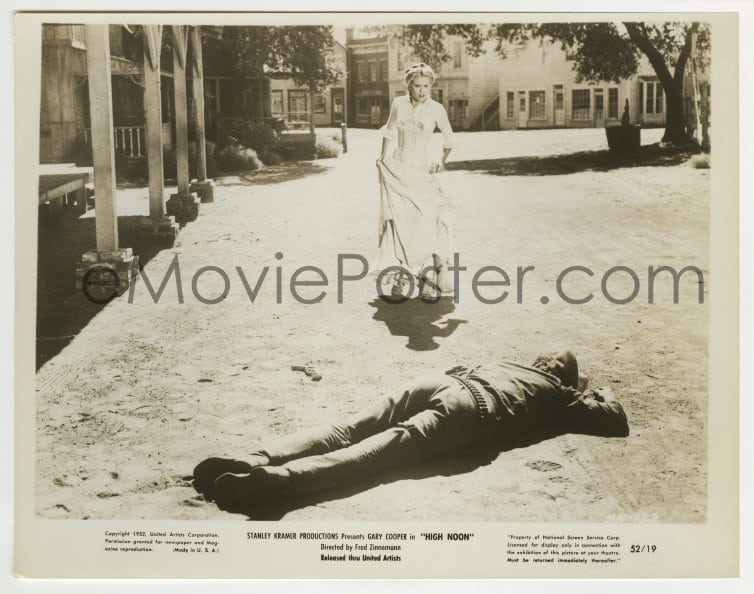
High Noon was one of the most important westerns of the 1950s and many films followed its pattern of a lone law officer facing a threat to the town.  Image courtesy of eMoviePoster.

The 1947 investigation proved to be only a testing of the waters for HUAC.  The Hollywood 10 went to prison in September 1950 and the committee re-gathered momentum to pounce on Hollywood again.  The Hollywood 10’s imprisonment had increased the power of HUAC to make it feared throughout the film industry.  Director Joseph Losey told an interviewer that ‘the most terrifying thing about the atmosphere was seeing people succumb, and seeing all protest disappear.  Because if you did protest, you’d had it.’[1]  The second HUAC investigations were to be larger and more systematic and they destroyed the remnants of the liberal-left in Hollywood without any effective opposition.  In the middle of these rising fears about HUAC’s return, Carl Foremen was writing the screenplay for a western called High Noon.

The film was about the desperate efforts of the Sheriff Will Kane, played by Gary Cooper, to get help from the townspeople to fight Frank Miller and his gang, who were being released from jail that day, and who had promised revenge on the town and Kane.  Miller, who Kane put in prison for murder, had been pardoned, and his gang were gathering at train station to meet when the train arrived at noon.  Kane approached all the town leaders for assistance to fight Miller but they all abandoned him.  The town and church leaders demanded that he leave town, claiming that the gang would leave the town alone if he was not there.  Kane failed in his attempts and faced the gunmen alone.  After defeating the four outlaws, Kane threw his badge onto the street in disgust at the town and left.  The screenwriter wanted the audience to equate the people of Cooper’s town with those who suddenly deserted their blacklisted friends in Hollywood.

Kane’s disgust equaled Foreman’s as friends humbled themselves and begged for help from the Hollywood community without success.  Foreman had been called to testify in front of HUAC and intended to be an un-co-operative witness. He said his friends began turning their backs on him even though he was not a communist:

My associates were afraid for themselves – I don’t believe them – and tried to get off the film, unsuccessfully.  They went to Gary Cooper and he refused (to go along with them).  Fred Zimmerman, too, was very staunch and very loyal, so was out backer, Bruce Church.

There are scenes in the film that are taken from life.  The scene in the church is a distillation of meetings I had with partners, associates and lawyers.  And there’s the scene with the man who offers to help and come back with his gun and asks, where are the others?  Cooper says there no others … I became the Gary Cooper character.[2]

Foreman depicted Hollywood society in a poor light as the threat of McCarthyism approached.  The pillars of the community were afraid that a gunfight would jeopardise business and possible future investment in the town and urged Kane to leave.  Their attitude was similar to the studio heads who abandoned their employees on the slightest of pretexts to avoid bad publicity and poor box office returns.  The religious leaders also pulled back from Kane because they cannot sanction violence.  He was only offered help by only a 14 year old boy and the town drunk and he turned down both.  The retired marshal wanted to help but could not because of his arthritis.

The point of the film was that the town united could have easily defeated the threat.  Instead the Hollywood community pursued their own individual selfish ends and were torn apart.  The point was not lost after the film’s release and Foreman was blacklisted for his efforts for many years.  He was ‘morosely pleased’ when the message of the film was understood by the conservatives.[3]

Grace Kelly supports her husband in High Noon Image courtesy of eMoviePoster.

High Noon was one of the most important westerns of the 1950s and many films followed its pattern of a lone law officer facing a threat to the town.  Foreman certainly had no doubts when he wrote the screenplay that the town was Hollywood and the four men approaching represented HUAC and when the film was released The New York Times film reviewer Bosley Crowther wrote:

It is a story that bears a close resemblance to things that are happening today where people are traumatised by bullies and surrendering their freedoms … (Kane) is a man with the sense to meet a challenge, not duck and hope it will go away … The marshal can give a few lessons to the people of Hollywood today.[4]

However, it is doubtful whether the audience of the time saw it in that light.  One of the Hollywood 10, Ring Lardner Jr, who knew Carl Foreman, said he could see no anti-HUAC message in the film beyond the general theme of standing up for oneself.[5]  If members of the Hollywood 10, who were more sensitive on the topic did not get the message, and knew the screenwriter, what hope was there for the general audience.  The film had an anti-HUAC message but it is uncertain whether that message got across to the audience.  Director Zinnemann said he did not make films to prove anything.[6]

The film can also be read as a defence of McCarthy with a lone figure standing  up against the communist threat.  The heroic figure of Kane could be seen as McCarthy desperately trying to awaken the community to the impending threat of communism.  Critic Phillip French has also suggested that the film was about the United States reluctantly renewing its role in world affairs.[7]  High Noon started a cycle of movies with the lone or aloof law official figure, struggling with both the town and some form of menace on the horizon.  Something in that formula clicked with the audience and the film finished eighth in the box office for 1952.[8]  The audience responded to the film but it is unclear to exactly what they were responding.


[1] Tom Milne (ed.). Losey on Losey, Secker & Warburg, London, 1968, p. 90.

[2] Rudy Behlmer, Behind the Scenes: The Making of, Samuel French, New York, 1990, p. 276.

[3] Nora Sayre, Running Time: Films of he Cold War, Dial, New York, 1982, p. 176.

[4] New York Times, 3 August 1952.

[5] Ring Lardner Jr. at an Australian Film Institute Seminar on 26 March 1991.  (Notes taken by author).

[6] Behimer, Behind p. 277.

[7] Phillip French, Westerns: Aspects of a Genre, Secker and Warburg, London, 1977, p. 35

[8] Cobbett Steinberg, Reel Facts: The Movie Book of Records, Vintage, New York, p. 21.

Chaplin and HUAC

A king in New York’s attack on the destructive paranoia of McCarthyism was similar to his attack on Hitler in The Great Dictator (1940) where Chaplin used slapstick to cut his enemies down to size.
Image courtesy of eMoviePoster.  

Kevin Brianton

Senior lecturer La Trobe University

The only direct depiction of the HUAC investigations in a negative light came in Charlie Chaplin’s A King in New York (1957).  Chaplin had been one of he earliest victims of the anti-communist hysteria and had always been a target for the American Right.  Several of his films had enraged the conservatives such as Modern Times (1936) and The Great Dictator (1940).  His controversial private life had added fuel to the fire of conservatives who considered him to be a moral threat to the country.  An editorial in the Los Angeles Herald Express said:

Charlie Chaplin shelf proclaimed “citizen of the world” and “man without a country,” is fast nearing the end of the trail as far as the United States is concerned.

The complacent self-worship of the man, in a New York press conference is amazing.

In boasting that he was neither a patriot nor an American citizen, he said, in part:

“I am not nationalist of any country … You might say I am a citizen of the world … I never voted in my life … I did a great deal for the war effort … I made a speech in favour of opening a second front in 1942 … I believe that voting for people … leads to fascism.”

What a moral non-eternity that Chaplin is!

In joining the ranks of subversives who have the overthrow of the American way of life as their avowed objective, he insults the American people, the very people who have poured millions into his lap.[1]

The FBI had more than 1900 pages of reports devoted to Charlie Chaplin during his 50 year residency in America.[2]  Just as John Jefferson’s sexual preferences in My Son John were seen as evidence of his political leanings, Chaplin’s divorces and paternity litigations were seen as pointers to his communist sympathies.  Certain scenes in Modern Times comment on communist issues such as when the tramp walked down the street waving a red flag, trying to signal a driver after it fell off a truck.  A communist parade turned the corner behind him and police arrest him as a communist leader.  More important was his depiction of the dehumanizing nature of industrial work which Chaplin delighted in satirizing, along with bosses and police.  It was these scenes and his support for issues such as a second front against the Nazis in 1942 which left him tainted as a communist sympathizer.  It was in this cold war atmosphere of 1952 that United States Attorney General James McGranery rescinded Chaplin’s re-entry permit while he was travelling to London for the premiere of his film Limelight.[3] 

Chaplin was to remain away from the United States for the rest of his life, apart from one visit to pick up a life achievement award at the Academy Awards in 1971.  But although he was never to return, he left his thoughts on he HUAC investigations and he whole atmosphere of paranoia in his film A King in New York (1957).  The film’s attack on the destructive paranoia of McCarthyism was similar to his attack on Hitler in The Great Dictator (1940) where Chaplin used slapstick to cut his enemies down to size.  The exiled King Shahdov of Estrovia sought refuge in the United States where he hoped to fund his plans for the peaceful use of nuclear power.  Unfortunately the crooked Prime Minister, played by Jerry Desmonde, had run off with the funds.  The King and his loyal ambassador Jaume, played by Oliver Johnston, were introduced into various aspects of American culture.  The King visited a progressive school and met a precocious child Rupert Macabee, played by his son Michael Chaplin, who launched into Marxist critique of society.

Chaplin was to remain away from the United States for the rest of his life, apart from one visit to pick up a life achievement award at the Academy Awards in 1971.  But although he was never to return, he left his thoughts on the HUAC investigations and he whole atmosphere of paranoia in his film: A King in New York (1957).
Image courtesy of eMoviePoster.

The King later met Rupert wandering homeless in the streets because he was running away from the Un-American Activities Committee who wanted to question him about his parents’ loyalties.  The FBI eventually captured the boy in the King’s apartment and the King was called before the committee.  Before appearing he was wrapped up in a fire hose and proceeded to douse the committee with water. He was cleared of any wrongdoing and before leaving visited Rupert who was destroyed after naming names.  The film’s subject matter was so contentious it was not shown in the United States until 1976.[4]

The pro-HUAC pictures were popular with the American audience.  Both On the Waterfront and The Caine Mutiny were in the top 20 grossing films of 1954.  It is almost impossible to determine whether the main cause of their success was their pro-HUAC message, but it does seem that conservative films had more resonance with the American public.  Mankiewicz’s A Letter to Three Wives was a determined attack on the McCarthyite mentality and the anti-intellectual atmosphere of the time.  It was a popular film and part of the post-war liberal flowering of films.  The high-minded aspirations of Storm Centre did not attract an audience.  A King in New York never had a chance.  Although the stinging verbal jab by Wilder on informers in Stalag 17 struck some kind of chord, the attacks mad on HUAC by Chaplin, Miller, Taradash had a little, if any, impact on the American public.  They were pot shots against a well armored opponent.  It is doubtful that the American Right ever felt the sting in the lines delivered in the films.

From the lack of popular reaction to his set of films it would seem that the American public were more behind McCarthy and the HUAC investigations.  The efforts of Hollywood’s liberal community failed to impress the American public that the communists were victims.  However, the pro-HUAC films were also one-offs, and no cycle of films began from On the Waterfront with the informer as hero or from the garbled political message of The Caine Mutiny.  At the close of the decade and in the early 1960s, the political tone of films became more and more anti-McCarthyite.  Films such as Ben-Hur (1959), Spartacus (1960), The Manchurian Candidate (1962), and Seven Days in May (1964) attacked McCarthyism in many different ways.  However, these films were looking at McCarthyism in retrospect when controls were looser and there was little likelihood that a career could be ended by a political statement.  Even though the anti-HUAC films did not strike a chord with the public, it is a credit to the courage and the integrity of the filmmakers that they were made at all.


[1] Los Angeles Herald Express 15 April 1947 printed in David Robinson Chaplin: His Life and Art, McGraw Hill, New York, 1990, p. 546.

[2] Ibid. p. 750. A detailed summary of the FBI’s campaign can be found in this biography.

[3] Ibid., p. 572.

[4] Robinson, Chaplin., p.589.