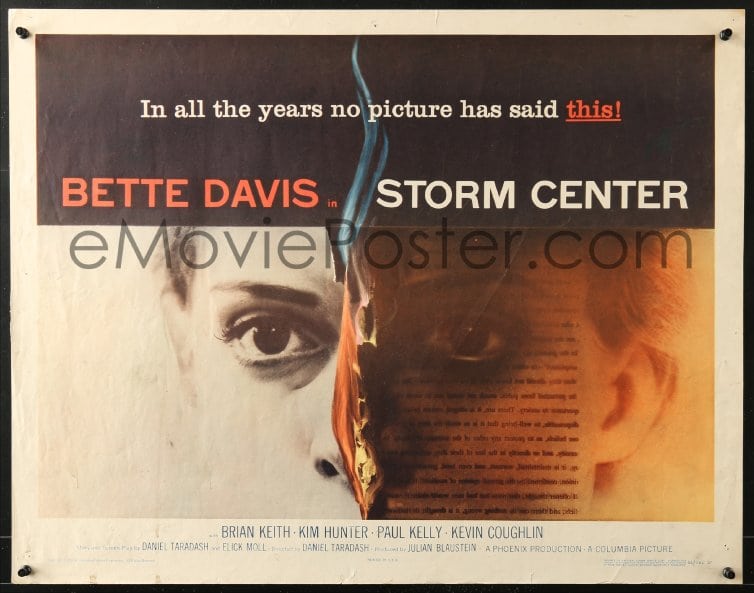
One American film which stood out clearly against McCarthyism was Storm Center (1956) which focused on a small town in America where a librarian Alicia Hull, played by Bette Davis, was dismissed for having a book called ‘The Communist Dream’ on the library’s shelves. Image courtesy of eMoviePoster
One
American film which stood out clearly against McCarthyism was Storm Center (1956) which focused on a
small town in America where a librarian Alicia Hull, played by Bette Davis, was
dismissed for having a book called ‘The Communist Dream’ on the library’s
shelves. The local council wanted the
book removed and for future decisions about questionable material to be brought
before them. She told the council:
There was a book in our
library for many years. It is still
there. It made me sick to my stomach
every time I checked it out, Mein Kampf.
Maybe we ran the risk of spreading Hitlerism but it didn’t work that
way. People read it. It made them indignant. Maybe it helped defeat Hitler? Don’t you see by keeping it in the library we
attack the communist dream? We say to
the communists, ‘We do not fear you.’ We are not afraid of what you have to
say. Tell me, would they keep a book in
a Russian library praising democracy?[1]
The
council demanded that the book be removed and she refused to withdraw a book
because ‘it has ideas we don’t like’. A
politically ambitious councilor then told her that Hull had been linked to
several communist front organisations such as the ‘American Peace Mobilization’
and the ‘Voice of Freedom Committee’ during the war. Hull denied that she was a communist and she
had resigned form the organisations when she found out they were fronts.
The
council sacked her as well as telling the press that she had former communist
affiliations. The community began to shrink
from her, just as the Hollywood community pulled away from those who spoke up
for the Hollywood 10 and its supporters.
The councilor who leaked the information prepared to use it as a
platform for further political battles ahead.
The councilor was a depiction of those politicians who used their
investigations to further their political careers. Hull was one of the victims whose liberal
sympathies were now out of step with the political conventional wisdom.
The
film also depicted the traditional American family in a less than appealing
light. One man was hideous
anti-intellectual, he resented even his wife’s fondness for music and his son’s
taste for reading. In its defence of the
little boy who liked reading books, the film may have been reacting to the
depiction of the American family in My
Son John. Provoked by his father’s
hatred of ‘pinkos’, the son in Storm Centre burned down the library. The message of the film was that stamping out
even one set of ideas – even repellent ideas – was a short step to book-burning
fascism. The film was an extraordinarily
bold statement for its time.
Director
and writer Daniel Taradash mad his position on the film clear in The New York Times.
Storm Centre is a
dangerous picture about dangerous ideas.
It is about the burning of books and assassination of character. It is about gossip and its peculiar impact on
children. It is about faith in headlines
and distrust of the intellectual. It is
about political ambition disguised as patriotism. It is about the unpredictable line of cause
and effect which can start with the banning of a book and end with the creation
of a lunatic. And on the positive side,
it is about a person who believes the best way to save a country is to be loyal
to its own traditions, rather than afraid of another’s propaganda.[2]
The
film had enormous problems despite its liberal and anti-communist message. In 1952, Mary Pickford had almost signed to
do the picture but had backed out after being approached by he anti-communist
columnist Hedda Hopper. Bette Davis
decided to take the role after it had been rejected by Barbara Stanwyck and
Loretta Young. Davis did not work for
three years after doing the film.[3] At studio insistence, screenwriter Daniel
Taradash was extremely careful to make sure that Hull acted from liberal
motives rather than communist sympathies.[4] Even so, the Catholic Legion of Decency
described it as ‘hugely propagandistic’ which offered a ‘warped, oversimplified
and strongly emotional solution to a complex problem’.[5] Taradash later included a jab at the
witch-hunt in the film Bell, Book and
Candle (1958) when Kim Novak tried to tell James Stewart about her hidden
secret and he asked her if she had done ‘something un-American’.[6] Her secret was that she was a witch.
[1]Storm Centre Columbia/Phoenix (Julian Blaustein), (d) Daniel
Taradash, Daniel Taradash, Elick Moll.
The Caine Mutiny (1954) was about a mutiny aboard a ship because of a demented captain. The first part of the film demonstrated the complete incompetence of Captain Queeg, played by Humphrey Bogart. Image courtesy of eMoviePoster
On The Waterfront was not an isolated
example of a film by the disaffected left about HUAC. The year 1954 saw the release of another
popular film which attacked those who criticised or rebelled against authority. The
Caine Mutiny (1954) was about a mutiny aboard a ship because of a demented
captain. The first part of the film
demonstrated the complete incompetence of Captain Queeg, played by Humphrey
Bogart. The films showed that his
judgment was deeply flawed and he had deep psychological problems. The aspiring novelist Keefer called him
paranoid and aroused the executive officer Maryk’s suspicion about Queeg’s
mental stability. Maryk began a medical
journal of Queeg and he had plenty of material.
Queeg was both obsessive and paranoid and few in the audience could
forget the performance of Bogart with the continuous rolling of his steel balls
in his hands. Incident builds on
incident. Queeg was cowardly, deceptive,
arrogant, evasive, and dishonest. He
finally fell apart during a typhoon and the film make it clear that mutiny was
the only way to save the ship when Queeg was incapable of giving proper orders.
Up
to this point it was clear that Queeg was in the wrong. The film then executed a reversal and
attacked the mutineers for being disloyal.
The defence attorney Greenwald, played by Jose Ferrer, by a vicious
cross examination proved Queeg’s incompetence and paranoia. Yet in the penultimate scene of The Caine Mutiny, Greenwald turned on
the crew, and in particular Keefer, for not supporting Queeg. Greenwald’s final outburst was a real jolt,
because at no time had the men failed in their duties or responsibilities or
both. The film made it clear that
Captain Queeg was too paranoid to command the ship. According to Greenwald, however, the crew was
wrong not to have followed a leader who may have killed them.
Film
historians Roffman and Purdy point out the reason for the unsettling savage
twist may have come from the film’s director Edward Dmytryk who was the only
one of the Hollywood 10 who later testified before HUAC.[1] Dmytryk went to prison for contempt of
Congress, but after being released from prison, testified before HUAC. His testimony allowed him to regain his
position in Hollywood and The Caine
Mutiny was on of his first films after his return. He later claimed that he opposed the
Hollywood 10 before going to prison, but was afraid that recanting before
imprisonment would brand him a coward.[2] The casting of Ferrer as the lawyer Greenwald
was also interesting. Like Dmytryk,
Ferrer appeared before the HUAC hearings in 1951 as a friendly witness. His testimony was described by one historian
as ‘cooperative to the point of obsequiousness’.[3]
The
film was based on a bestselling novel and a long running play The Caine Mutiny Court Martial (1953),
both of which were written by Herman Wouk, but was sharply different from them
both. In the play, which focused
entirely on the court martial trial, Queeg was depicted as a reasonable man
until the weight of evidence crushed his spirit and revealed him to be a
paranoid incompetent. Even then some
doubt remained. In the film, it was
clear from Bogart’s opening scenes that Queeg was an unstable and dangerous
leader. The film also has an important
scene where Queeg, after a cowardly display escorting marines into battle,
asked for support from his crew. The
crew continued to ostracise him through a mixture of fear of his madness and
disgust at his cowardice.
The Caine Mutiny did not contain a personal commentary like On the Waterfront, but it had clear parallels with Dmytryk’s situation. The mutiny was blamed on an intellectual writer and officer who had manipulated events for his own ends. Keefer was the left wing figure who had duped the naive liberals, Maryk and Keith into rebelling against authority. Keefer was depicted as the true enemy which made The Caine Mutiny one of he most subtle defences of the HUAC investigations and the attacks on communist subverters. The communists, as represented by Keefer, were cowardly manipulators.[4] Both the book and the play leave some area of doubt about the dubious role of Keefer in undermining Queeg. In the film, Keefer accepted that he was guilty and cowardly and all the officers accept their guilt and walk away from him.
In
more general terms, the film argued that authority should not be challenged no
matter how inept or how dangerous it became.
However, in Bogart’s memorable depiction of the insane Queeg, it was
clear that the officers had no choice.
Wouk’s message that brave little men like Queeg stopped Jews from ending
up as ‘bars of soap’ and therefore deserved the crew’s full support was lost in
the film version. When the lawyer
Greenwald condemned the men, his speech seemed unjust and unnecessary. Perhaps the film reflected he divided state
of Dmytryk’s allegiances which he described in his autobiography.
The film argued that authority should not be challenged no matter how inept or how dangerous it became. However, in Bogart’s memorable depiction of the insane Queeg, it was clear that the officers had no choice. Image courtesy of eMoviePoster.
I had long been
convinced that he fight of the Ten was political, that the battle for freedom
of thought, in which I believed completely, had been twisted into a conspiracy
of silence. I believed that I was forced
to sacrifice my family and my career in defense of the communist party, from
which I had long been separated and which I had grown to dislike and
distrust. I knew that if it ever got
down a choice between the party and our traditional democratic structure I
would fight the party to the bitter end.
On the other hand, I
would have to name names, and I knew the problems this would cause.[5]
Dmytryk
argued that he was forced by communist tactics to refuse to testify before the
HUAC and strongly objected to the uniformity.[6] When Kefer testified and lied before the
court martial hearings abandoning Merrick to his fate, the scene mirrored the
abandonment he felt when John Howard Lawson testified before HUAC. Dmytryk felt that the sympathy was ‘oozing’
away from the Hollywood 10 because of Lawson’s screaming and yelling.[7] The Caine Mutiny was a popular film and was
ranked second in rentals by Variety.[8]
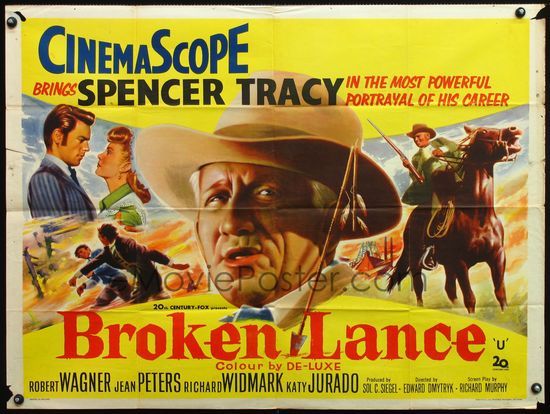
Broken Lance can be read as a defense of Dmytryk’s actions as the hero was prepared to go to jail for a noble cause and at the end of the film was welcomed back to the ranch, of which he is now owner. Image courtesy of eMoviePoster.
Dmytryk’s first effort after The Caine Mutiny was a successful western called Broken Lance (1954) in which the hero is forced to falsify evidence in a trial to ensure that his guilty father will not be sent to prison. The film can be read as a defense of Dmytryk’s actions as the hero was prepared to go to jail for a noble cause and at the end of the film was welcomed back to the ranch, of which he is now owner. The film was ranked 20th by Variety. Dmytryk’s flair for box office successes abandoned him when he came to direct Soldier of Fortune in 1955. It was about the rescue of an American taking pictures of military bases in China. The Chinese tortured him by sowing him pictures of his wife eating dinner with another man. She was actually trying to arrange his rescue. The escape was ludicrously simple. Overall, the film as anti-communist propaganda and as drama was exceptionally poor. The film did poorly at the box office despite having a big budget and the draw cards of Clark Gable and Susan Hayward.[9]
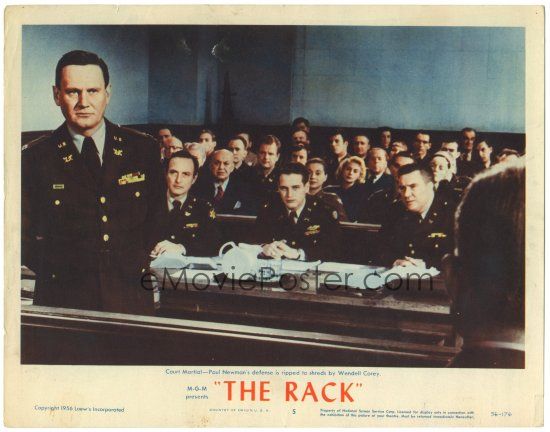
The strained logic of the Caine Mutiny can also be seen in a minor film called The Rack (1956) which dealt with the collaboration of American soldiers during the Korean War. Image courtesy of eMoviePoster.
The strained logic of The Caine Mutiny can also be seen in a minor film called The Rack (1956) which dealt with the collaboration of American soldiers during the Korean War. The film was based on a TV play by Rod Sterling. Captain Edward W. Hall, Jr, played by Paul Newman, returned from Korea accused of collaborating with the enemy. The defence of his actions rested on the mental and physical torture he was given by the communists during his internment. The communists discover that Hall had a strained relationship with his father and respected career soldier Colonel Edward Hall, Sr, played by Walter Pidgeon. For several days, he was locked in a small cellar with wet rags a denied sleep. The communists made him relive again and again his strained relationship with his father. He was told constantly that he was totally alone and no one cared for him. To be released from this torment, he must sign some leaflets. Under pressure, Hall Jr eventually cracked and collaborated with the enemy.
His
defence, however, appeared strong. The
ordeal suffered by Hall Jr was monstrous and his testimony revealed him to be a
man on he edge of a mental collapse. Yet
under questioning from the prosecution, he admitted that he could have kept on
going. In a further statement, he said
that under a torture a man came a to a critical point where he could be a saint
or a sinner. The decision to collaborate
was a simple moral choice between good and evil.
The
film argued that any soldier who collaborated was guilty of a moral crime. Hall Jr invited a guilty verdict from the
court and it was brought down on a vote of two to one. The film wrenched form being a plea for
understanding for Korean prisoners of war who collaborated to being the hardest
of hardline statements. Even under
torture, there must be no concession to the communists. Those people who willing aided the communists
had no defence under any circumstances.
It would have been difficult for
a film of the 1950s to extol or defend a collaborator with the communists. Yet by not even allowing a compassionate view
of those people who collaborated with the communists under torture, the film
certainly had no sympathy with any voluntary communist sympathisers.
[1] Peter Roffman and Jim Purdy, The Hollywood Social Problem Film: Madness,
Despair and Politics From The Depression to the Fifties, Midland, USA,
1981, p. 294.
[2] Nancy Lynn Schwartz, The Hollywood Writer’s Wars, Knopf, New
York, 1982, p. 308.
[3] Bernard F. Dick, Radiacal Innocence: A Critical Study of the
Hollywood 10, University of Kentucky Press, Lexington, 1989, p. 154.
Arthur Miller with Marilyn Monroe. Miller defined the word witch hunt with his play The Crucible released in 1953. Image courtesy of eMoviePoster.
Marilyn Monroe was never considered political, yet her image would be entwined with the acclaimed playwright Arthur Miller. A year before DiMaggio and Monroe, began their ill-fated marriage, on January 22, 1953 the play The Crucible held its premiere at the Martin Beck Theatre in New York. It was a groundbreaking play and it defined the HUAC investigations as a witch hunt and cemented the reputation of Miller, who had been acclaimed for Death of A Salesman in 1949, when he had won the Pulitzer prize for drama. The Crucible, represents the paranoia about communism that pervaded America in the 1950s. There are clear and obvious parallels between the House Committee on Un-American Activities investigation rooting out of real and suspected communists and the seventeenth-century witch-hunt mania that hit Salem. Clearly, the necessity to “name names” was another link between the two periods. Miller wrote in his autobiography that the main point of the hearings was to have the accused make a public confession, to damn their confederates as well as the Devil. The accused would then guarantee their new allegiance by breaking ‘disgusting old vows’ in public.[i]The Crucible remains one of Miller’s most acclaimed plays and its continued revivals have painted an indelible image of the ‘witch-hunt’ as part of the hysteria of the McCarthyite period. As recently as 2015, the Melbourne Theatre Company was reviving the play to great popular and critical success. It is played all over the world to this day.
Miller certainly did not invent the term witch hunt. From at least the 1930s, the term witch-hunt has been used allegorically to describe investigations by governments to seek out and expose perceived and real political enemies, fostering a degree of social fear. One of the first to use it in terms of Hollywood in the Red Scare period was actually an arch-conservative in Cecil B. DeMille. After the 1947 HUAC hearings, the media reported that: “DeMille said he thought Reds were neither more or less active in Hollywood than in other major American cities … ‘Hollywood is a convenient target for so-called witch hunters … I sometimes think these hunters are actually hunting headlines while the real witch sits in her little red tent and laughs at them.’”
The playwright Arthur Miller handled the HUAC investigations in a far different way to Kazan. He was called long after the early investigations and he believed that his marriage to Hollywood’s most popular actress Marilyn Monroe helped spark the interest of the HUAC investigators. At his hearing, Miller talked quite openly about himself and his political beliefs. He had never been a member of the communist party, but had been active in left circles for many years. Miller refused to name any other person and his approach earned him a contempt citation from Congress. The charge was later quashed by the Circuit Court of Appeals in 1958.
Miller
made several artistic responses to the HUAC investigations through his plays A View From the Bridge (1955) and The Crucible (1953). A View
From the Bridge cannot be considered to be a direct rebuttal of On the Waterfront, but there are strong
similarities. In the play, a
longshoreman informed immigration authorities of wife’s two relatives who were
illegal immigrants. His actions were not
terribly evil, but he was destroyed by them nonetheless.
The Crucible was a powerful play
which linked the HUAC investigations to the Salem witch-hunts. Miller wrote in his autobiography that the
main point of the hearings was to have the accused make a public confession, to
damn their confederates as well as the Devil.
The accused would then guarantee their new allegiance by breaking
‘disgusting old vows’ in public.[1] The Crucible remains one of Miller’s most
acclaimed plays and its continued revivals have painted an indelible image of
the ‘witch-hunt’ as part of the hysteria of the McCarthyite period.[2]
 Daniel Taradash, Elick Moll.


 Cinema history